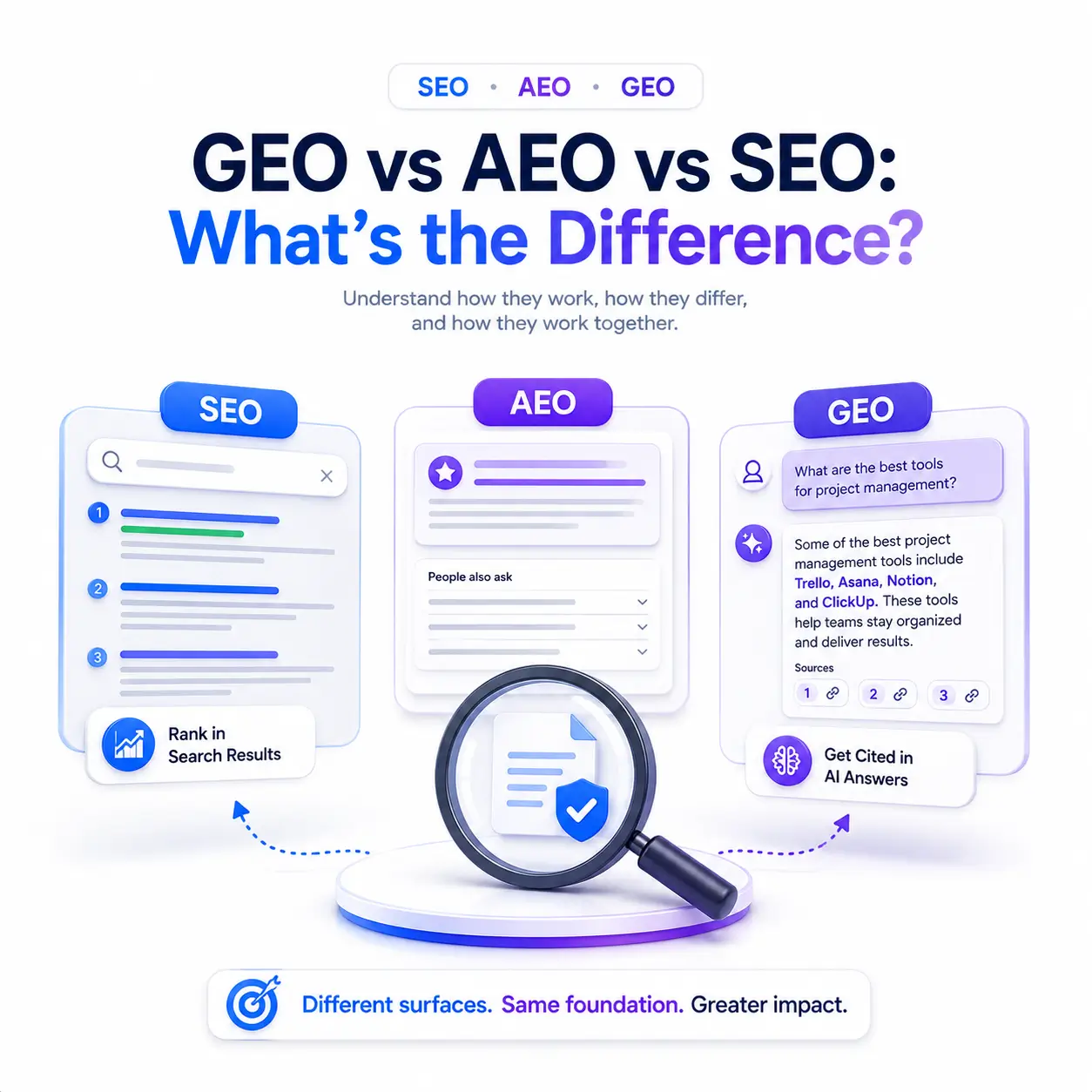
If you’ve spent any time in marketing circles lately, you’ve probably noticed a new alphabet soup crowding out the old one. For twenty years, SEO was the only acronym that mattered. Now you’re hearing about AEO and GEO too and if you’re like most beginners, you’re wondering whether these are three different jobs, three different tools, or just three different names for the same thing.
They’re not the same thing. But they’re not rivals either.
A growing share of searches today never end in a click at all the answer just appears, whether that’s a snippet at the top of Google or a paragraph from ChatGPT. That shift is exactly why SEO vs AEO vs GEO have entered the conversation. This guide breaks down what each one actually means, how they differ, and how they fit together no jargon assumed.
SEO: The Foundation of Getting Found Online
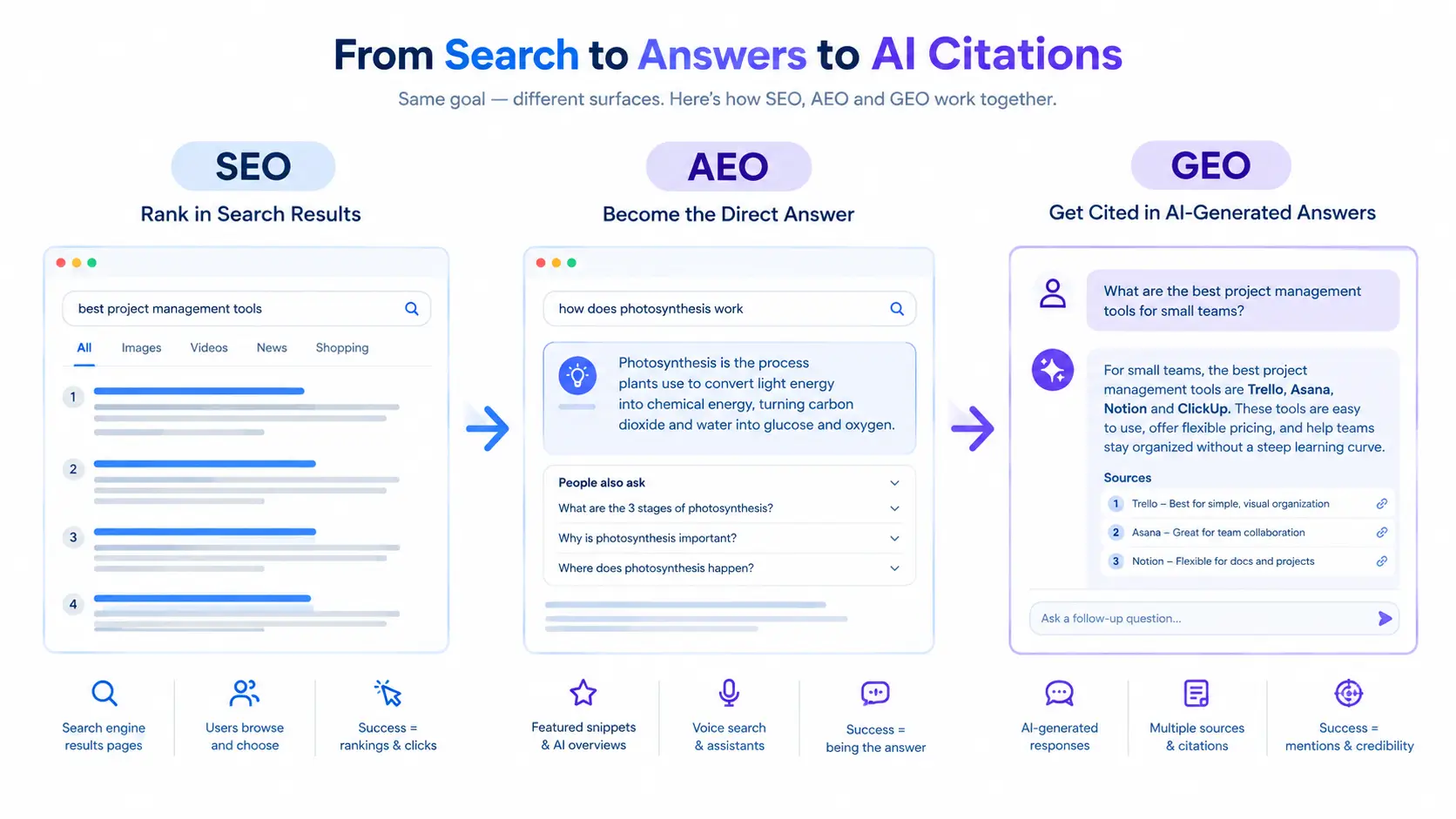
Search Engine Optimization is the practice you already sort of know: making a webpage rank higher in traditional search results, primarily on Google. It’s the discipline built around keywords, backlinks, site speed, and content quality all in service of one goal: showing up in that list of blue links when someone searches.
SEO works on a “list of results” model. The searcher sees several options and clicks the one that looks most relevant. Your job is to be one of the first things they see, and to make your listing compelling enough to earn the click over the nine other results on the page.
How SEO Works in Practice
At a practical level, SEO breaks into a few core buckets. On-page SEO covers your titles, headings, and content, making sure they align with what people are actually searching for so both users and search engines understand your page. Technical SEO covers the health of the site itself: fast load times, mobile-friendliness, clean site structure, and no broken links standing between you and a good ranking. Off-page SEO covers signals from outside your site, mainly backlinks from other reputable sites vouching for your content.
None of this has gone away. If anything, it matters more now, because as you’ll see below SEO vs AEO vs GEO tends to lean on a site that already has strong SEO fundamentals in place.
AEO: Optimizing to Be the Answer
Answer Engine Optimization is where things start to feel less familiar. Instead of optimizing to appear in a list, AEO optimizes your content to become the direct answer the text that gets pulled out and shown before anyone even scrolls down to the list of links.
Think about the last time you searched something on your phone and got an instant answer box, or asked a voice assistant a question and got a spoken response with no screen involved at all. That’s AEO in action. It’s the difference between being on the menu and being the dish the waiter actually recommends.
Where AEO Shows Up (Featured Snippets, AI Overviews, Voice Search)
AEO shows up in a handful of specific places: classic featured snippets, “People Also Ask” boxes, Google’s AI Overviews, and the spoken answers you get from voice assistants like Siri or Alexa. To win these placements, content generally needs to answer a specific question clearly and concisely often in the first 40 to 60 words of a section using clean formatting like short paragraphs, numbered steps, or tables that are easy for an algorithm to lift out and present on its own.
AEO still builds directly on SEO. A page has to be crawlable, relevant, and reasonably well-ranked in the first place before it has any real shot at being selected as the featured answer. Understanding SEO vs AEO vs GEO together makes it easier to build content that performs across traditional and AI-powered search experiences.
GEO: Getting Cited Inside AI-Generated Answers
Generative Engine Optimization is the newest of the three, and it solves a different problem entirely. Where SEO gets you ranked and AEO gets you selected as a direct answer, GEO is about getting your brand or content mentioned inside an AI-generated response from tools like ChatGPT, Google Gemini, or Perplexity.
Here’s what makes GEO fundamentally different: traditional search hands the user a list of links to choose from, but a generative engine synthesizes information from multiple sources into a single, conversational answer and the user often never sees a link at all. There’s no page one, no ranking position, no click. There’s just the question of whether your brand made it into the answer or didn’t.
How GEO Differs From a Traditional Ranking
This is the part beginners find hardest to wrap their heads around, so it’s worth being blunt about it: GEO usually doesn’t drive traffic the way SEO does. When an AI tool answers a question directly, the user gets what they came for and moves on no visit to your site required. What GEO earns instead is visibility and credibility at the exact moment someone is starting their research, which can shape a decision long before that person ever runs a traditional search. It’s a brand-awareness play as much as a traffic play, and it’s worth going into GEO with that expectation set correctly from the start.
SEO vs AEO vs GEO: Side-by-Side Comparison
Laid out next to each other, the differences between SEO vs AEO vs GEO become much easier to see.
| SEO | AEO | GEO | |
| Primary goal | Rank in search results | Be selected as the direct answer | Be cited inside an AI-generated answer |
| Target platforms | Google, Bing | Featured snippets, AI Overviews, voice assistants | ChatGPT, Gemini, Perplexity |
| User experience | Sees a list of links, clicks one | Sees or hears one answer, pulled from a source | Reads a synthesized answer combining multiple sources |
| Success metric | Ranking position, organic traffic | Snippet/answer placements | Brand mentions and citations in AI answers |
| Typical tactics | Keywords, backlinks, technical health | Concise Q&A formatting, structured data | Clear facts, entity clarity, authoritative sourcing |
| Click-through | Yes, usually | Sometimes | Rarely |
Read sideways, the relationship becomes clear: SEO is the foundation, AEO is the layer that turns a well-ranked page into an answer, and GEO is the newest surface where your brand competes to be part of the AI’s synthesized response. All three share much of the same underlying DNA: relevance, authority, and clarity; they just compete for attention on different battlefields.
Do You Need SEO vs AEO vs GEO or Just One?
For a beginner, this is the question that actually matters. The short answer: you need all three, but not all three at the same intensity, and not necessarily starting on day one. Understanding SEO vs AEO vs GEO can help you decide where to focus your efforts at each stage of your marketing strategy.
Think of it in terms of the classic marketing funnel. At the top of the funnel, when someone doesn’t even know your brand exists yet, GEO is increasingly where that first impression happens inside a conversational AI answer to a broad, exploratory question. In the middle of the funnel, as someone narrows down their options and starts comparing specifics, AEO becomes more relevant they’re asking pointed questions and want a fast, direct answer. At the bottom of the funnel, when someone is ready to act, traditional SEO still does the heavy lifting they’re searching by name, comparing pages directly, and clicking through to make a decision.
How the Three Work Together in One Content Strategy
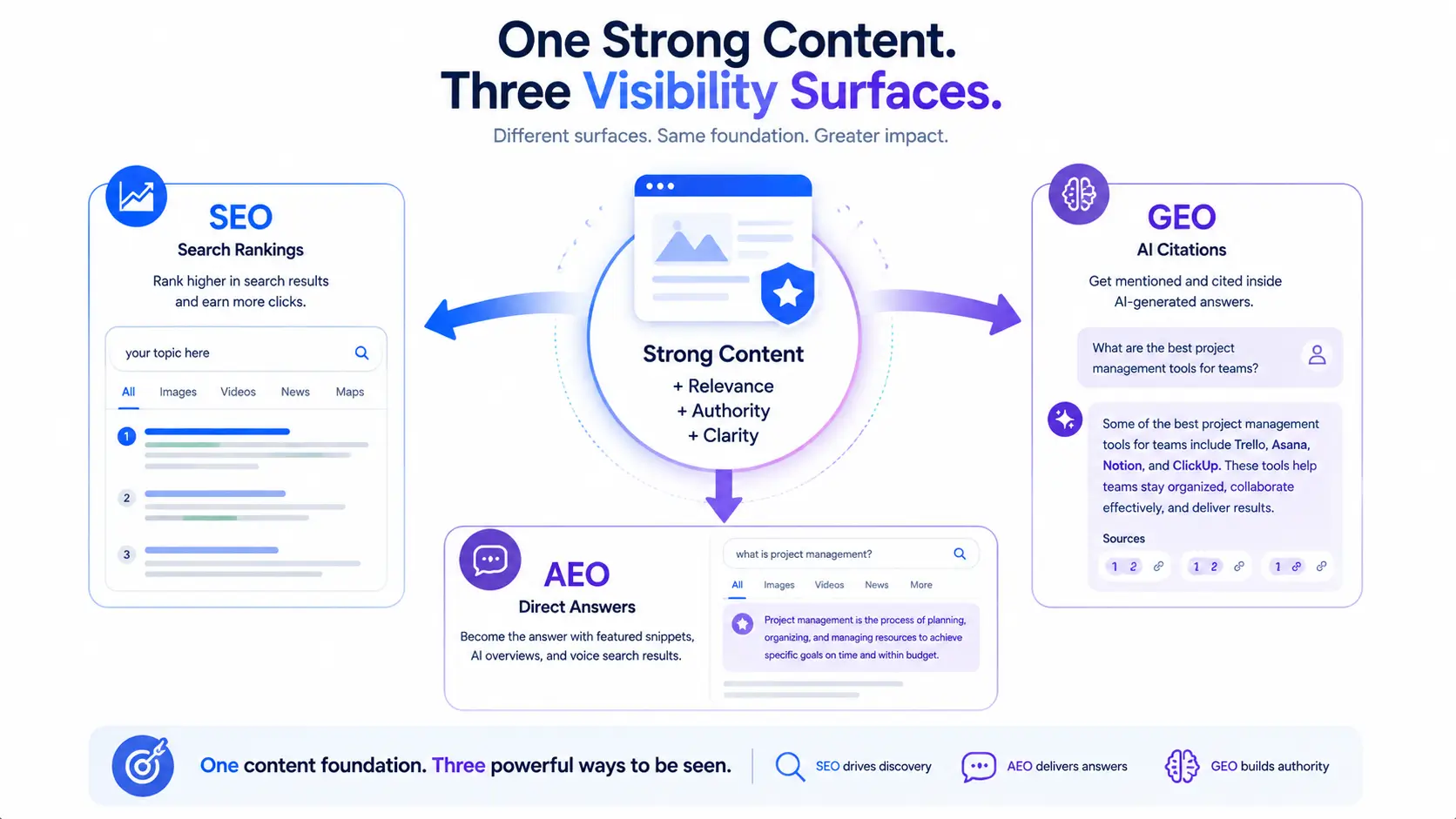
In practice, this means a single well-built piece of content can serve all three goals at once. A page with strong technical SEO and clear authority signals is already positioned to win AEO placements. And because generative engines lean on many of the same relevance and authority signals as traditional search, that same strong foundation gives you a real shot at GEO too. You’re not running three separate campaigns you’re building one strong piece of content and letting its quality carry across SEO vs AEO vs GEO.
Is GEO Replacing SEO?
No. GEO and AEO extend what SEO already does rather than replacing it. AI systems still rely on many of the same authority and relevance signals that traditional algorithms use, which means a site with weak SEO fundamentals will struggle to succeed at AEO or GEO too.
Does AI Search Actually Send Traffic to Websites?
Not much, at least not yet. AI-driven answers tend to build brand visibility rather than referral traffic plenty of frequently-cited sources see only a small fraction of their overall traffic coming from AI platforms, even when they’re mentioned often. The value shows up more in mindshare than in click volume, at least for now.
What Tools Track SEO vs AEO vs GEO Performance?
Because there’s no “ranking position” for a citation inside an AI answer, GEO and AEO call for different measurement than classic rank tracking. That generally means monitoring brand mentions and citations across AI platforms, tracking any appearances in featured snippets or AI Overviews, and watching for referral traffic or conversions that do originate from AI tools, even if that volume stays modest for now.
Getting Started: A Simple First Step for Each
You don’t need to overhaul your entire content strategy overnight. A single, manageable starting point for each discipline goes a long way:
- For SEO: Audit your technical basics first page speed, mobile-friendliness, and broken links. None of the other two matter if this foundation is shaky.
- For AEO: Pick one high-value page and rewrite its opening paragraph to answer the core question directly within the first 40 to 60 words, in plain, structured language.
- For GEO: Make sure your key facts, figures, and claims are stated clearly and consistently across your site generative engines favor content that’s unambiguous and easy to extract as fact.
A strong strategy for SEO vs AEO vs GEO doesn’t require three completely separate content plans. Start with solid SEO fundamentals, make your content easy to extract and understand, and then build authority that can help your brand appear across AI-generated answers.
Frequently Asked Questions
What is the main difference between SEO vs AEO vs GEO?
SEO helps a webpage rank in traditional search results like Google. AEO helps content get selected as a direct answer, such as a featured snippet or voice response. GEO helps a brand get cited inside AI-generated answers from tools like ChatGPT and Gemini, often without any click at all.
Is GEO replacing SEO in 2026?
No. GEO and AEO extend SEO rather than replace it. Generative engines still rely on many of the same authority and relevance signals traditional search algorithms use, so a weak SEO foundation makes it harder to succeed at AEO or GEO.
Does AI search send traffic to my website?
Rarely, compared to traditional search. AI answer engines tend to build brand visibility rather than clicks; some frequently cited publishers report receiving under 1% of their traffic from AI platforms, even when cited often in generated answers.
How do I start optimizing for AI Overviews or ChatGPT answers?
Start by answering the core question clearly within the first 40–60 words of a section, using structured headings, and backing claims with clear facts or data. This helps both traditional featured snippets and AI systems extract and cite your content.
Do small businesses need to worry about GEO yet?
It helps to start early, but SEO fundamentals still matter most. A technically healthy, well-structured, authoritative site gives GEO and AEO something solid to build on, so prioritizing SEO first is rarely wasted effort.
What metrics should I track for AEO and GEO instead of rankings?
Track brand mentions and citations inside AI-generated answers, appearances in featured snippets or AI Overviews, and any referral traffic or conversions that do come from AI platforms rather than relying only on traditional keyword rank tracking.