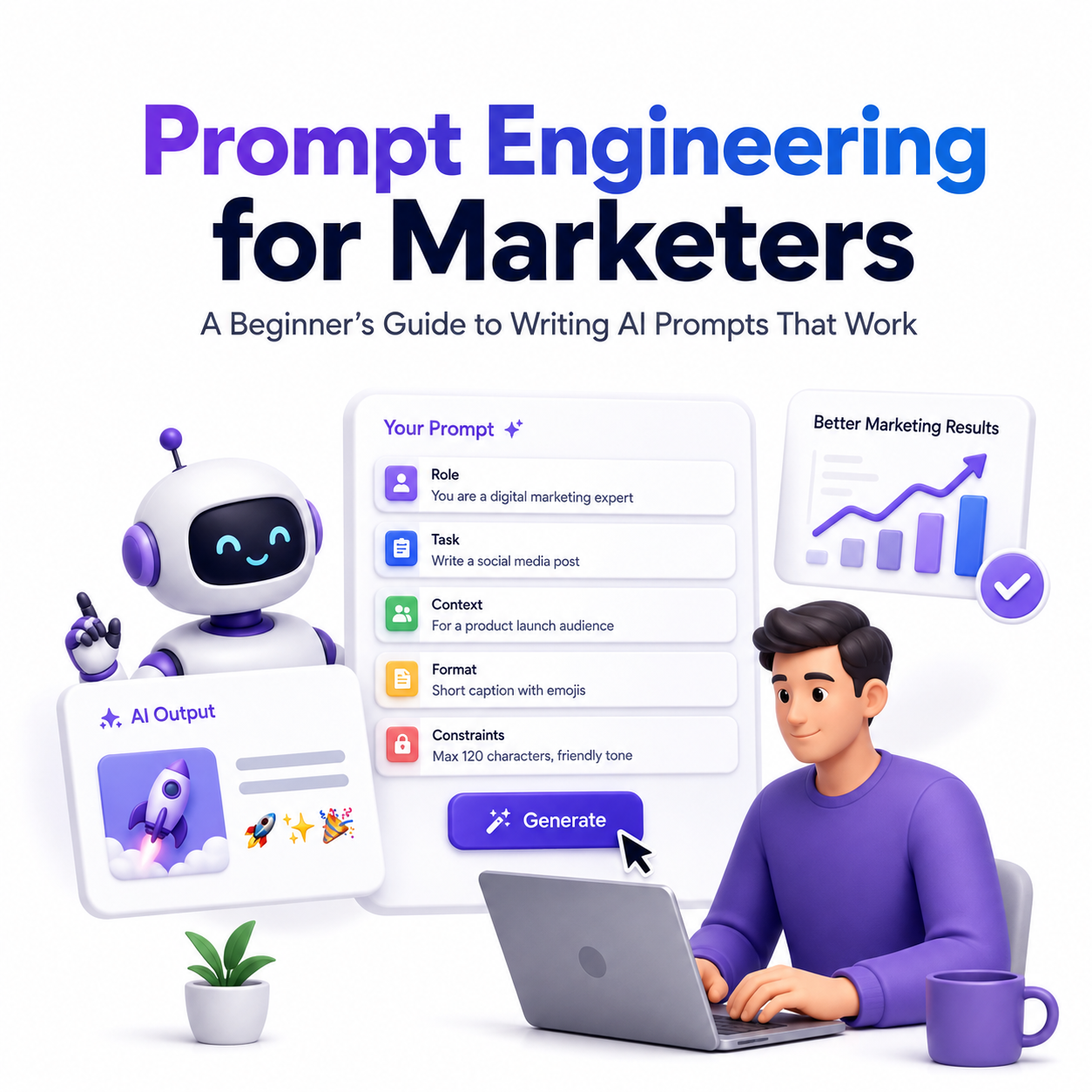
If you’ve ever typed “write me a social media post” into ChatGPT and gotten back something bland, generic, and completely off-brand, you’ve already run into the core problem prompt engineering solves. The AI isn’t broken it just doesn’t know what you actually want, because you haven’t told it yet.
Prompt engineering sounds like a job for developers. In practice, it’s closer to something every marketer already knows how to do: writing a clear brief. If you can brief a freelance designer or a junior copywriter, you can learn to prompt an AI tool. This guide breaks down exactly how, with a framework and real examples you can start using today.
What Is Prompt Engineering and Why Marketers Need It
What is prompt engineering in digital marketing?
Prompt engineering in digital marketing is the practice of writing clear, structured instructions for AI tools like ChatGPT, Claude, or Gemini so they generate usable content on the first or second try. That means ad copy, email subject lines, blog outlines, social captions, or campaign ideas that actually sound like your brand, instead of generic AI filler.
The word “engineering” makes it sound technical, but the actual skill is communication. A vague prompt gets a vague answer. A specific, well-structured prompt gets something you can use with minor edits.
Is prompt engineering in digital marketing skill or a technical skill?
For marketers, it’s a communication skill, not a coding skill. You don’t need to understand how large language models work under the hood any more than you need to understand how a search engine’s ranking algorithm works to write good SEO copy. What you need is the same instinct you already use when briefing a freelancer: be specific about the audience, the goal, the tone, and the format and the AI does the rest.
Why Prompt Engineering Matters for Marketing Teams Right Now
Do digital marketers need to learn prompt engineering?
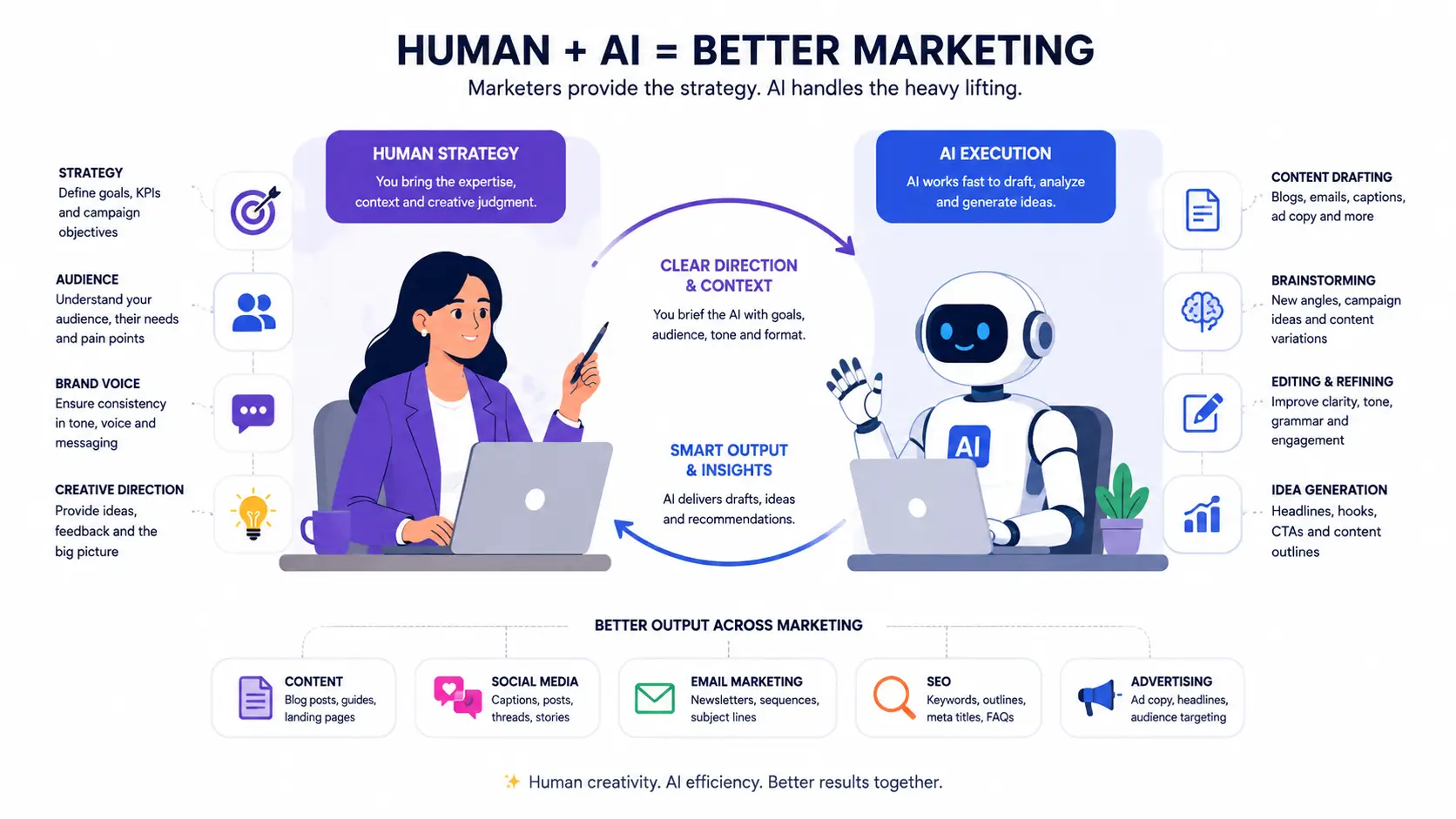
Increasingly, yes and not as an optional extra skill. As generative AI becomes a standard part of the marketing workflow, giving AI tools clear direction is turning into a baseline expectation, not a specialty reserved for “AI people” on the team.
Industry research backs this up. HubSpot’s 2026 State of Marketing research suggests the entry-level marketing role of the near future looks less like an individual contributor cranking out drafts by hand, and more like someone directing and managing AI output essentially, a coach guiding a very fast, very literal doer. Separate research projects that by the end of 2026, the large majority of new marketing job postings will call for specific human-AI interaction skills, prompt engineering chief among them.
The practical takeaway: this isn’t a trend to watch from the sidelines. It’s becoming table stakes, the same way “basic Excel skills” or “familiarity with a CMS” became table stakes a decade ago.
The Anatomy of a Great Marketing Prompt
What makes a good AI prompt for marketing content?
A strong prompt gives the AI the same information you’d give a new freelancer on their first day: who they’re writing for, what they’re writing, and what “good” looks like. Skip any of that, and you get generic output because the AI has nothing specific to work with.
The 5-part prompt framework: Role, Task, Context, Format, Constraints
This is the core framework to memorize. Every strong marketing prompt touches these five elements:
- Role: Tell the AI who it’s acting as. “You are an experienced email marketer for a B2B SaaS company” produces a very different result than no role at all.
- Task: State exactly what you need. Not “help with an email” but “write a re-engagement email for inactive trial users.”
- Context: Give the background a human writer would need: audience, product details, brand voice, past campaign performance, competitor angle.
- Format: Specify the shape of the output: subject line + 3 body paragraphs, a table, five bullet options, a 30-second video script.
- Constraints: Set the boundaries: word count, reading level, banned phrases, required keywords, tone (playful vs. formal), things to avoid.
Put together, a five-part prompt might read: “You are a senior email marketer for a project management SaaS tool. Write a re-engagement email for users who signed up for a free trial but haven’t logged in for 10 days. Their biggest hesitation is complexity. Format: subject line plus 120-word body. Keep the tone casual and encouraging, avoid corporate jargon, and end with a single clear CTA to book a 15-minute onboarding call.”
Compare that to “write a re-engagement email” and it’s obvious why one produces something usable and the other doesn’t.
Prompt Engineering Examples for Common Marketing Tasks
How do you write a prompt for social media content?
Give the AI the platform, the goal, and the voice. Example: “You are a social media manager for an eco-friendly skincare brand. Write 3 Instagram caption options announcing a new product launch. Audience: women 25–40 interested in clean beauty. Tone: warm and conversational, not salesy. Include a question to drive comments. Max 150 characters each.”
Email marketing prompt examples
“You are an email copywriter for a fitness app. Write a 3-email welcome sequence for new free-trial sign-ups. Email 1 should build excitement and set expectations, Email 2 should highlight a key feature tied to a common user goal (weight loss, strength, habit-building), Email 3 should nudge toward upgrading before the trial ends. Keep each email under 150 words, friendly and motivational tone.”
Blog and SEO content prompt examples
“You are a content strategist writing for a B2B accounting software audience. Create a detailed outline for a blog post titled ‘[topic]’ targeting the keyword ‘[keyword]’. Include an H1, 5–6 H2 sections with a one-sentence note on what each covers, and 2–3 FAQ questions a beginner in this space would search for.”
Ad copy prompt examples
“You are a paid social copywriter. Write 5 Facebook ad headline variations (under 40 characters) and 3 primary text options (under 125 characters) for a productivity app targeting freelancers who struggle with time management. Emphasize the pain point of losing billable hours, not just the feature list.”
Notice the pattern across all three: role, task, audience context, and format constraints, every time. That repetition is the point once the framework becomes automatic, writing a good prompt takes seconds.
Tools Marketers Use for Prompt Engineering
What tools for prompt engineering in digital marketing use?
Most marketers split their AI use between two categories:
- General-purpose AI assistants like ChatGPT, Claude, and Gemini flexible tools for drafting, brainstorming, and editing across any content type.
- Marketing-platform AI features built directly into tools like HubSpot, Jasper, Canva, and various email and social schedulers often narrower in scope but pre-integrated into your existing workflow.
The good news: the five-part prompting framework works identically across all of them. You’re not learning a different skill for each tool you’re applying the same core discipline everywhere you write a prompt.
Common Prompt Engineering Mistakes Beginners Make
The most common mistake is being too vague and expecting the AI to fill in the gaps with your specific brand voice and audience it can’t, unless you tell it. A close second is treating the first response as final instead of a first draft to refine: good prompting is often a short back-and-forth (“make this punchier,” “cut this in half,” “add more urgency to the CTA”) rather than a single perfect prompt. A third mistake is skipping constraints entirely, which leads to output that’s technically fine but the wrong length, wrong reading level, or wrong tone for the channel.
Can prompt engineering in digital marketing replace copywriters?
No. Prompt engineering speeds up drafting and idea generation. However, it still requires human judgment to catch inaccuracies, protect brand voice, apply strategy, and add the originality that makes content actually stand out. It changes what a copywriter’s day looks like: less blank-page staring, more editing and directing rather than eliminating the role.
How to Get Better at Prompt Engineering
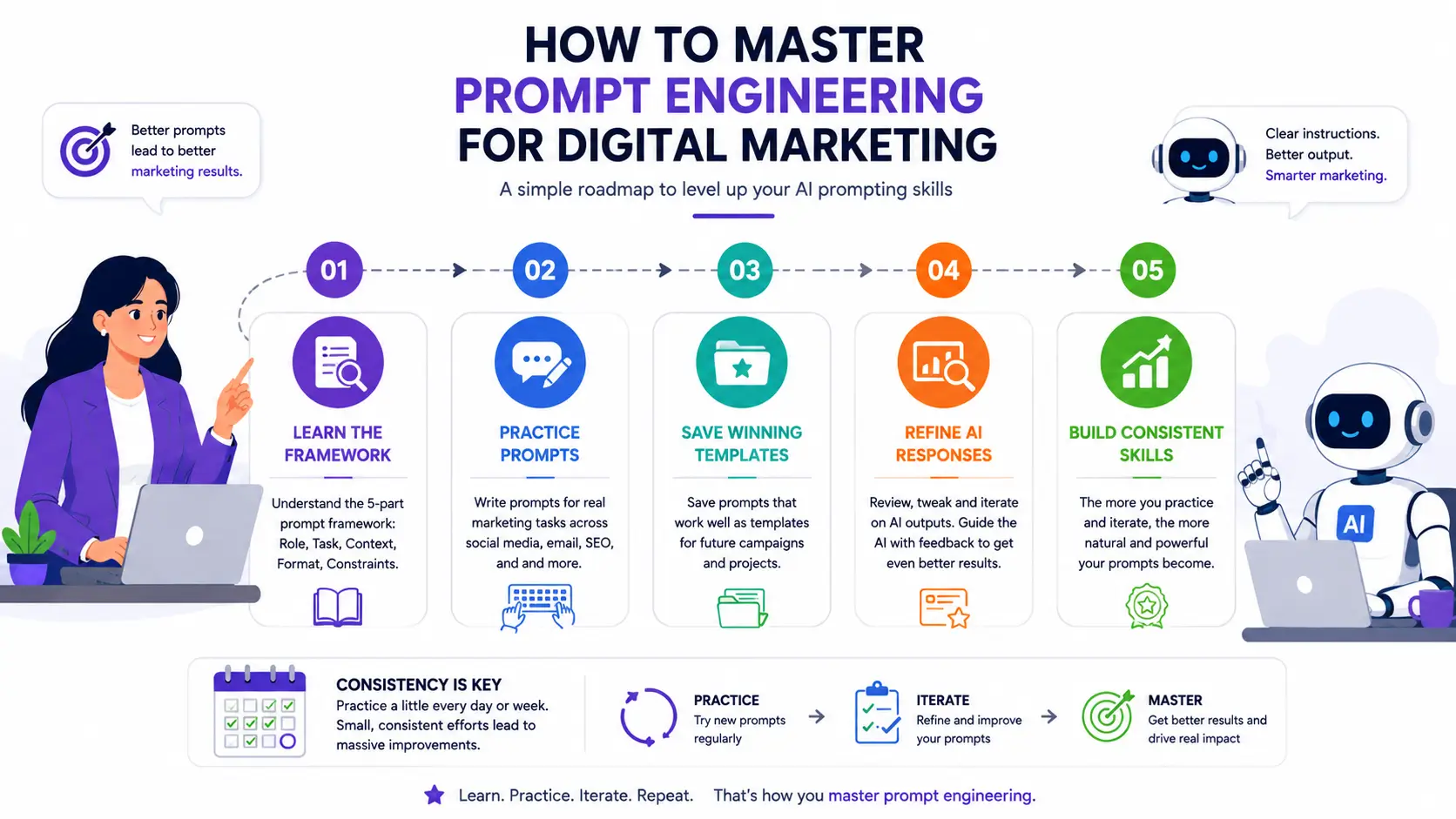
Getting good at this is less about studying and more about repetition. Start by using the five-part framework deliberately for a week; write out Role, Task, Context, Format, and Constraints as literal labels before you type the prompt, even if it feels clunky at first. Save prompts that work well as templates you can reuse and adapt. And treat every AI response as a draft to iterate on with follow-up instructions, not a final answer to accept or reject.
How long does it take to learn prompt engineering in digital marketing basics?
Most digital marketing pick up the fundamentals: role, task, context, format, constraints in a single afternoon of hands-on practice. Real proficiency, where your prompts consistently produce polished, on-brand output without much editing, typically develops over a few weeks of regular use.
FAQ
What is prompt engineering in digital marketing?
Prompt engineering in digital marketing is the practice of writing clear, structured instructions for AI tools like ChatGPT or Claude so they generate usable marketing content ad copy, emails, captions, outlines that matches your brand voice, audience, and goals on the first or second try.
Do marketers need to learn prompt engineering?
Increasingly, yes. As generative AI becomes standard in marketing workflows, the ability to give AI tools clear direction is becoming a core skill alongside copywriting and strategy, not a separate technical specialty reserved for developers.
What makes a good AI prompt for marketing content?
A strong prompt defines the AI’s role, the specific task, relevant context (audience, brand voice, product details), the desired format, and any constraints like word count or tone. Vague prompts produce vague, generic output.
Can prompt engineering in digital marketing replace copywriters?
No. Prompt engineering is a tool that speeds up drafting and ideation, but it still requires human judgment to edit for accuracy, brand fit, strategy, and originality. It changes the copywriter’s role rather than eliminating it.
What tools do marketers use for prompt engineering?
Marketers commonly use general-purpose AI assistants like ChatGPT, Claude, and Gemini, along with marketing-specific AI features built into platforms like HubSpot, Jasper, and Canva, applying the same prompting principles across all of them.
How long does it take to learn prompt engineering basics?
Most marketers can learn the fundamentals role, task, context, format, constraints in a single afternoon of practice. Genuine proficiency, where prompts consistently produce polished, on-brand output, typically develops over a few weeks of regular use.