Search used to mean scrolling through ten blue links. Now, millions of people type a question into ChatGPT, Perplexity or Google and get a complete answer before they ever visit a website. If you want your work to show up inside those answers, you need to learn how to structure content for AI.
Here’s the short version. Use clear, question-based headings. Put the answer first. Break your page into self-contained chunks. Support your claims with real data and sources. Then add schema markup so machines understand what’s on the page.
That’s the whole formula. This guide walks you through each step to Structure Content for AI Answer Engines, before-and-after examples and a template you can reuse, even if you’ve never heard the terms AEO or GEO before.
What Are AI Answer Engines?
An AI answer engine is a tool that responds to questions with a written, conversational answer instead of a list of links. ChatGPT, Perplexity, Google AI Overviews, Gemini and Claude all work this way. They gather information from web pages, summarize it, and often cite the sources they relied on.
How are AI answer engines different from traditional search engines?
A traditional search engine ranks pages and lets you choose which one to read. An answer engine does the reading for you and hands back a summary. That changes what “winning” looks like. Ranking on page one still matters, but the bigger prize is being one of the few sources the AI quotes.
You can already see this shift in how people behave. A Pew Research Center study tracking 900 US adults found that about 18% of Google searches in March 2025 showed an AI summary. When one appeared, people clicked a traditional result in just 8% of visits, compared with 15% when there was no summary. When fewer people click, being cited inside the answer becomes far more valuable.
How AI Answer Engines Choose What to Cite
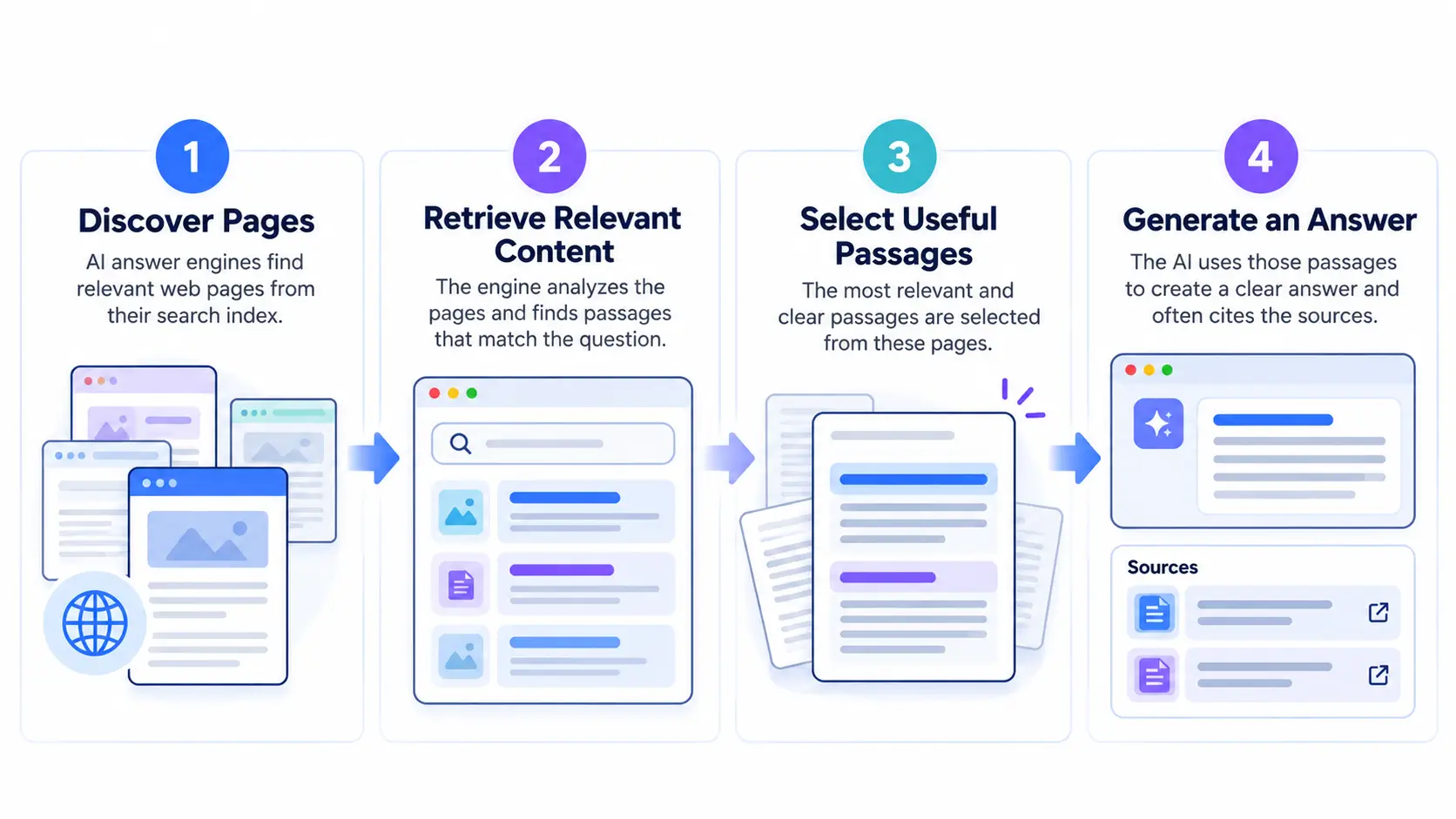
Most answer engines first retrieve a set of relevant pages, often from a search index, then pick the passages that answer the question most clearly. Pages that are easy to parse, specific, recent and trustworthy are more likely to be quoted. Strong traditional SEO helps your page make that shortlist in the first place.
Why AI reads in chunks, not full pages
This is the part most beginners miss. AI tools rarely read your article from top to bottom the way a person does. They split pages into smaller passages and judge each one on its own.
That means every section needs to make sense out of context. If a paragraph begins with “As mentioned above…” or depends on a chart three scrolls up, the AI may skip it. Here’s a simple test: copy any single section into a blank document. If it still answers a clear question, it passes the chunk test.
SEO vs AEO vs GEO: What’s the Difference?
You’ll see these three acronyms everywhere, so let’s untangle them.
| Term | Stands for | Main goal |
| SEO | Search engine optimization | Rank pages in traditional search results |
| AEO | Answer engine optimization | Get your content used as a direct answer (featured snippets, voice, AI) |
| GEO | Generative engine optimization | Get cited inside AI-generated responses |
The key takeaway: AEO and GEO don’t replace SEO. They sit on top of it. If search engines can’t crawl or trust your page, AI tools are unlikely to find it either. Think of SEO as the foundation, and AEO and GEO as the floors you build above it.Want to know more about the difference between AEO vs GEO vs SEO in detail?
7 Principles to Structure Content for AI Answer Engines
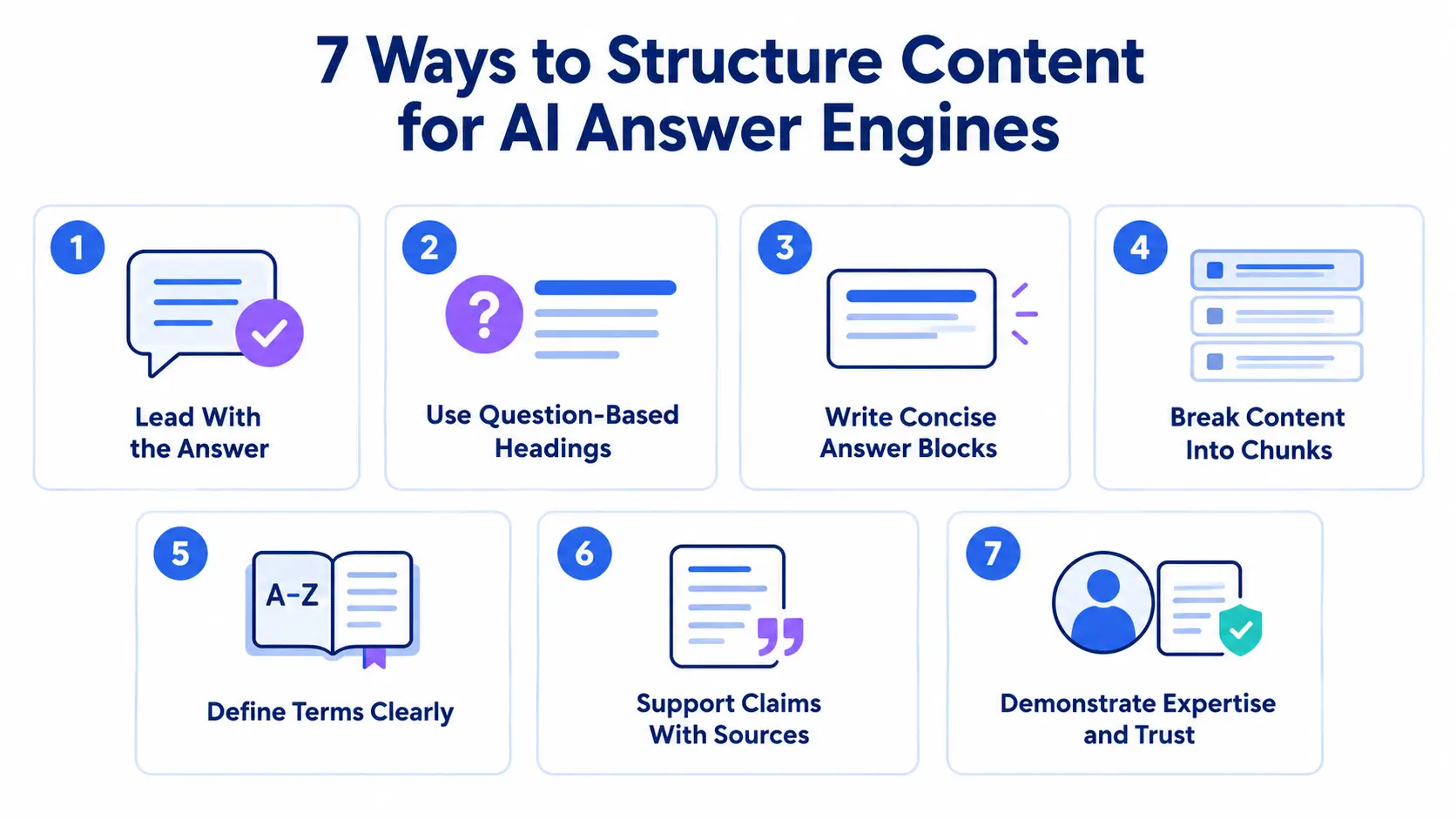
1. Lead with the answer
Journalists call this the inverted pyramid: the most important information goes first, and the details follow. AI tools favor passages that answer the question immediately.
Before: “Content marketing has changed a lot over the years, and experts have many different opinions about how long a blog post should be…”
After: “The ideal blog post length depends on search intent. Quick questions need a few hundred words, while in-depth guides often need 1,500 words or more.”
The second version gives the AI something it can actually quote.
2. Use question-based headings
People ask AI tools full questions, so mirror that language in your H2s and H3s. “Schema benefits” is vague. “Does schema markup help with AI search?” matches how someone really asks. Pull question ideas from Google’s People Also Ask box, sales calls and customer emails.
3. Write 40–60 word answer blocks
Directly under each question heading, write a short, complete answer of roughly 40–60 words. It should answer the question without needing anything else on the page. Then expand with examples and detail below it. As a bonus, this format also helps you win featured snippets in regular Google search.
4. Break content into scannable chunks
Walls of text are hard on humans and machines alike. Use numbered steps for processes, bullet lists for tips, and tables for comparisons. Keep paragraphs to two to four sentences. Structured formats hand AI clean, ready-made pieces to pull from.
5. Define terms clearly and consistently
Pick one name for each concept and stick with it. If you call it “AI Overviews” in one section and “Google’s AI box” in another, you blur the signal. Define key terms the first time you use them with a simple “X is…” sentence. Those definition lines are exactly the kind of sentence AI tools like to quote.
6. Add statistics, sources and expert quotes
This principle has research behind it. The 2024 study “GEO: Generative Engine Optimization,” by researchers from Princeton, Georgia Tech, the Allen Institute for AI and IIT Delhi, found that adding citations, quotations and statistics boosted a source’s visibility in generative engine responses by up to 40%.
Specific numbers give AI tools concrete facts to cite, and named sources signal that your content is reliable. Always link to the original research rather than a blog that summarizes it.
7. Show E-E-A-T signals
E-E-A-T stands for experience, expertise, authoritativeness and trustworthiness. Add an author bio with real credentials, show a “last updated” date, and share first-hand experience: results you’ve seen, mistakes you’ve made, screenshots from your own work. Original insight is hard to copy, and AI tools already have plenty of generic content to choose from.
The Technical Layer: Schema Markup and Crawlability
Does schema markup help with AI search visibility?
Schema markup is code that labels your content so machines understand it, such as marking a section as an FAQ or a how-to. It can make your page easier to interpret, but it won’t guarantee AI citations on its own. Clear, visible, well-structured writing still matters most.
Start with four schema types: Article, FAQPage, HowTo, and Organization. Then check the basics. Make sure your robots.txt doesn’t block the AI crawlers you want to appear in (such as OAI-SearchBot or PerplexityBot), keep your pages fast, and avoid hiding key text behind tabs or heavy scripts.
How to Update Old Content and Track Your Results
You don’t need to rewrite everything. Start with your ten highest-traffic pages and refresh them in five steps:
- Rewrite headings as questions.
- Add a 40–60 word answer under each one.
- Split long paragraphs and add a table or list.
- Update statistics and link to sources.
- Add FAQ schema and a fresh “last updated” date.
To track progress, check GA4 for referral traffic from sources like chatgpt.com and perplexity.ai. Also run manual tests: ask AI tools the questions your page answers and note whether you’re cited. Repeat monthly, because AI answers change often.
Frequently Asked Questions
What is answer engine optimization (AEO)?
Answer engine optimization is the practice of structuring content so AI tools like ChatGPT, Perplexity and Google AI Overviews can easily understand, extract and cite it. It focuses on clear questions, direct answers, well-organized sections and trustworthy sources, helping your content appear inside AI-generated responses rather than only in traditional search results.
Is SEO still important for AI search?
Yes. Most AI answer engines draw on search indexes to find sources, so pages that are crawlable, fast and well-ranked are more likely to be retrieved. AEO and GEO build on SEO fundamentals rather than replacing them. Treat AI optimization as an extra layer on top of solid technical and on-page SEO.
How long should an answer be to get picked up by AI?
Aim for a direct answer of 40–60 words placed immediately after a question-style heading. This length is long enough to be complete and short enough for AI to quote cleanly. You can then expand with supporting detail, examples and data below, so the page serves both AI extraction and human readers.
Does FAQ schema help content appear in AI answers?
FAQ schema helps search engines and AI systems understand the question-and-answer structure of your page, which can make passages easier to extract. It isn’t a guarantee of citation, and Google limits FAQ rich results in search. Use it alongside clear on-page formatting, since visible, well-written content matters most.
Can small websites get cited by ChatGPT or Perplexity?
Yes. AI answer engines often cite smaller sites when they offer the clearest, most specific answer to a question. Focus on niche topics you know well, include original data or first-hand experience, structure answers clearly, and keep content updated. Specificity and clarity can outweigh domain size for long-tail questions.
Conclusion: Structure Is Your New Ranking Factor
Learning how to structure content for AI isn’t about tricking algorithms. It’s about making your expertise easy to find, understand and quote. Lead with answers, use question headings, write self-contained chunks, back up claims with data and show who you are. Do that consistently, and both readers and AI tools will start to trust your content.
Ready to start? Copy the template above, apply it to one existing post this week, and then check whether AI tools begin citing you.