Entity SEO is the practice of helping search engines understand the real-world things your content is about, such as people, brands, places, and concepts, rather than just matching the words on a page. Pair it with topical authority, your site’s reputation for covering a subject thoroughly, and you get a durable way to earn search visibility. This guide explains both ideas in plain English and gives you a six-step roadmap to start today.
Before you start: this guide assumes your site already has the basics covered: crawlable pages, clear titles, and sound on-page SEO. Entity SEO is a layer on top of those fundamentals, not a replacement.
What Is Entity SEO?
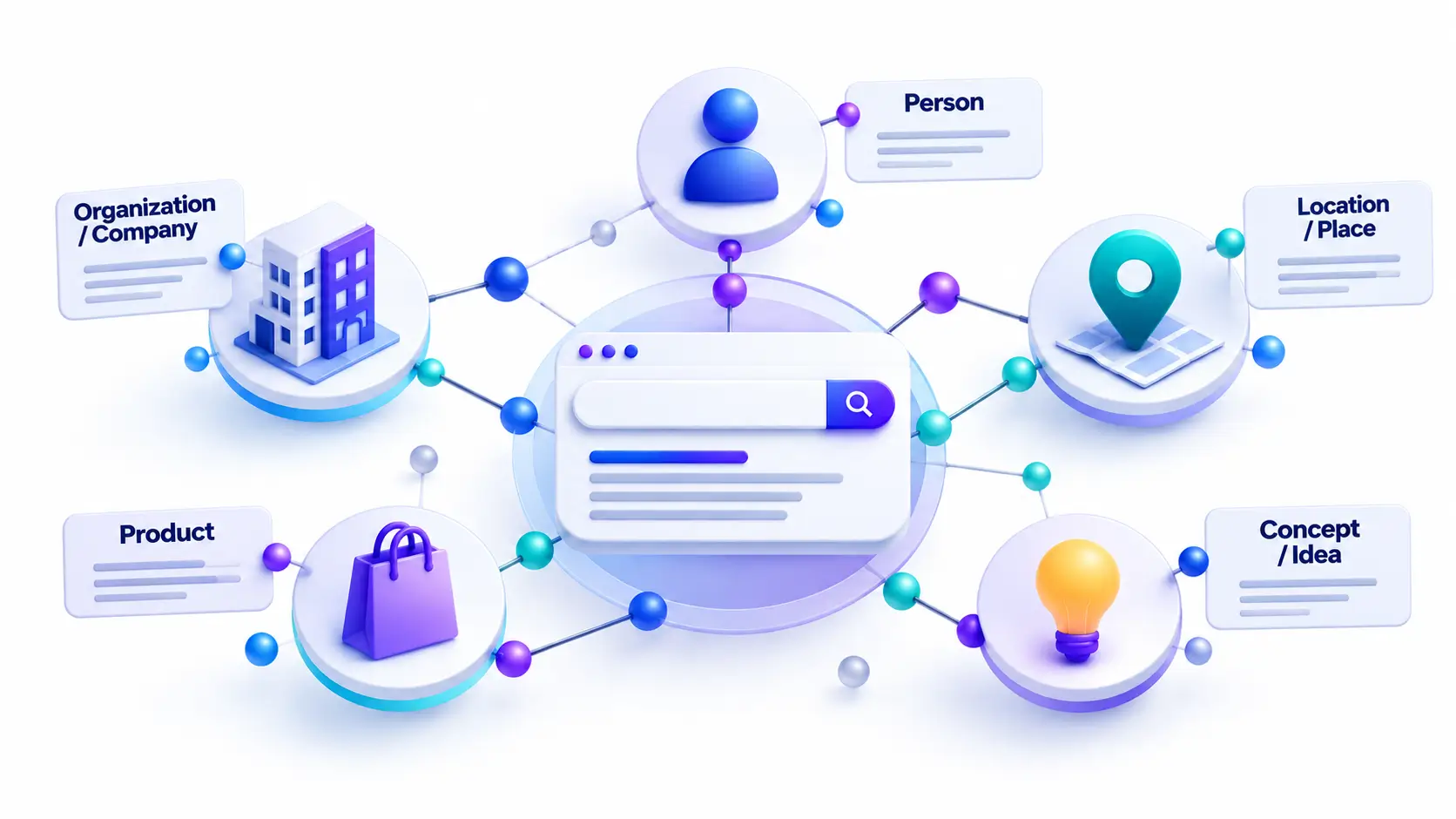
Entity SEO means optimizing your content so search engines can identify and connect the things it discusses. Instead of treating a page as a bag of keywords, Google tries to work out who or what is being described and how that relates to everything else it knows.
What Is an Entity in SEO?
An entity is any clearly identifiable thing a search engine can recognize and categorize: a person, a company, a city, a product, or an idea like link building. Elon Musk, New York, and the Eiffel Tower are all entities. Your brand can be one too, and a big part of entity SEO is making that identity unmistakable.
“Things, Not Strings”: How Google’s Knowledge Graph Works
In 2012, Google launched the Knowledge Graph, a model built to understand real-world entities and how they relate to one another. At launch it held more than 500 million objects and over 3.5 billion facts and relationships. A 2020 statement from Google was reported as putting it at more than 500 billion facts about roughly five billion entities.
Google’s own launch example explains why this matters. A search for “taj mahal” could mean a monument, a musician, or a nearby restaurant. Matching words alone cannot settle that; understanding entities and context can.
Entity SEO vs. Traditional Keyword SEO
| Traditional keyword SEO | Entity SEO | |
| Focus | Words and phrases | Things and their relationships |
| Unit of work | One page per keyword | A connected set of pages per topic |
| Question asked | “Which terms should I use?” | “What does Google need to understand?” |
| Typical tools | Keyword research, meta tags | Topic maps, internal links, schema markup |
Is entity SEO replacing keyword research? No. Keywords still tell you what people search for. Entities add the meaning behind those searches, so the two work together.
What Is Topical Authority?
If entity SEO is about being understood, topical authority is about being trusted on a subject.
Topical Authority in Plain English
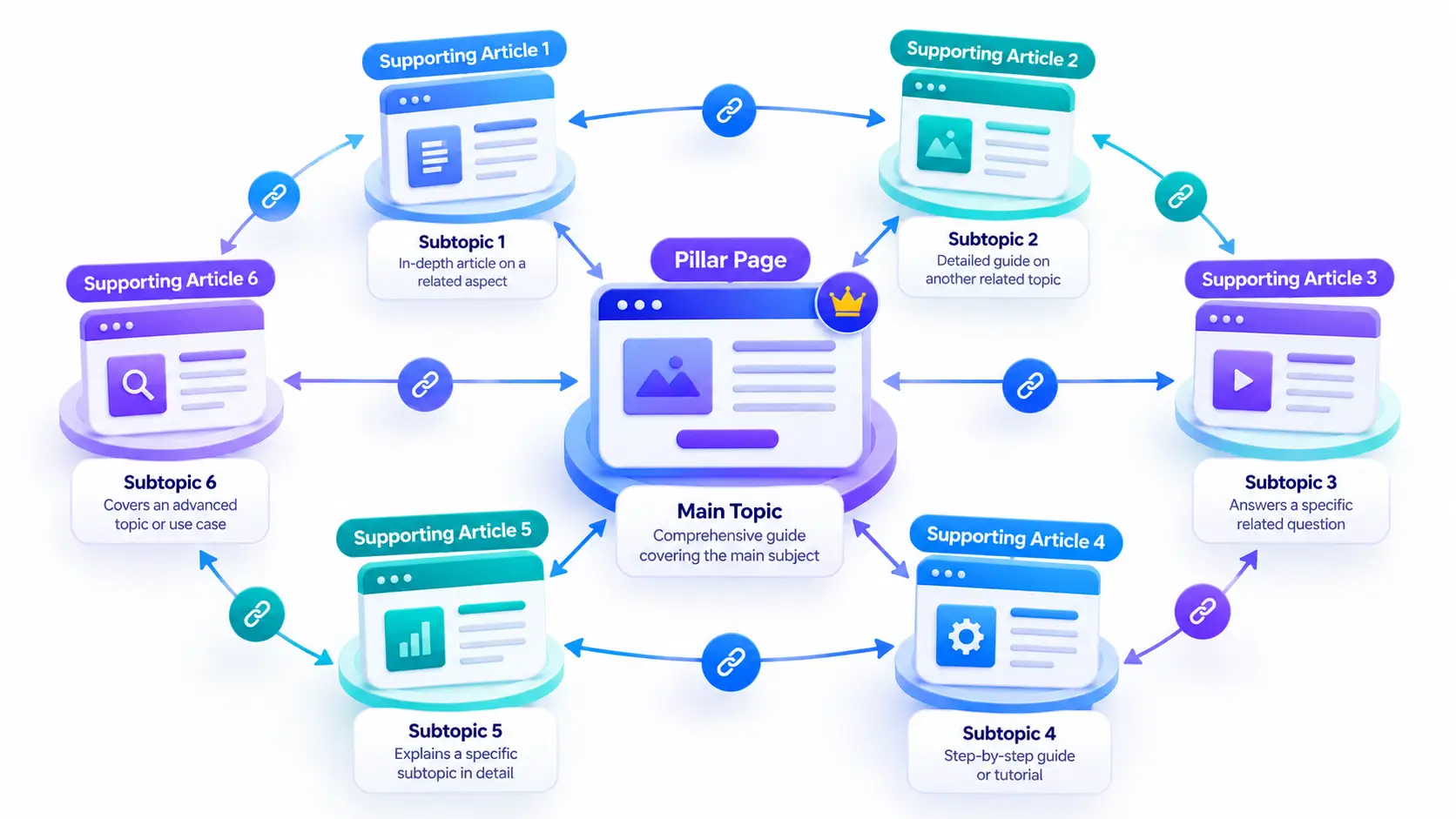
Topical authority describes how well a website is recognized as an expert on a particular subject. It comes from two things: depth, meaning thorough and accurate answers, and breadth, meaning coverage of the related questions around the topic. A site with one article on espresso machines has a post. A site with guides on grinders, milk frothing, descaling, and bean freshness, all linked together, starts to look like an authority.
Is Topical Authority a Google Ranking Factor?
Not in the sense many articles imply. Google has not published an official topical authority score, so you cannot check a number or optimize for it directly. Treat topical authority as a useful way of thinking about content strategy, not a metric. Its value is practical: comprehensive, well-connected content tends to satisfy more searches and earns more trust from readers.
Topical Authority vs. Domain Authority
Domain authority is a third-party score, mostly based on backlinks, that estimates a whole site’s strength. Topical authority is about subject-level expertise. A small site can compete with larger ones by going deeper on a narrow topic, which is why it appeals to beginners.
How Entity SEO and Topical Authority Work Together
Why Google Needs to Understand Who You Are First
Authority only counts if search engines know who it belongs to. Entity SEO supplies that clarity: consistent names, clear descriptions, and structured data tell Google who you are and what you cover. Topical authority then provides the evidence, through content that proves the expertise.
Where E-E-A-T Fits In
E-E-A-T stands for experience, expertise, authoritativeness, and trustworthiness. It is Google’s framework for judging content quality, not a single signal. Real author profiles, first-hand examples, and accurate sourcing show it, and they strengthen both your entity identity and your topical depth.
Why This Matters for AI Search and Answer Engines
AI-generated answers pull from sources they can identify and trust. Clear entities and complete topic coverage make your content easier to understand, quote, and cite. The same habits that help you in classic search help you in answer engines.
How to Build Topical Authority: A 6-Step Beginner Roadmap
Throughout these steps, imagine you run a site about home coffee brewing.
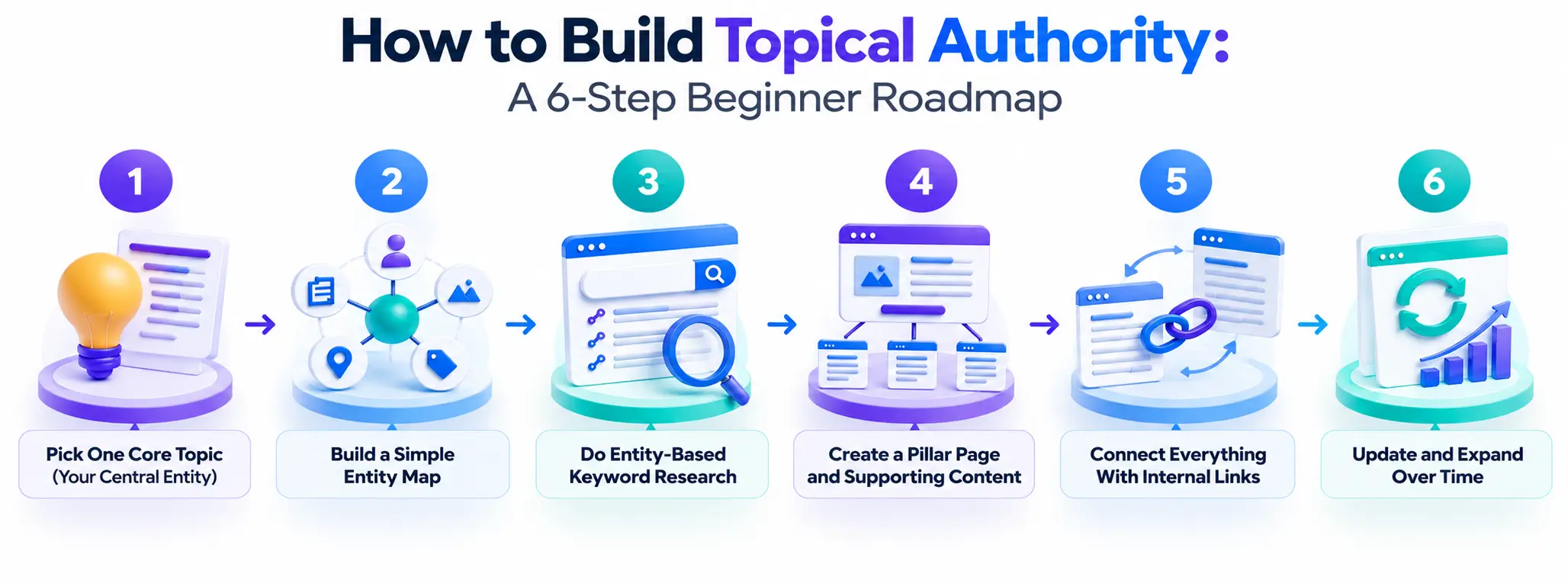
Step 1: Pick One Core Topic (Your Central Entity)
Choose a single subject you can cover better than most. Be specific: “home espresso” beats “coffee.” Authority is easier to build in a narrow area, and you can widen the scope later.
Step 2: Build a Simple Entity Map
Write your central entity at the top of a page. Beneath it, list its attributes (types, costs, skill level), related entities (grinders, beans, milk, descaling), and the questions people ask about each. Thirty minutes with a pen and paper is enough. This map becomes your content plan.
Step 3: Do Entity-Based Keyword Research
Now run normal keyword research, but group results by entity and subtopic rather than treating each keyword alone. “Best espresso grinder” and “burr vs. blade grinder” both belong under the grinder branch. Grouping helps you avoid duplicate pages and spot gaps.
Step 4: Create a Pillar Page and Supporting Cluster Content
Publish a comprehensive pillar page for the core topic, such as “The Beginner’s Guide to Home Espresso.” Then write cluster articles for each branch of your map, each answering one specific question in depth. Quality matters more than volume: a few strong, accurate articles beat dozens of thin ones.
Step 5: Connect Everything With Internal Links
Link the pillar to every cluster article and link clusters back to the pillar and to each other where it helps the reader. Use descriptive anchor text such as “how to descale an espresso machine” rather than “click here.” These links show search engines how your topics relate.
Step 6: Update and Expand Over Time
Revisit your content regularly to fix outdated facts, add new sections, and answer fresh questions. When the first topic feels complete, repeat the process with an adjacent one.
Entity SEO Checklist for Beginners
These on-page and technical signals make your entity unambiguous.
Use Consistent Names and Descriptions Everywhere
Use the same brand name, short description, and key facts on your site, social profiles, and directory listings. Inconsistency forces search engines to guess whether these are the same entity.
Add Schema Markup (Organization, Person, Article)
Schema markup is structured data that labels your content for machines. Organization schema describes your business, Person schema describes authors, and Article schema describes each post. It is not required, and it will not create authority on its own, but it reduces ambiguity.
Strengthen Your About and Author Pages
Spell out who you are, what you cover, and why you are qualified. Give authors real bios with relevant experience and link them to their profiles. These pages are where your entity and E-E-A-T signals meet.
How to Measure Progress
Because there is no authority score, track proxies in Google Search Console and your analytics:
- The number of distinct queries your site ranks for in your topic
- Impressions and clicks across your cluster pages
- Branded search growth, meaning people searching for your name
- Mentions or citations of your brand in AI-generated answers
Timelines vary with competition, site age, and content quality. Many sites see early movement within a few months, but meaningful authority usually builds over a longer period of consistent publishing.
Common Beginner Mistakes to Avoid
Publishing Lots of Thin Posts
Twenty shallow articles do not equal authority. Each page should answer its question completely.
Treating Entities as Just Another Keyword
An entity is a thing with relationships, not a phrase to repeat. Stuffing a name into every paragraph does not help; explaining how it connects to related ideas does.
Spreading Across Too Many Topics
Covering ten subjects shallowly signals expertise in none. Finish one cluster before starting another.
Frequently Asked Questions
What is entity SEO?
Entity SEO is the practice of optimizing content so search engines understand the real-world people, brands, places, and concepts it discusses, not just matching keywords. By defining entities clearly, connecting them to related topics, and using structured data, you help Google interpret meaning, context, and relationships, which supports more accurate rankings.
What is topical authority?
Topical authority is how strongly a website is recognized as an expert on a specific subject. It comes from covering a topic in depth and breadth, with interlinked, accurate articles that answer related questions. Google doesn’t publish an official topical authority score, so it’s a useful concept rather than a measurable metric.
How are entity SEO and topical authority related?
Entity SEO tells search engines who or what you are; topical authority shows you know a subject deeply. They work together: clear entities let Google connect your content to the right topics, while comprehensive coverage proves expertise. Without clear entities, authority signals are harder to attribute; without depth, entities lack credibility.
How long does it take to build topical authority?
Most sites see early movement in three to six months, but meaningful topical authority typically takes six to twelve months of consistent publishing. Timelines depend on competition, site age, content quality, and how completely you cover the subject. Focus on a narrow topic first, finish the cluster, then expand.
Do I need schema markup for entity SEO?
Schema markup isn’t required, but it helps. Structured data like Organization, Person, and Article explicitly labels who you are and how your content connects, reducing ambiguity for search engines. Pair it with consistent naming across your site and profiles, since schema alone won’t create authority without quality, well-covered content.
Is entity SEO replacing keyword research?
No. Entity SEO builds on keyword research rather than replacing it. Keywords still reveal what people search for, while entities clarify meaning and relationships behind those searches. Beginners should keep doing keyword research, then group keywords by the entities and subtopics they represent to plan more complete, connected content.
Conclusion and Next Steps
Entity SEO makes sure search engines understand who you are and what you write about. Topical authority proves you know the subject. Together they reward focus, depth, and clarity over keyword tricks. Your first move today: spend thirty minutes building an entity map for one core topic. Then pick the first cluster article from it and start writing.