If you’ve spent any time reading about digital marketing, you’ve probably run into the acronym CRO. It gets mentioned alongside SEO, PPC, and email marketing as if everyone already knows what it means but if you’re new to it, that’s not very helpful.
Here’s the short version: CRO stands for Conversion Rate Optimization, and it’s the practice of improving your website so that more of your existing visitors take the action you want them to take whether that’s buying a product, signing up for a newsletter, or requesting a demo.
What makes CRO worth understanding early in your marketing journey is this: most websites convert only a small fraction of the people who visit them. Industry benchmarks consistently show that the average website converts just 2% to 5% of its traffic. That means, on a typical site, somewhere between 95 and 98 out of every 100 visitors leave without doing anything at all.
CRO is how you close that gap and in this guide, we’ll break down exactly what it is, how it works, and how to start using it, even if you’re working with no budget and no technical background.
What Is CRO (Conversion Rate Optimization)?
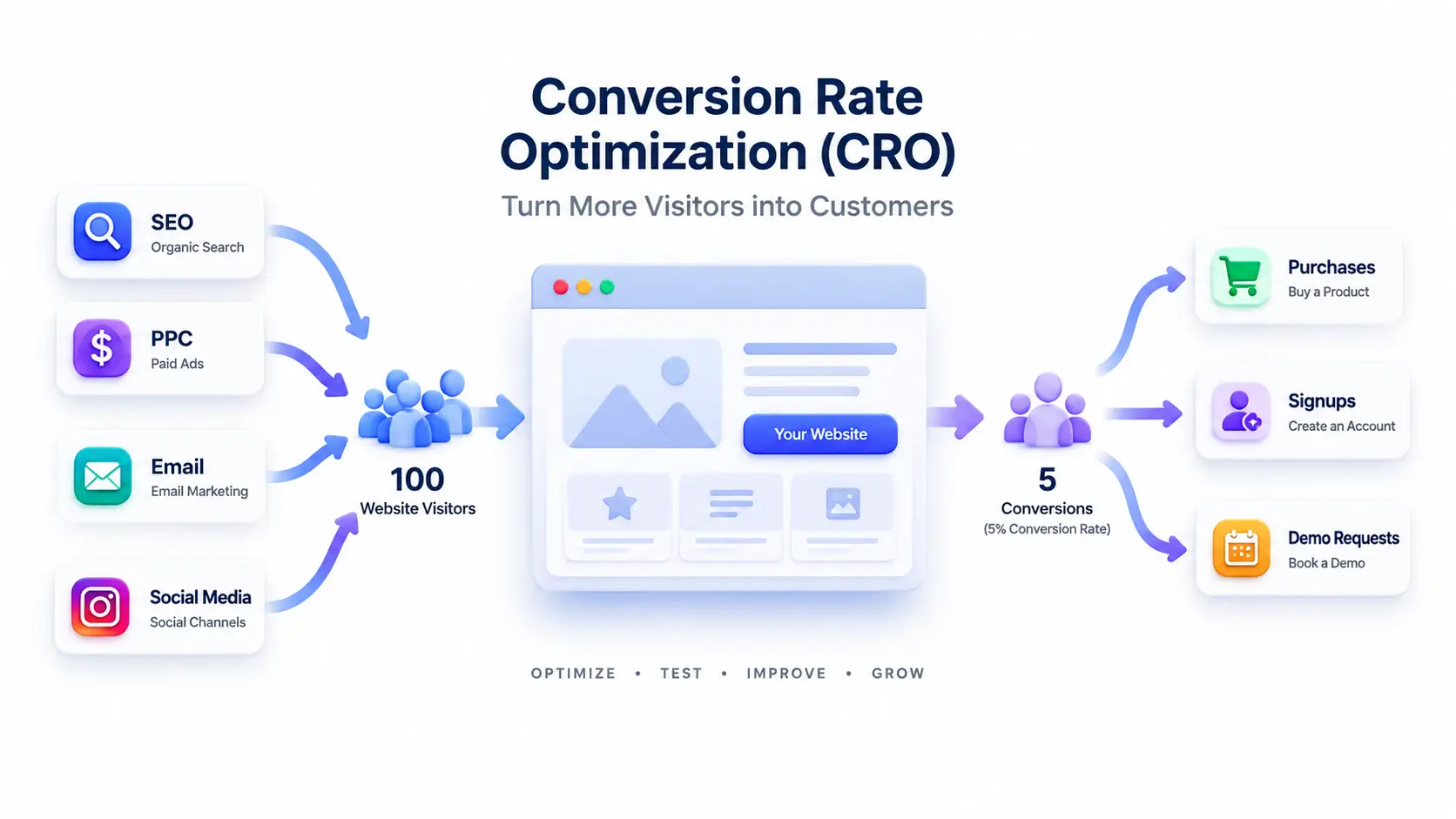
Conversion rate optimization is the process of testing and adjusting parts of your website headlines, buttons, layouts, forms to increase the percentage of visitors who complete a specific, desired action. Instead of trying to attract more traffic, CRO focuses on getting more value out of the traffic you already have.
Think of your website like a physical store. If 100 people walk in every day but only 3 make a purchase, you have two options: bring in more foot traffic, or figure out why 97 people are walking out empty-handed. CRO is the second approach and it’s usually far cheaper than the first.
What Counts as a “Conversion”?
A “conversion” isn’t always a sale. It’s simply any action that moves a visitor closer to becoming a customer, and it looks different depending on your business:
- An online store: a completed purchase
- A SaaS company: a free trial signup
- A service business: a booked consultation or submitted contact form
- A media site: a newsletter subscription
Before you can optimize anything, you need to know exactly what conversion you’re optimizing for.
How Does CRO (Conversion Rate Optimization) Work?
The Conversion Rate Formula (With a Worked Example)
Conversion rate is calculated with a simple formula:
Conversion Rate = (Number of Conversions ÷ Total Visitors) × 100
So if a landing page gets 4,000 visitors in a month and generates 200 signups, the math looks like this:
(200 ÷ 4,000) × 100 = 5% conversion rate
If you improve that page and lift the conversion rate to 7.5%, you’d generate 300 signups from the exact same 4,000 visitors a 50% increase in results without spending an extra cent on traffic.
The CRO Process Step-by-Step
Conversion Rate Optimization isn’t a single action it’s a repeatable cycle. Most CRO programs follow four stages:
- Analyze – Look at your data (analytics, heatmaps, session recordings) to find where visitors are dropping off.
- Hypothesize – Form a specific theory about why they’re dropping off (e.g., “the checkout form has too many fields”).
- Test – Run an A/B test comparing your original page against a modified version.
- Implement – If the new version performs better, make it permanent. If not, learn from the result and form a new hypothesis.
This cycle repeats continuously. CRO isn’t something you do once it’s an ongoing habit built into how you manage your website.
Why CRO Matters in Digital Marketing
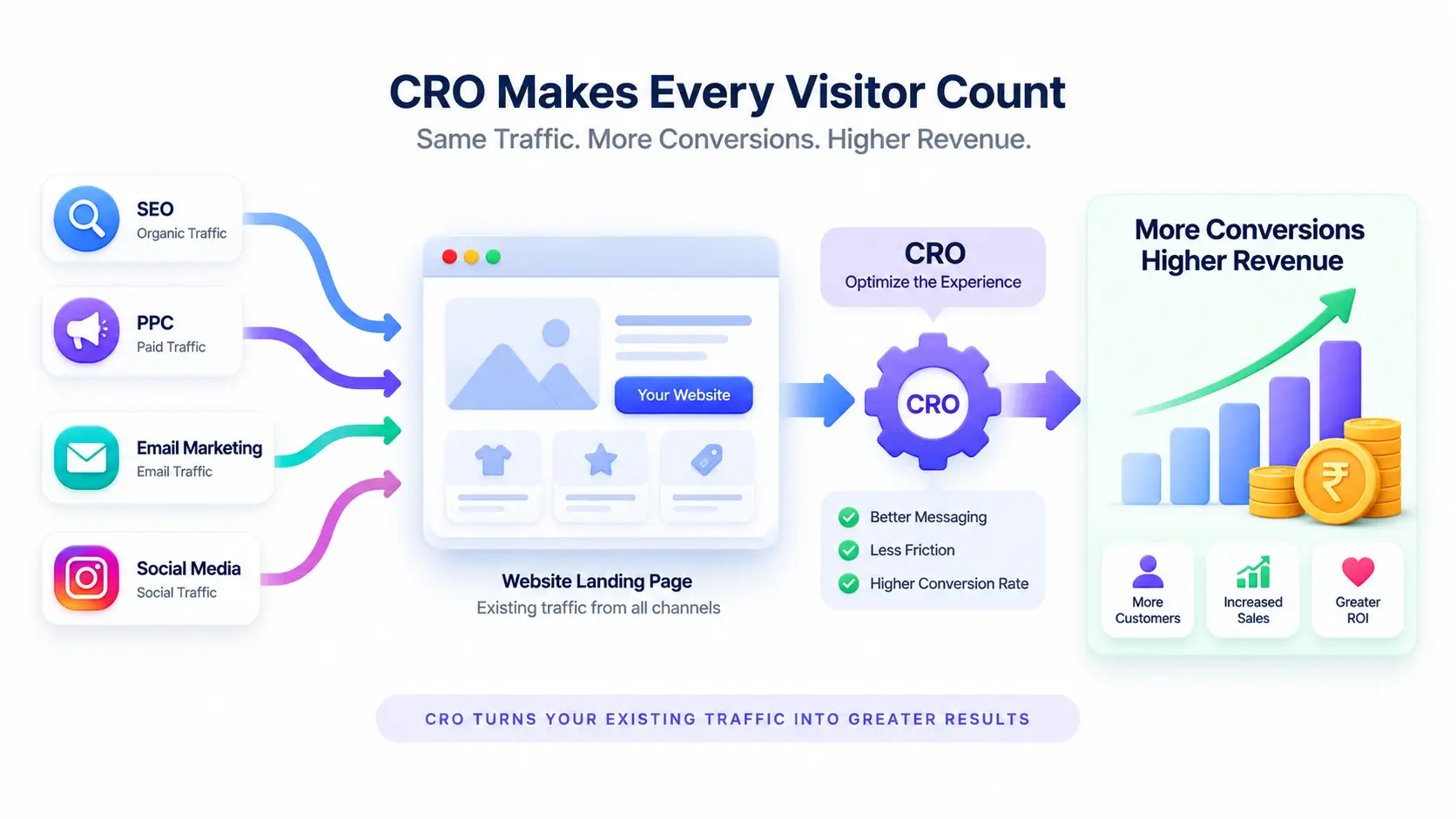
Getting More Value from Traffic You Already Have. Here’s what most beginner guides skip over: CRO doesn’t just improve one metric in isolation it acts as a multiplier across every other channel you’re already investing in.
Think about where your traffic actually comes from. It’s likely a mix of organic search (SEO), paid ads, email campaigns, and social media and in most cases, all of that traffic lands on the same handful of pages. That means a single conversion rate improvement on your homepage or landing page doesn’t just help one channel. It simultaneously boosts the return on your SEO efforts, your ad spend, and your email campaigns, because all three are sending people to the same optimized destination.
This is why experienced marketers often treat Conversion Rate Optimization as the highest-leverage improvement available to them: you’re not adding a new task to your plate, you’re making every other marketing task you’re already doing more effective.
CRO vs. SEO: How They Work Together, Not Against Each Other
It’s easy to assume CRO and SEO compete for the same resources, but they solve two different problems:
- SEO focuses on getting more people to your website through search rankings.
- CRO focuses on what happens after they arrive turning that traffic into results.
You can think of SEO as filling the top of the funnel and CRO as widening the bottom. A site with excellent SEO but poor CRO is like a store with a great location and no one at the register traffic without results. The two disciplines are meant to work in tandem, not in competition.
Common CRO Strategies and Techniques
A/B and Split Testing
A/B testing is the foundation of most CRO work. You create two versions of a page the original (“A”) and a modified version (“B”) and show each to a portion of your traffic. Whichever version produces more conversions becomes your new baseline.
Landing Page and Copy Optimization
Small wording and layout changes often produce outsized results. Common tests include rewriting headlines to be clearer and more specific, simplifying page layouts, and making the value proposition obvious within the first few seconds of a visit.
Reducing Friction in Forms and Checkout
Every extra field in a form or step in a checkout process gives a visitor another opportunity to abandon the page. CRO often involves auditing these processes to remove anything that isn’t strictly necessary.
Using Behavioral Data (Heatmaps, Session Recordings)
Beyond basic analytics, tools that show how people actually behave on a page where they click, how far they scroll, where they hesitate reveal friction points that raw numbers alone can’t explain.
How to Get Started with CRO (Even With No Budget)
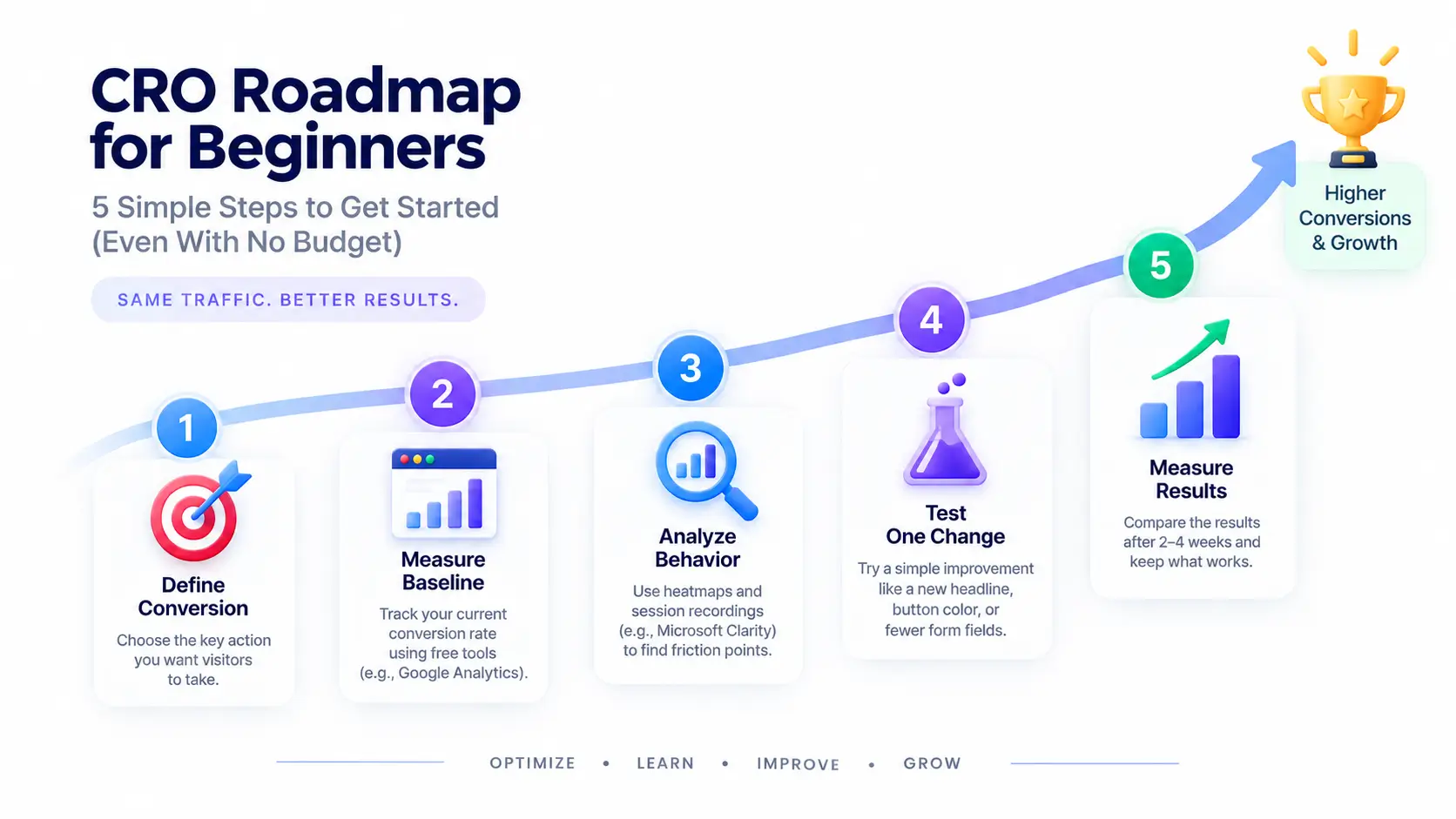
You don’t need an enterprise testing platform to begin. Here’s a realistic starting path for beginners.
Free/Low-Cost Tools to Start With
- Google Analytics – to establish your baseline conversion rate and identify where visitors drop off
- Microsoft Clarity – a free heatmap and session recording tool that shows real visitor behavior
- Built-in A/B testing features in landing page platforms like Unbounce or similar tools, many of which offer entry-level free tiers
Your First CRO (Conversion Rate Optimization) Audit Checklist
- Define what a “conversion” means for your most important page
- Calculate your current conversion rate using the formula above
- Watch 5–10 session recordings to spot obvious friction points
- Pick one specific, testable change (a headline, a button color, a form field)
- Run the test for at least 2–4 weeks before drawing conclusions
Start small, document what you learn, and build from there. CRO rewards consistency far more than it rewards any single clever tactic.
Frequently Asked Questions
What does CRO (Conversion Rate Optimization) stand for in marketing?
CRO stands for Conversion Rate Optimization the practice of increasing the percentage of website visitors who complete a desired action, such as making a purchase, signing up, or filling out a form, without needing to increase traffic.
What is a good conversion rate?
Average conversion rates across industries typically fall between 2% and 5%, though this varies by sector and traffic source. A “good” rate depends on your industry, offer, and audience the real goal is steady improvement over your own baseline, not a universal benchmark.
How is conversion rate calculated?
Conversion rate is calculated by dividing the number of conversions by total visitors, then multiplying by 100. For example, 200 conversions from 4,000 visitors equals a 5% conversion rate.
Is CRO the same as SEO?
No. SEO focuses on attracting more visitors to your site through search rankings, while CRO focuses on converting the visitors you already have into customers. They’re complementary: SEO brings traffic, CRO makes that traffic more valuable.
What tools do beginners use for CRO?
Beginners often start with free or low-cost tools like Google Analytics for data, built-in A/B testing in landing page platforms, and heatmap tools like Microsoft Clarity to see how visitors actually behave.
How long does it take to see results from Conversion Rate Optimization?
Most CRO tests need 2–4 weeks to gather statistically meaningful data, depending on traffic volume. Meaningful, compounding results from an ongoing CRO program typically show up over 3–6 months of consistent testing.