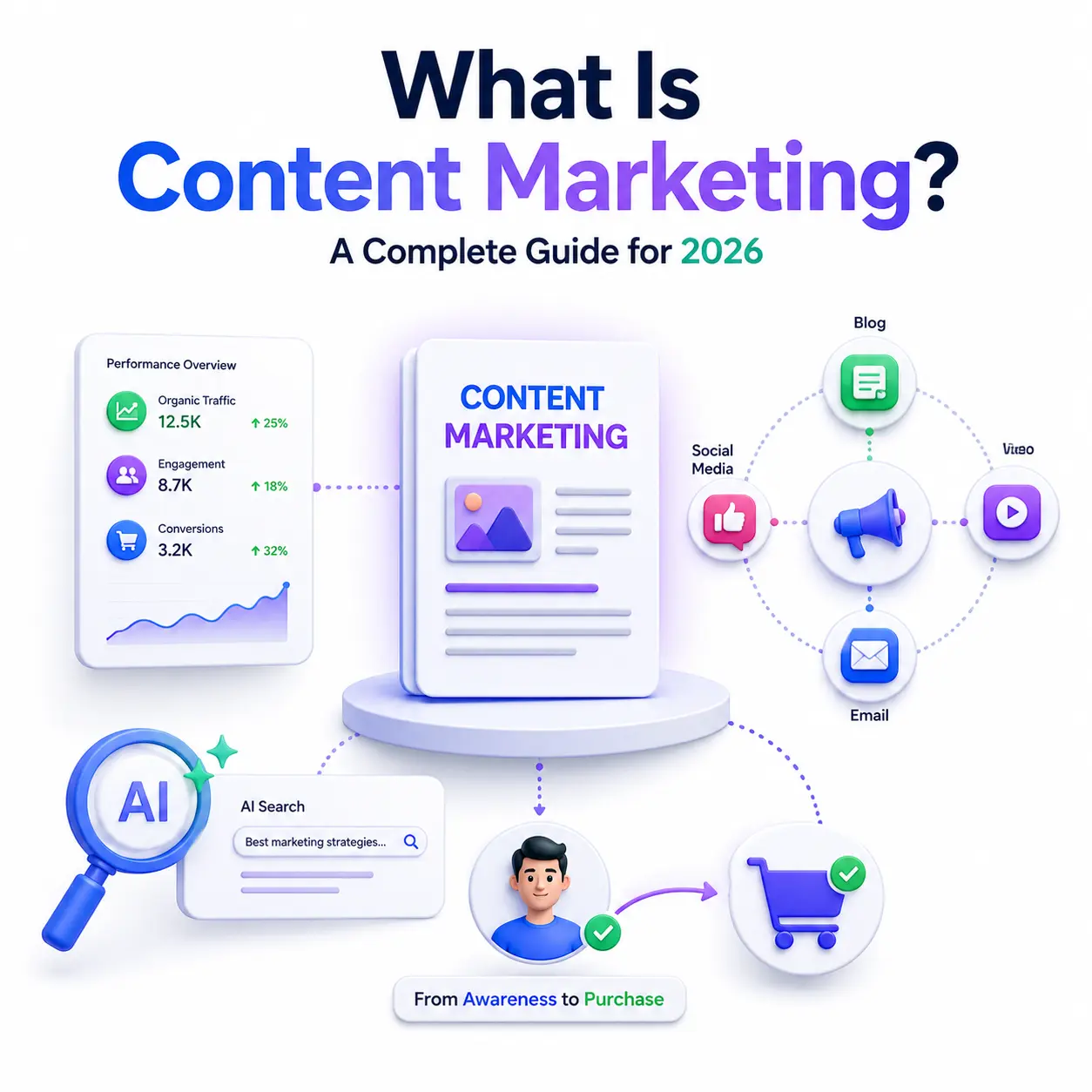
If you’ve spent any time in digital marketing, you’ve heard the term everywhere but the definitions floating around tend to be either too vague to be useful or so broad they could describe almost anything. This guide clears that up. You’ll learn what content marketing actually is, how it works, how it differs from advertising and SEO, and why it has quietly become one of the most reliable ways to grow a brand in 2026.
What Is Content Marketing?
Content marketing is the practice of creating and sharing valuable, relevant content blogs, videos, emails, and more to attract and retain a clearly defined audience, and ultimately to drive profitable customer action. Instead of interrupting people with a pitch, you earn their attention by helping them.
That last part is the whole idea. Traditional marketing tells people why your product is great. Content marketing shows people you understand their problem, builds trust over time, and positions your brand as the obvious choice when they’re finally ready to buy.
Content marketing in simple terms
Think of a fitness brand that publishes free workout guides, or a software company that runs a blog answering the exact questions its customers Google at 11 p.m. Neither is “selling” in that moment. They’re being genuinely useful and that usefulness is what makes the eventual sale feel natural rather than forced.
How Content Marketing Works
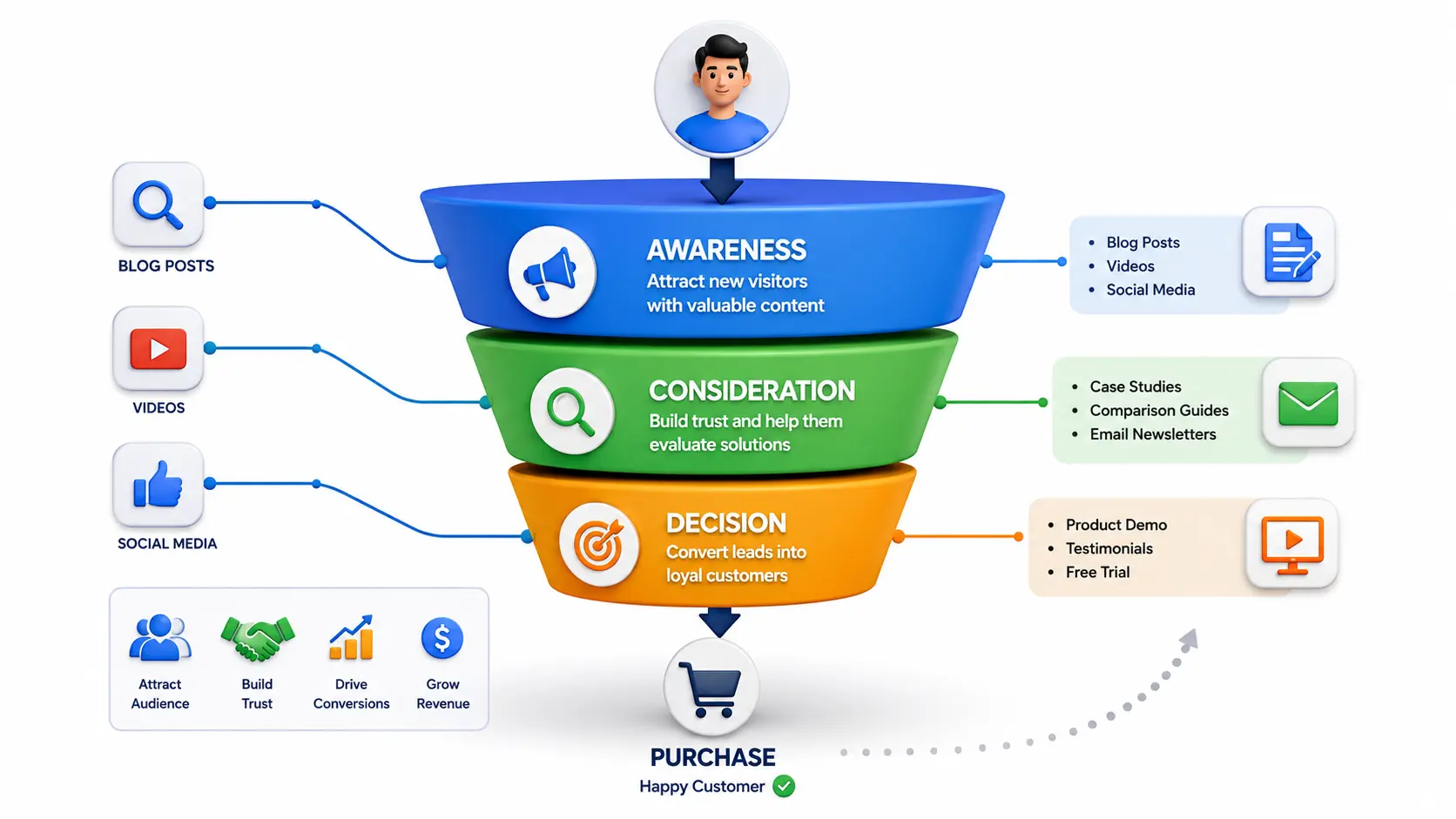
Content marketing works by guiding people through a journey rather than chasing a single transaction. That journey is usually mapped as a funnel with three stages: awareness, consideration, and decision.
At the awareness stage, someone realizes they have a problem. Your job is to be there with helpful, educational content a blog post, a short video, a social clip. At the consideration stage, they’re weighing options, so you offer comparisons, case studies, or in-depth guides. By the decision stage, they’re ready to act, and content like product demos, testimonials, or free trials nudges them over the line.
Owned, earned, and paid distribution
Creating content is only half the work the other half is getting it seen. Marketers distribute content across three channel types. Owned channels are the ones you control your website, blog, and email list. Earned channels come from others sharing or citing your work, like press mentions or organic social shares. Paid channels amplify reach through advertising. The strongest strategies use all three, but the long-term compounding value lives in owned content that keeps working for years.
Where SEO fits in
Search engine optimization is how your content gets found. A brilliant guide that nobody can discover isn’t doing its job. SEO ensures your content ranks when people search for the problems it solves which is why content marketing and SEO are so often mentioned in the same breath.
Content Marketing vs Traditional Advertising
The simplest way to understand content marketing is to contrast it with advertising.
Advertising is a push you buy attention and interrupt whatever someone was doing to deliver a message. It works fast, but it stops the moment you stop paying. Content marketing is a pull you create something valuable enough that people come to you, and that asset keeps attracting an audience long after it’s published.
Both have a place. Ads deliver immediate visibility; content builds durable authority. The trade-off is time: content marketing rewards patience, while advertising rewards budget.
Is content marketing the same as SEO?
No, though they overlap heavily. SEO is the discipline of optimizing content to rank in search engines. Content marketing is the broader practice of creating and distributing valuable content across many channels search being just one. Good content marketing uses SEO to get found, and good SEO needs quality content to rank, but neither one fully contains the other.
Types of Content Marketing
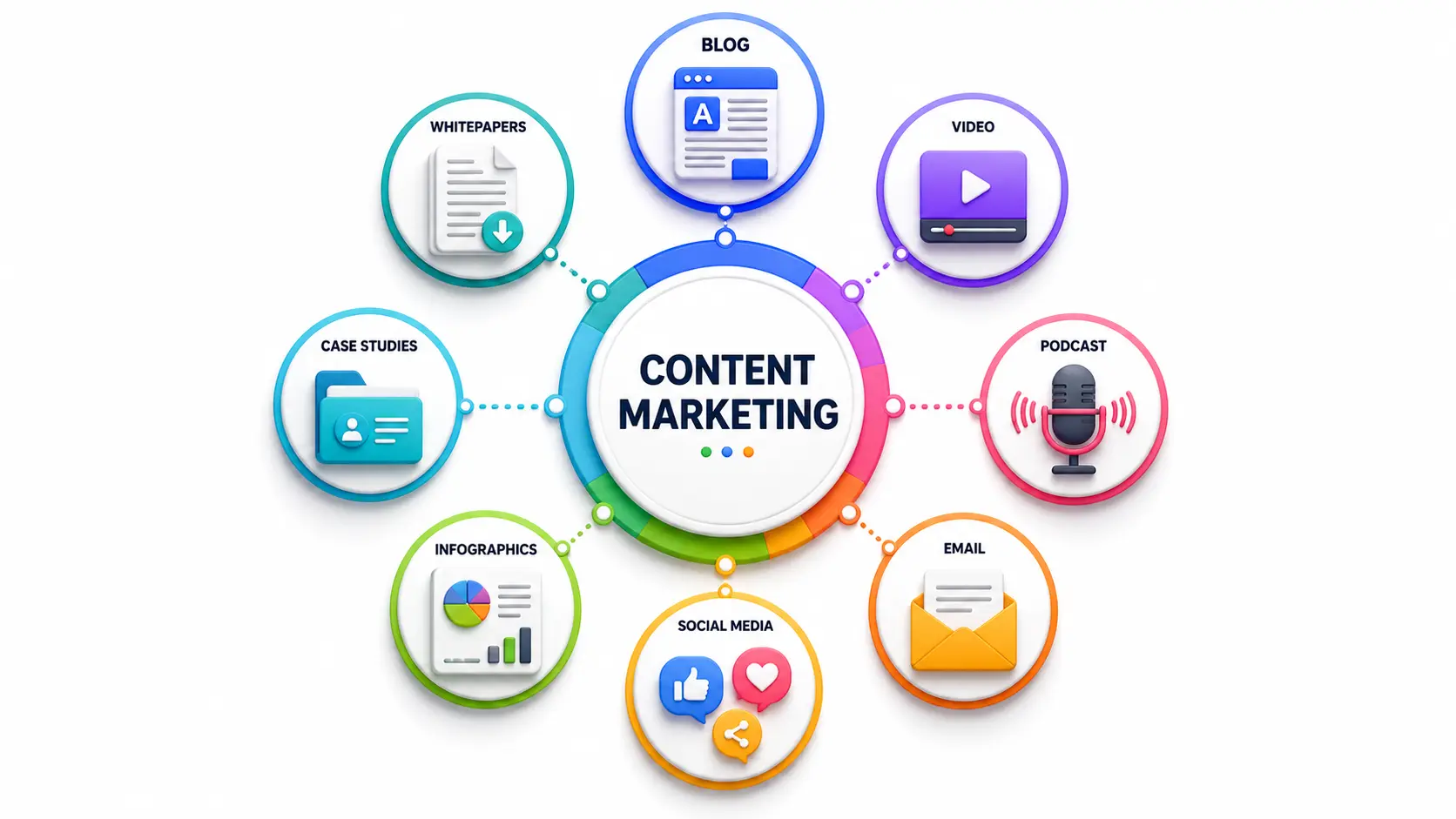
Content marketing isn’t a single format it’s a toolkit. The most common types include:
- Blog posts and long-form articles — the backbone of most strategies, ideal for SEO and answering audience questions in depth.
- Video and short-form video — now the highest-adoption format across both B2B and B2C, from tutorials to quick social clips.
- Email newsletters — a direct line to an audience you own, unmediated by any algorithm.
- Infographics and visual content — perfect for making complex data quick to grasp and easy to share.
- Podcasts and audio — a way to build intimate, long-form relationships with a loyal audience.
- Social media content — for reach, community, and distribution.
- Case studies, whitepapers, and gated assets — bottom-of-funnel content that proves results and captures leads.
Most effective strategies combine several formats, matching each to a stage of the buyer’s journey rather than betting everything on one channel.
Real Content Marketing Examples
The best examples rarely feel like marketing at all. A cookware brand running a recipe blog, an accounting software company publishing free guides on small-business taxes, or a skincare label posting “how to build a routine for oily skin” each solves a real problem for its audience while quietly building authority.
It works at any scale. A local bakery sharing short videos on sourdough technique is doing exactly what a global brand does with a content studio, just with a smaller budget. The principle is identical: help first, sell second.
Why Content Marketing Matters
The case for content marketing isn’t philosophical it’s measurable.
Content marketing generates roughly three times more leads than outbound methods while costing about 62% less, according to Demand Metric. Beyond raw lead numbers, it builds something advertising can’t rent trust. Audiences that repeatedly get value from your content come to see your brand as a credible authority, which shortens sales cycles and improves conversion.
It also compounds. A well-optimized article can attract visitors for years, unlike an ad that vanishes when the budget runs out. That compounding is why content is often described as an asset rather than an expense.
The 2026 shift you can’t ignore
Here’s what most “what is content marketing” guides still miss. For years, the endpoint of content marketing was a search results page. That’s changing fast. Buyers increasingly research inside AI assistants a striking 94% of B2B buyers now use large language models to synthesize their research (6sense, 2025 Buyer Experience Report).
The implication is significant content marketing in 2026 is no longer only about earning clicks. It’s about earning citations becoming the authoritative source an AI model draws on when it answers your customer’s question. The same fundamentals of trust, depth, and clarity that helped content rank on Google now determine whether an AI surfaces your brand at all.
How to Start Content Marketing
If you’re ready to begin, resist the urge to publish everywhere at once.
Start by defining one clear audience and one measurable goal more leads, more sign-ups, more brand awareness. Then commit to one or two formats you can produce consistently, because consistency beats volume every time. For most businesses, a blog plus an email newsletter is a strong starting combination.
Next, document your strategy. It sounds bureaucratic, but the data backs it up: around 73% of B2B marketers have a content strategy, yet fewer than half have it written down and documented strategies consistently outperform (Content Marketing Institute). Finally, measure what matters and refine as you go.
Frequently Asked Questions
What is content marketing in simple words?
Content marketing is creating and sharing useful content like blogs, videos, or emails to attract and keep an audience, instead of directly pitching products. The goal is to build trust so people choose your brand when they’re ready to buy.
Is content marketing the same as SEO?
No. SEO optimizes content to rank in search engines, while content marketing is the broader practice of creating valuable content across many channels. They overlap heavily, but neither fully contains the other.
Does content marketing actually work?
Yes, when done consistently. It generates roughly three times more leads than outbound methods at about 62% lower cost. Its main trade-off is time results compound over months rather than appearing instantly like paid ads.
How do I start content marketing for a small business?
Define one clear audience and goal, then commit to one or two formats you can produce consistently often a blog plus email. Document a simple strategy, publish on a regular schedule, and track your results to refine what works.
Want to learn content marketing professionally? Check out our Digital Marketing Course in Trivandrum and gain hands-on experience with SEO, AI-driven content strategies, social media marketing, and performance marketing.


Pingback: What Is User-Generated Content In Modern Marketing In 2026?