Opening a Shopify store takes an afternoon. Getting people to buy from it is the hard part. If you are searching for Shopify marketing for beginners, you have probably noticed the problem: every guide tells you to do SEO, email, TikTok, Instagram, influencers, and ads all at once, with no order and no budget guidance.
This guide takes a different approach. You will build a simple foundation, capture emails, pick one traffic channel, and measure what happens. By the end, you will have a 30-day plan to work through and the benchmarks to tell whether it is working.
What Is Shopify Marketing and Where Should Beginners Start?
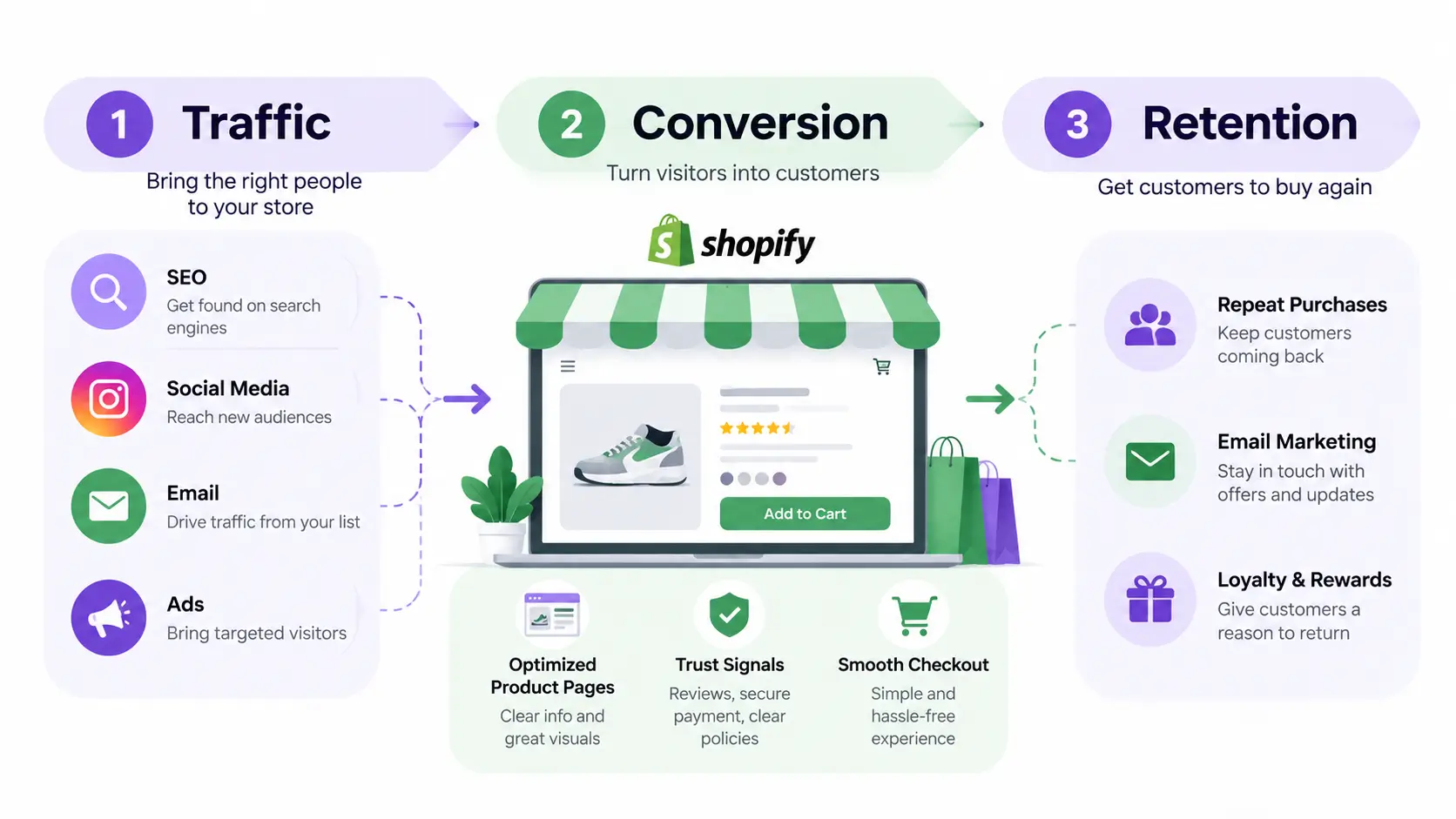
Shopify marketing is everything you do to bring the right people to your store, turn them into buyers, and bring them back again. Store setup builds the shop; marketing fills it. Every tactic you will read about pulls one of three levers:
- Traffic: getting visitors from search, social media, email, or ads.
- Conversion: turning visitors into customers with strong product pages, trust signals, and a smooth checkout.
- Retention: getting existing customers to buy again.
What is the best marketing strategy for a new Shopify store?
Follow the one-channel rule. Work in this order: build a foundation, capture emails, put your effort into one traffic channel, then measure. Beginners usually have a small budget and limited time, and spreading both across five channels means none of them gets enough attention to work.
Conversion matters as much as traffic. Industry compilations put the average Shopify conversion rate at roughly 1.4% to 1.8%, which means most visitors leave without buying. That is why the foundation and email capture come before any big push for traffic.
Shopify SEO for Beginners
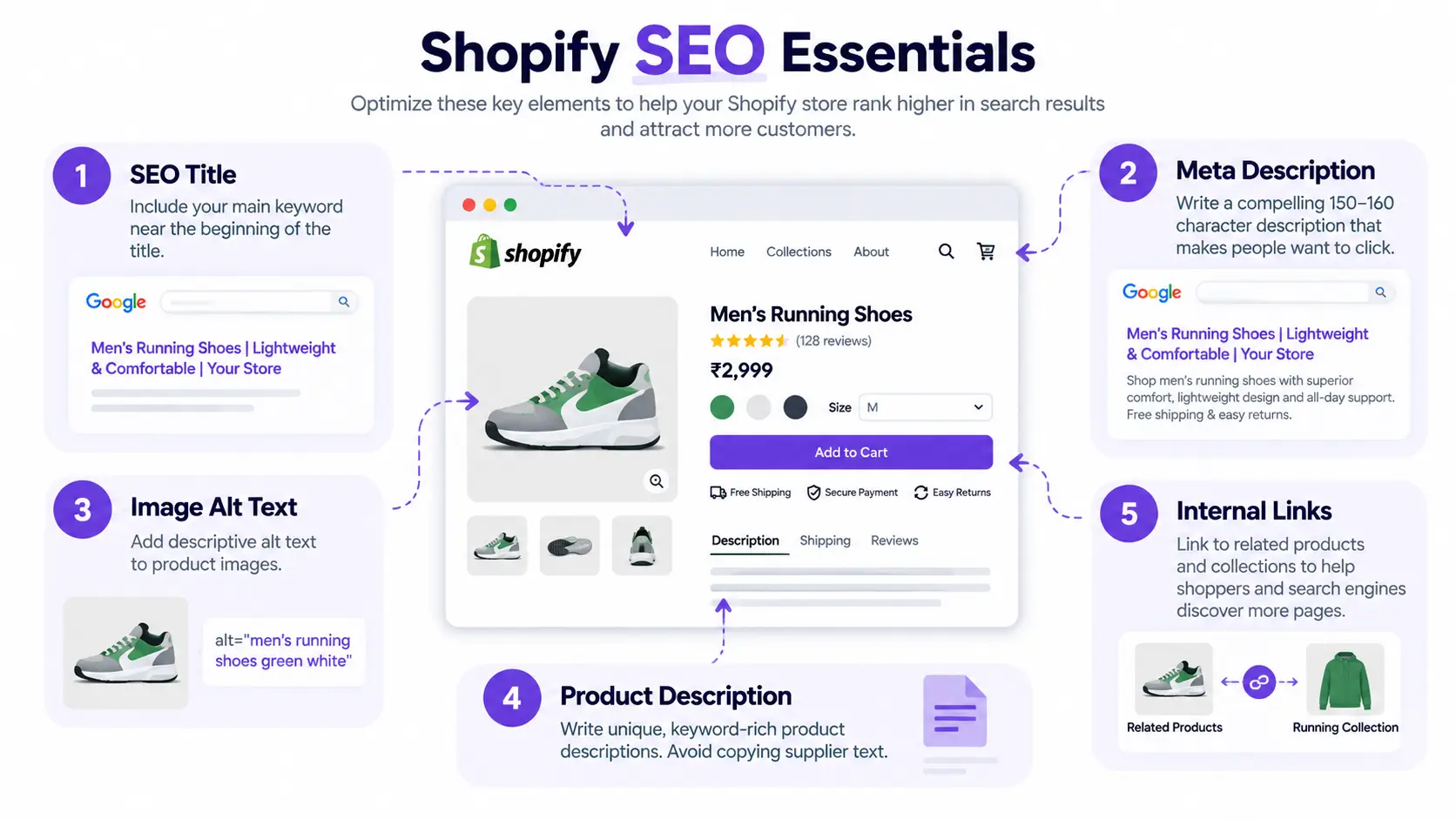
SEO is free and compounds over time, but it is slow. Expect three to six months before it sends meaningful traffic, so start early even if you lead with another channel. For Shopify stores, ecommerce SEO focuses on optimizing product pages, collection pages, site structure, and content so potential customers can find your products through search engines.
Titles, meta descriptions, and product copy
Every product, collection, and page in Shopify has a “Search engine listing” section. Use it.
- Put the main phrase a shopper would search near the front of the page title.
- Write a meta description of about 150 to 160 characters that makes someone want to click.
- Write original product descriptions instead of pasting supplier text, which many other stores also use.
- Add descriptive alt text to product images.
- Use relevant ecommerce SEO keywords naturally in product titles, descriptions, headings, and supporting content.
Collection pages and site structure
Collection pages often rank for broad searches such as “women’s running socks” better than individual products do. Add a short introduction to each collection, and keep your structure shallow: Home, then Collection, then Product. Link related products and collections to each other so shoppers and search engines can move through the store easily.
How do I market my Shopify store for free?
The free options are SEO, organic posting on one or two social platforms, email capture with free tools such as Shopify Email, and asking early customers for reviews. Free tactics cost time instead of money, so choose a couple and stay consistent for at least 90 days. Ecommerce SEO is particularly useful for building long-term organic visibility without relying entirely on paid advertising.
Email Marketing: The Channel to Set Up First
Email Marketing belongs first because you own the list. Algorithms and ad costs can change overnight, but your subscribers stay yours. Industry compilations also show email outperforming other channels. One 2026 comparison reports conversion rates of about 4.2% for email, 2.7% for organic search, and 1.1% for paid social, while ROI estimates for email range from about $36 to $45 per $1 spent depending on the source. Treat these as directional benchmarks, not promises.
Capture emails with a simple popup or embedded form and one clear incentive, such as a small first-order discount or a useful guide.
Does Shopify have built-in marketing tools?
Yes. Shopify includes Shopify Email, discount codes, abandoned checkout recovery, built-in analytics, and integrations with social sales channels. Shopify Email has a free monthly allowance, so check Shopify’s current pricing for the limits. These tools cover the basics, and you can add apps later.
Your first three flows
A flow is an automated email sequence triggered by customer behavior. Build these three first:
- Welcome flow: Sent right after signup. Tell your brand story, show best sellers, and include your first-order offer.
- Abandoned cart flow: Reminds shoppers who left items behind. Send the first email within a few hours, while the purchase is still fresh.
- Post-purchase flow: Thanks the customer, explains how to use the product, asks for a review, and suggests related items.
Shopify Email vs. Klaviyo and other apps
Start with Shopify Email if you want zero learning curve. Move to a tool like Klaviyo or Omnisend when you need deeper segmentation, more flexible automation, or SMS. Do not pay for a premium platform before you have subscribers to send to.
Social Media Marketing for Shopify Stores
Choose one platform
Match the platform to your product and customer:
- TikTok and Instagram Reels: best for visual products you can demonstrate in short videos.
- Pinterest: works like a search engine for home, fashion, food, and DIY, and pins keep sending traffic for months.
- Instagram feed and Facebook groups: good for lifestyle brands and niche communities.
Social traffic tends to convert at lower rates than email or search, so judge it by reach, engagement, and email signups, not only by direct sales. Post three to five times per week for 90 days before deciding whether it is working.
User-generated content and micro-influencers
Send free products to small creators in your niche, and ask customers to share photos of what they bought. With permission, reuse that content on your product pages and social accounts. Real customers are more convincing than polished brand photos.
Paid Ads for Beginners: When and How to Start
Wait until your product pages convert, your tracking works, and you know your margins. Ads multiply whatever you already have, including problems.
Google Shopping vs. Meta ads
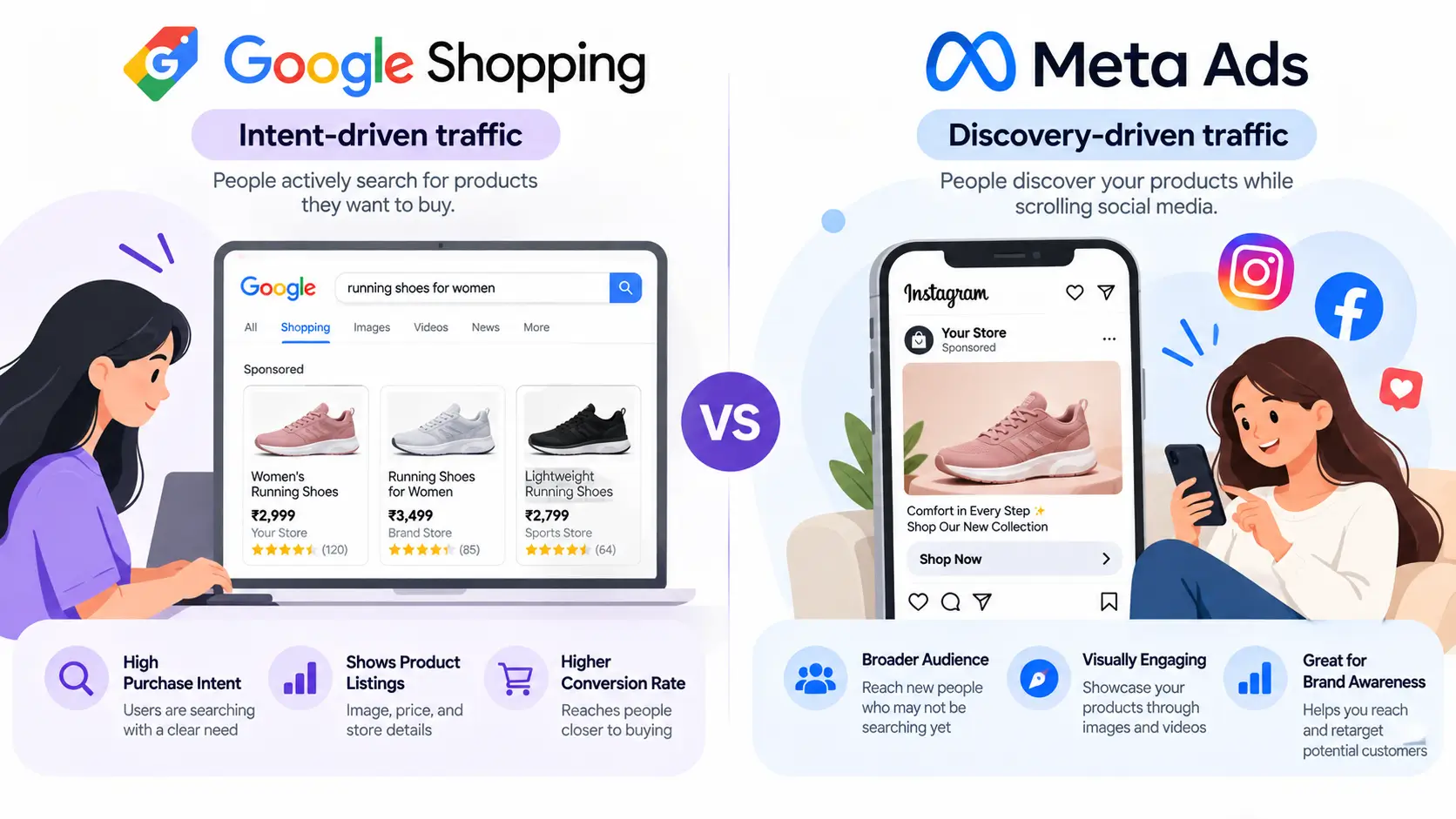
Google Shopping reaches people who are already searching to buy, and one 2026 compilation puts its conversion rate at roughly 1.9%. Meta ads (Facebook and Instagram) interrupt people who were not looking, so they convert lower, at about 1.1% in the same data, but they suit visual products and creative testing. Pick one and test it properly before adding the other.
How much should I spend on marketing a new Shopify store?
A reasonable starting range is about $0 to $300 per month. Treat it as paid research: the goal of early spending is to learn what works, not to turn a profit. That range is editorial guidance, so adjust it to your own finances and margins.
Break-even CAC explained (worked example)
Customer acquisition cost (CAC) is what you spend to win one customer. Your break-even CAC is the most you can pay before an order loses money. Here is an illustrative example, with numbers chosen for simplicity:
- Average order value: $85 (a figure commonly reported for Shopify stores)
- Assumed gross margin: 50%
- Gross profit per order: about $42.50, before shipping, fees, and other costs
So you should not pay more than roughly $42 to acquire a customer on a first order. Now suppose your ads convert at 1.1%, meaning about 91 clicks per sale. At $0.50 per click, that is roughly $45 per customer, slightly above break-even. The lesson is to improve your conversion rate or margin before you scale spending. Repeat purchases and email can also make a tight first order worthwhile.
Best Shopify Marketing Apps for Beginners
You probably need fewer apps than you think. Every app can add cost and slow your store. Most beginners can start with three:
- Email: Shopify Email, with Klaviyo or Omnisend as an upgrade later.
- Reviews: a reviews app so social proof builds automatically.
- Analytics or SEO: one tool that helps you see what is working.
Start free where you can, and upgrade only when you hit a real limit.
Shopify Marketing for Beginners: Your First 30-Day Plan
- Week 1, foundation: Write your customer sentence, install tracking, fix product pages, and add trust signals.
- Week 2, capture and SEO: Add an email signup form, build your welcome and abandoned cart flows, and optimize titles and descriptions on your top products.
- Week 3, launch one channel: Choose a single traffic channel from the sections above and publish or run your first campaign.
- Week 4, review and adjust: Check sessions by source, add-to-cart rate, and signups. Double down on what shows signs of life and drop what does not.
How do I get my first sale on Shopify?
First sales usually come from people close to you or from niche communities where you are already a real participant. Tell your network, share your launch in relevant groups with a clear offer, email your first subscribers, and reach out personally to a few people who fit your customer profile. Do not wait for strangers to find you.
How long does it take for Shopify marketing to work?
Paid ads can produce sales within days, while SEO and organic social usually take three to six months. Treat the first month as setup and testing, not profit.
How to Measure Results (Without Drowning in Data)
Track five numbers:
- Conversion rate: the share of sessions that end in a purchase.
- Average order value: revenue divided by orders.
- CAC: what it costs to win a customer.
- Email signup rate: the share of visitors who subscribe.
- Repeat purchase rate: the share of customers who buy again.
Check sessions by source, add-to-cart rate, and conversion rate weekly. Review CAC, AOV, repeat purchases, and list growth monthly.
Frequently Asked Questions
How do I market my Shopify store for free?
You can market a Shopify store for free by optimizing product pages for search, posting consistently on one or two social platforms, collecting emails with a popup offer, and sending free Shopify Email campaigns. Free tactics cost time instead of money, so pick two channels and stay consistent for at least 90 days.
What is the best marketing strategy for a new Shopify store?
Shopify marketing start with a foundation of email capture, search-optimized product pages, and one traffic channel that matches your customer, such as TikTok, Pinterest, or Google Shopping. Add automated welcome and abandoned-cart emails early. Concentrating on a single channel until it produces results beats spreading a small budget across five.
How much should a beginner spend on Shopify marketing?
Most beginners can start with 0–300 per month: free tools for SEO and email, plus a small test budget for ads. Treat early spending as paid research. Once you know your average order value and margin, set a budget so customer acquisition cost stays below the profit from a typical order.
How long does it take for Shopify marketing to work?
Paid ads can produce sales within days, email works once you have subscribers, while SEO and organic social usually need three to six months. Expect the first month to be about setup and testing, not profit. Track leading indicators like email signups and add-to-cart rate before sales climb.
Does Shopify have built-in marketing tools?
Yes. Shopify marketing includes tools like Shopify Email for campaigns, customizable SEO titles and meta descriptions, discount codes, abandoned-cart recovery, built-in analytics, and social sales channel integrations. These cover beginner needs. As you grow, apps like Klaviyo, Google & YouTube, or Meta integrations add automation, advanced segmentation, and ad management.