
Is a 4-month digital marketing course worth it? For most beginners, yes, as long as the course is practical, current and honest about outcomes. Four months is enough to learn the core channels, run real campaigns and build a portfolio that earns interviews. It is not enough to make you an expert, and no course can guarantee a job. This guide explains what the Certified Digital Marketing Associate (CDMA) program covers, who it suits, and how to judge the return before you enrol.
Is a 4-month online digital marketing course worth it in 2026?
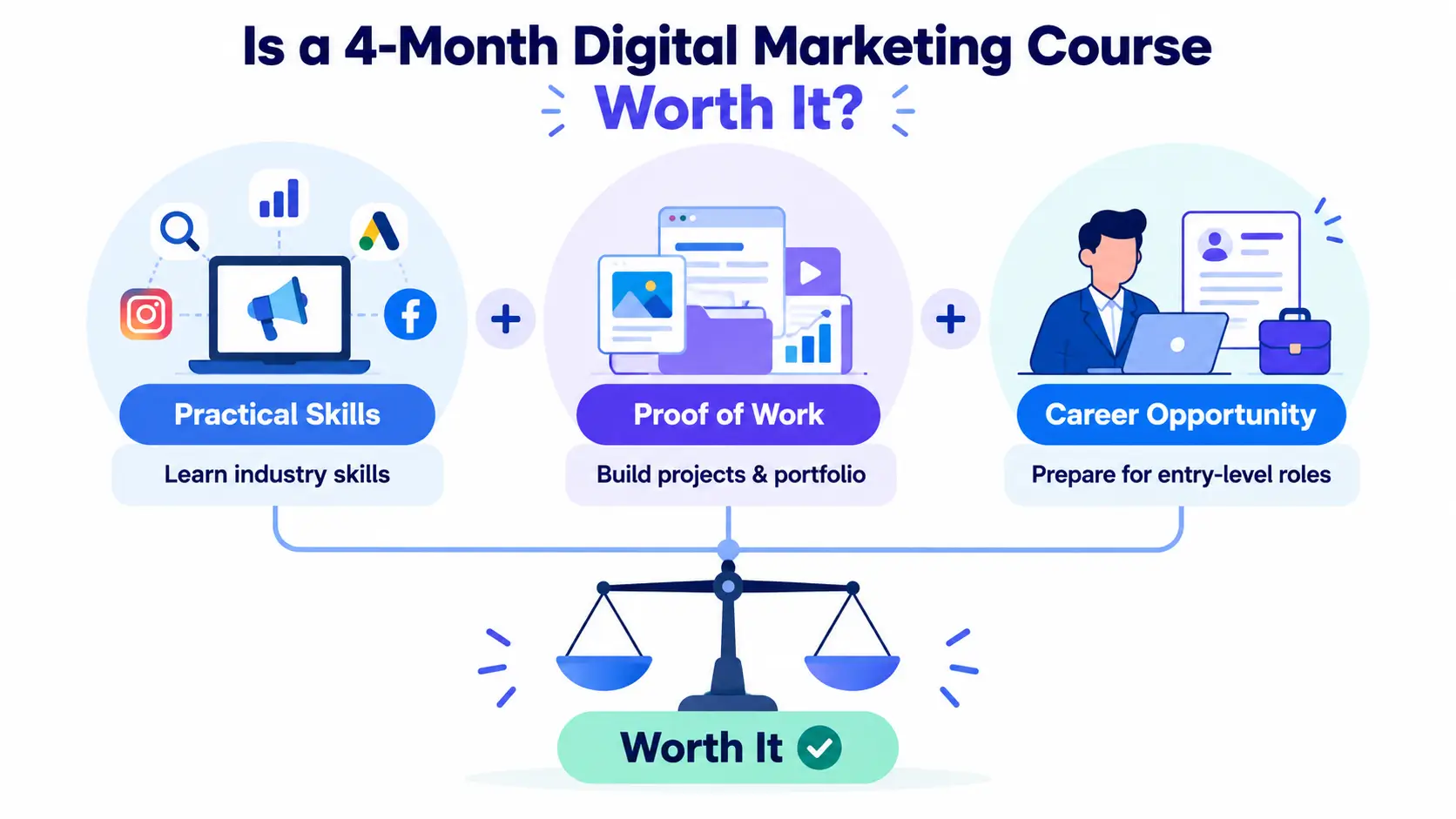
A 4-month course is worth it when it delivers three things: skills employers use daily, proof of work you can show, and a credible route to a first role. A course that offers only lectures and a certificate does not clear that bar.
When it is worth it
- Beginners and students: you get structure, deadlines, and feedback instead of scattered tutorials.
- Career-switchers: four focused months is faster than a degree and easier to fit around a job.
- Creators and entrepreneurs: you learn to turn attention into leads and sales, and to run your own ads.
- Working professionals An online format can make it easier to learn alongside an existing job or other responsibilities.
When it isn’t
It is a poor fit if you expect a guaranteed job, cannot commit weekly hours to practice, or want depth in only one narrow specialism.
Why Choose an Online Digital Marketing Course in Trivandrum?
Online learning can be a practical option for students, graduates and working professionals who want to develop digital marketing skills without depending on a physical classroom.You can learn from home, attend live sessions where available, and work on assignments or projects from your own setup. For someone in Trivandrum, this also makes it possible to learn from an institute offering structured training without making daily travel a part of the learning process.
However, convenience should not be the only reason to choose an online program. Before enrolling, check whether the course provides practical assignments, mentor guidance, project experience, feedback and opportunities to build work that you can show to employers. The quality of the learning experience matters more than whether the classroom is online or offline.
What this means for hiring and freelancing
More spend means more campaigns to plan, run and measure. Brands need people who can handle SEO, paid ads, social content and analytics, and small businesses increasingly hire freelancers for the same work. Employers value candidates who can show results, not just credentials.
What a 4-month online digital marketing course should cover (CDMA breakdown)
A good beginner course covers search, social, paid ads and analytics, then adds AI. CDMA follows that structure:
| Module | What you learn | Skill you walk away with |
| SEO | Keyword research, on-page and off-page SEO, WordPress and Rank Math, Search Console, GA4, Core Web Vitals, schema, Google Business Profile | Ranking a site or blog and tracking results |
| Social media & Meta Ads | Funnel thinking, campaign objectives, image, video and carousel ads, retargeting, Business Manager, metrics | Launching and optimising paid social campaigns |
| Google Ads | Quality Score, Search, Display, Shopping, Video, Performance Max, conversion tracking, YouTube basics | Running and measuring performance campaigns |
| LinkedIn & special sessions | Profile optimisation, content frameworks, sessions on AI, HR and LinkedIn | A professional brand and a job-search edge |
| AI integration | AI-assisted keyword research, content, video and image creation, automation | Working faster and producing more |
Why the AI layer matters
AI now handles first drafts, research and creative variations, so entry-level work is shifting toward judgment: choosing the right audience, message and metric. A course that teaches AI tools alongside fundamentals prepares you to direct the tools rather than compete with them.
Is 4 months enough to learn digital marketing?
Yes for entry-level readiness, no for mastery. Four months is enough to learn the fundamentals and practise them. Depth comes with real client work.
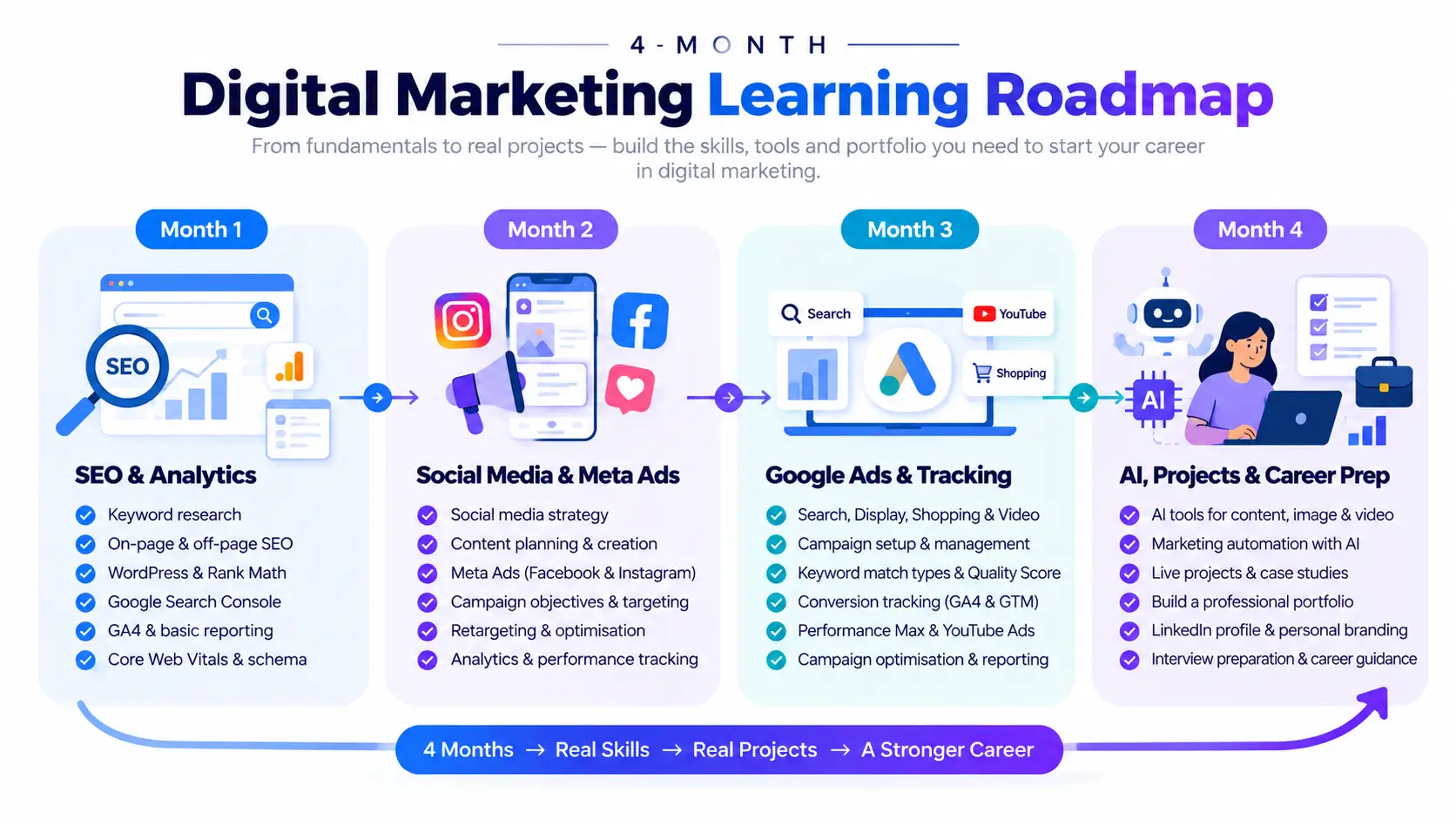
What’s realistic month by month
Most well-designed four-month programs follow a similar arc. This is a general progression, not an official CDMA schedule.
- Month 1: how search works, keyword research, analytics setup.
- Month 2: social media and Meta Ads.
- Month 3: Google Ads, tracking and optimisation.
- Month 4: AI workflows, live projects, portfolio and interview preparation.
Why an internship-integrated format shortens the learning curve
CDMA – online digital marketing course integrates an internship, so you practise while you learn instead of waiting until the end. Live briefs expose you to deadlines, client feedback and messy real data, which is where beginners improve fastest.
Hands-on learning, internships and portfolios: what “job-ready” really means
Job-ready means you can show what you’ve done, not just list what you’ve studied.
Real campaigns versus theory
Theory explains what Quality Score is. A real campaign shows you how a low one drains your budget. Look for assignments that use live accounts, real budgets or real websites.
What to show in a beginner portfolio
- A campaign case study with objectives, spend and results.
- A blog or site you optimised, with ranking and traffic screenshots.
- Analytics dashboards that show you can read the data.
- A LinkedIn profile or content channel showing consistent output.
Certifications and tools: do they matter to employers?
They help as signals, but they never replace proof of work.
Semrush, HubSpot and academy certifications
CDMA learners earn the academy’s own certification alongside Semrush and HubSpot credentials. The third-party certificates show familiarity with widely used platforms, and the academy certificate signals structured training. Paired with a portfolio, they strengthen a beginner’s CV.
The tool stack
Learners work with roughly 35 tools: about 20 industry marketing tools and about 15 AI tools.
|
Category |
Examples |
|---|---|
|
Advertising |
Meta Ads Manager, Meta Ads Library, Google Ads, Google Ad Manager |
|
SEO & research |
Ahrefs, Semrush, Moz, Ubersuggest, SpyFu, Google Keyword Planner, Google Trends |
|
Analytics, site & content |
Google Analytics, PageSpeed Insights, WordPress, HubSpot, Canva, Grammarly |
|
AI tools |
ChatGPT, Gemini, Claude, NotebookLM, Leonardo.Ai, Adobe Firefly, Gamma, HeyGen, ElevenLabs and more |
Career paths and income potential
Six common roles
Graduates typically target digital marketing executive, social media expert, SEO/SEM specialist, PPC manager, AI automation expert and content creator.
Freelancing and starting your own venture
Marketing skills are portable. Many learners take freelance clients alongside a job, then move into consulting or launch small agencies. The same skills (ads, SEO, content, analytics) also grow your own business.
Realistic salary expectations
Entry-level pay varies by city, employer, role and portfolio, so no single headline figure is reliable. Check current listings for your target role on LinkedIn, Naukri and Indeed, note the fresher range in your city, and use it in the ROI calculation below.
How to verify placement claims
The academy behind CDMA reports a 95% placement rate and provides placement assistance. Treat any such figure as a starting point and ask:
- How is “placed” defined?
- Within how many months?
- In which roles and at what pay?
- Can I speak to recent graduates?
Placement assistance is not a guarantee, and a good institute will answer these questions openly. Other red flags include promised jobs or income, no student work on show, outdated tools and pressure to enrol quickly.
Who should join CDMA, and who should wait
Best fit
Students, career-switchers, creators and entrepreneurs who can commit regular weekly hours and want practice over theory.
Consider waiting if
You need a guaranteed job offer, cannot commit to live sessions and projects, or want a specialist track in just one channel.
Frequently asked questions
Is a 4-month digital marketing course enough for beginners?
Yes, four months can be enough to become job-ready for entry-level roles if the course is practical. You need to learn core channels like SEO, social media and paid ads, run real campaigns, and build a portfolio. Mastery comes later through on-the-job experience, so treat the course as a launchpad, not a finish line.
Can I learn digital marketing without a technical or marketing background?
Yes. Digital marketing rewards curiosity and consistency more than prior qualifications. Beginners from any degree can start with fundamentals such as search, social platforms and analytics, then add AI tools and paid advertising. Choose a course with live classes, structured practice and mentor feedback so you are never learning alone.
Do online digital marketing courses guarantee a job?
Yes, an online digital marketing course can guarantee a job, with good programs offering placement assistance, such as interview preparation, portfolio reviews, and employer introductions. Always ask for verifiable placement data, including how many students were placed, in which roles, and at what salaries. Your portfolio and interview performance ultimately decide whether you are hired.
What does the CDMA course cover?
CDMA covers search engine optimisation, Meta (Facebook and Instagram) advertising, Google Ads, LinkedIn organic marketing and analytics tools such as GA4 and Search Console. It also integrates AI tools for content, research and automation, plus an internship component, so learners practise on live campaigns instead of only studying theory.
What jobs can I get after an online digital marketing course?
Common entry-level roles include digital marketing executive, social media manager, SEO or SEM specialist, PPC manager and content creator. Newer roles, like AI automation specialist, are growing as brands adopt AI tools. Many graduates also freelance or launch their own agencies once they build client results and confidence.
How do I know this online digital marketing course is worth the money?
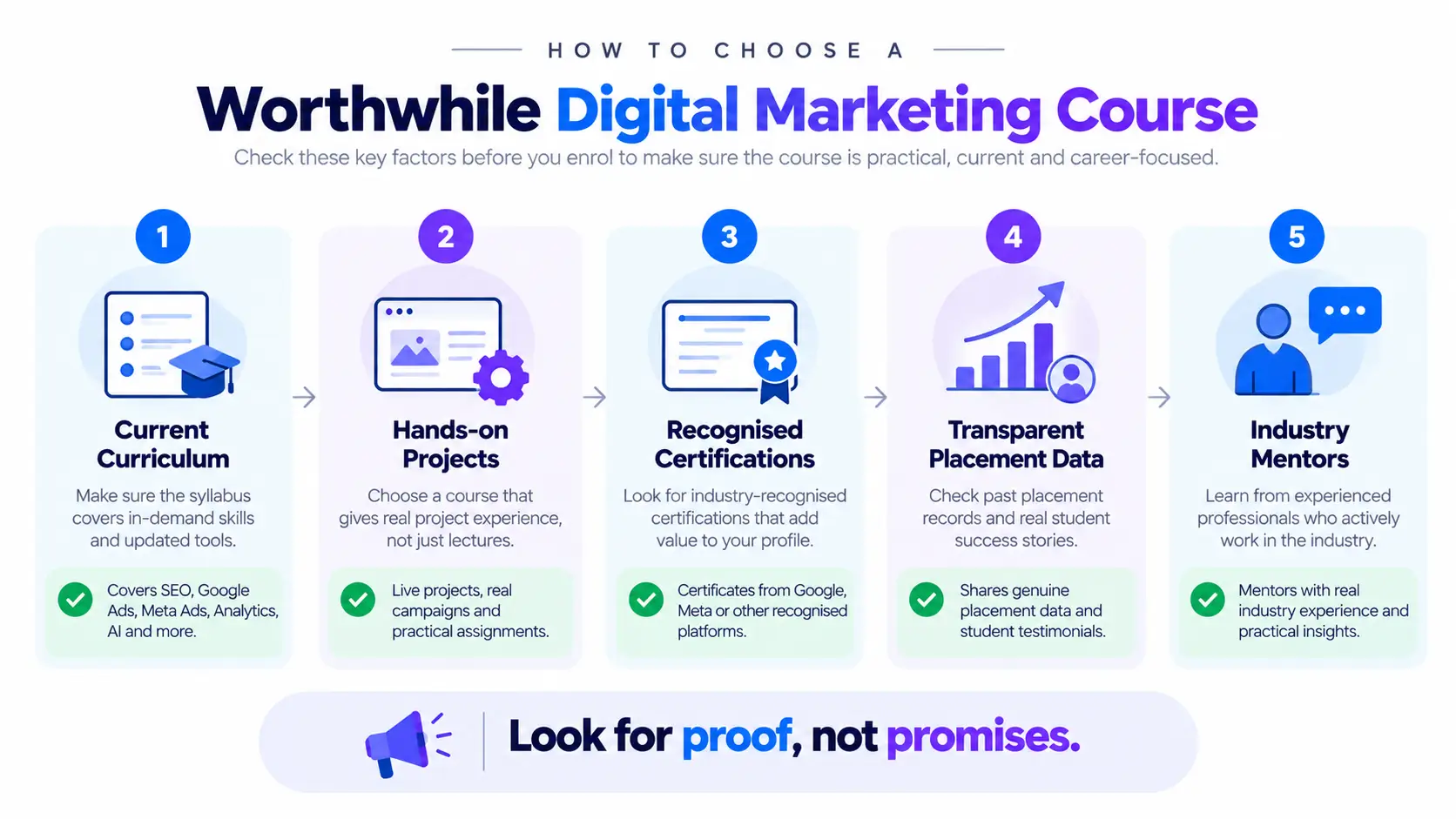
Compare total fees against realistic first-year earnings, then check five signals: a current curriculum, hands-on projects, recognised certifications, transparent placement data and mentors who work in the industry. If a course cannot show student portfolios or outcomes, treat its promises cautiously, whatever the price.
Final verdict: is it worth it?
A 4-month online digital marketing course is worth it if it is practical, current and transparent about outcomes. CDMA’s mix of SEO, paid ads, social media, AI tools, an internship and recognised certifications covers what most beginners should look for. Before you enrol, confirm the current batch format and fee, ask for placement data, and run the scorecard above. Ready for the next step? Talk to a counsellor or book a demo class to see the course in action.