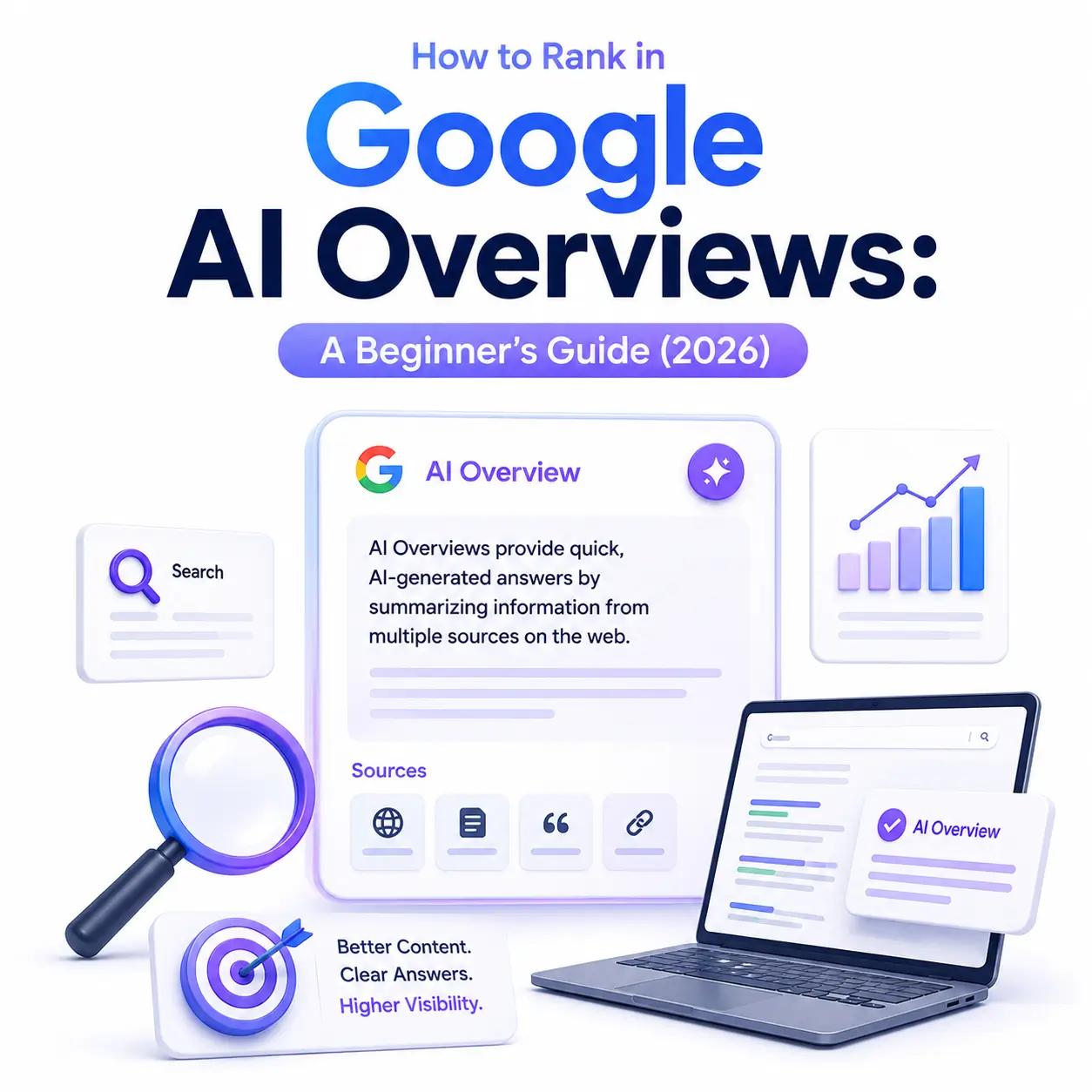
If you’ve noticed your traffic shifting even while your rankings stay steady, Google AI Overviews are probably part of the reason. These AI-generated summaries now appear on a large and growing share of searches, sitting above the traditional blue links and answering the user’s question before they ever click through. For beginners, this can feel like a brand-new game with brand-new rules. It isn’t. It’s an extension of SEO with a few new priorities layered on top, and this guide walks you through exactly what those priorities are and how to act on them.
What Are Google AI Overviews?
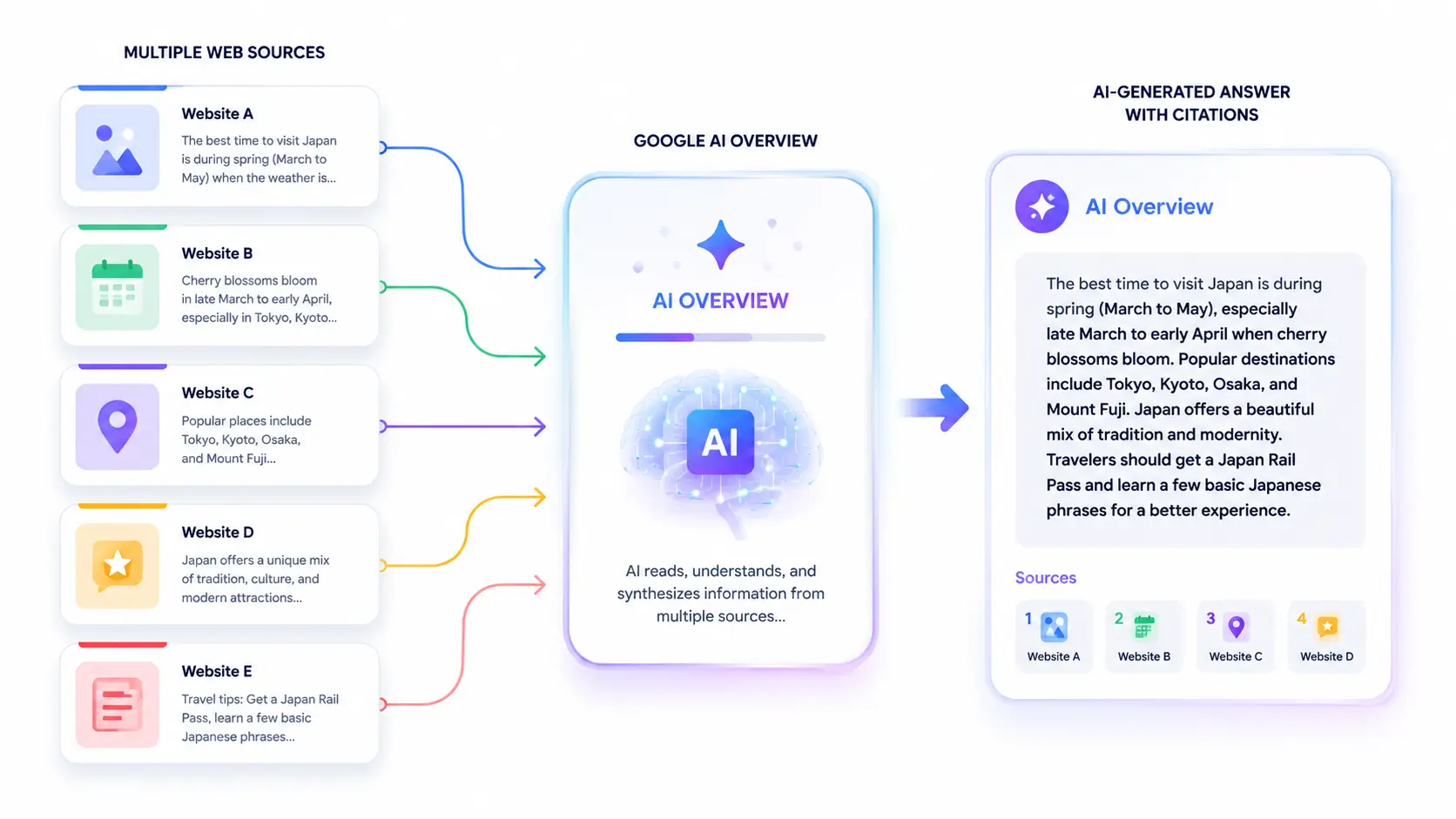
A Google AI Overview is a generative summary that appears at the top of a search results page. Instead of sending users straight to a list of ten links, Google’s AI reads across multiple pages already in its index, synthesizes a concise answer, and shows that answer directly on the results page along with a handful of linked sources it drew from. For many informational searches, this AI-written answer is now the first (and sometimes only) thing a user sees.
This matters because being “cited” inside an AI Overview is a different goal from being ranked at first position. You can rank with on-page seo and still never appear in the summary, and you can rank outside the top ten and still get pulled into it if your content answers the specific question more clearly than anyone else’s.
How AI Overviews Differ From Regular Search Results
Traditional search results are a ranked list: the algorithm decides which pages are most relevant and orders them. AI Overviews work differently. Google’s AI breaks a search query into smaller sub-questions (a process often called “query fan-out”), searches its index for the best answer to each sub-question, and stitches the strongest passages together into one narrative answer. The pages it draws from are shown as citation links inside or below the summary.
How AI Overviews Differ From Featured Snippets
A featured snippet pulls one passage from one page and displays it above the results.AI Overviews can gather information from multiple pages, combining details from different sources into one generated response. That means a featured-snippet strategy (write one perfect paragraph) is a good starting point, but it’s not the whole strategy your content needs to hold up as one voice among several in a synthesized answer, not just as a standalone box.
How Google’s AI Selects Sources to Cite
Google has been fairly direct about this: its generative AI features in Search are built on top of its core ranking and quality systems, not a separate crawl or a separate index. In practice, that means the same fundamentals that get a page ranked in classic search relevance, structure, authority, and trust are also the entry ticket to being considered for an AI Overview citation. But ranking well on SERP is necessary, not sufficient.
Why Ranking First Doesn’t Guarantee a Citation
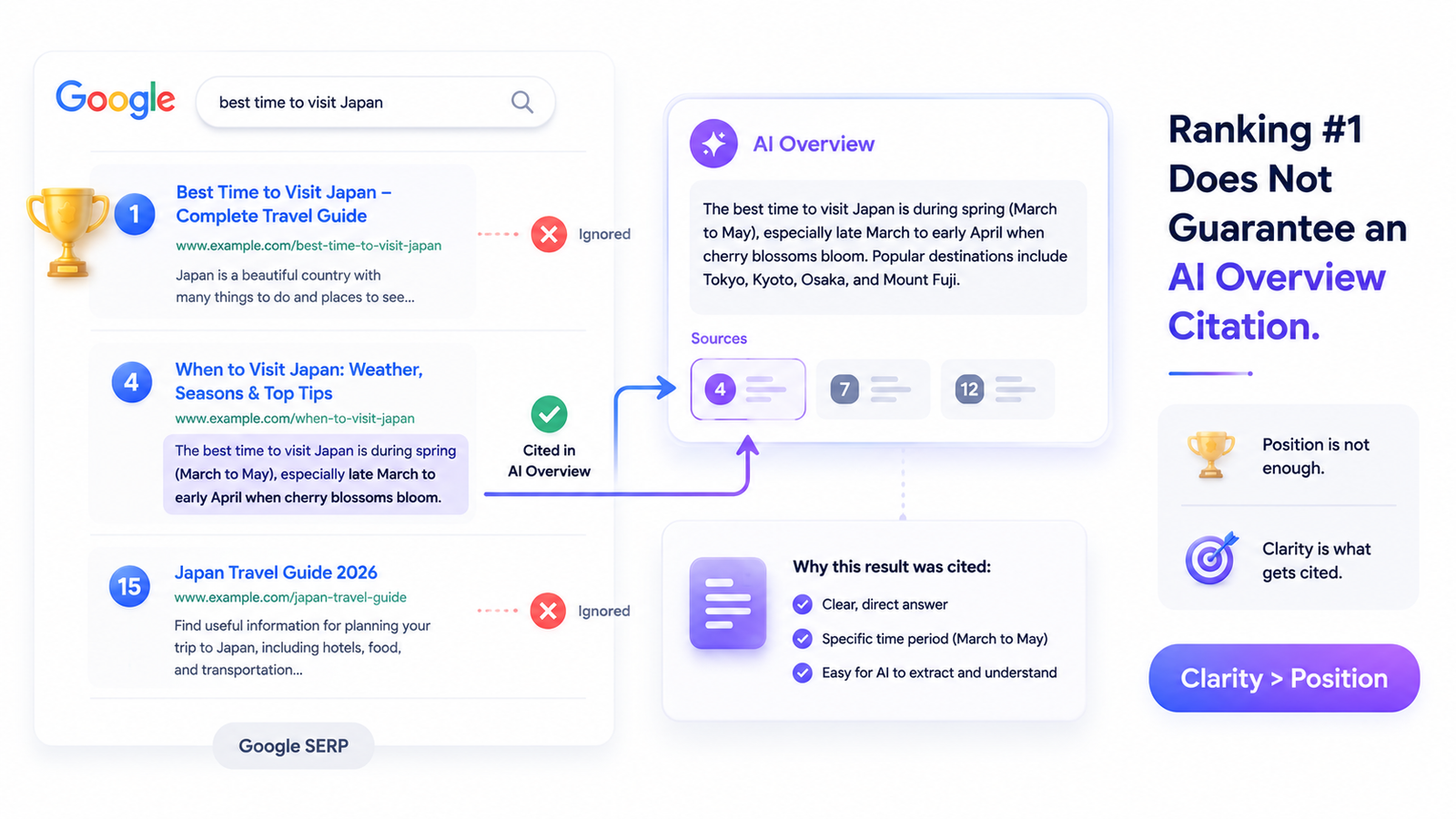
Because the AI is answering a specific sub-question rather than rewarding an entire page, a page ranking fourth with one exceptionally clear, self-contained paragraph can win the citation over a page ranking first with a long, unfocused introduction. Some data even suggests a meaningful share of AI Overview citations come from pages that rank outside the traditional top ten, often somewhere in positions 11 through 20, because those pages happened to answer the sub-question more precisely.
The Role of Gemini in Source Selection
AI Overviews are powered by Google’s Gemini models, which read the retrieved passages, evaluate them for relevance and completeness, and generate the summary text. This is why writing in a way that’s easy for a model to extract and understand clear structure, direct answers, no buried key facts has become as important as writing for a human skimmer.
Is “Ranking in AI Overviews” the Same as SEO?
Mostly yes, with a shift in emphasis. If you’re new to this, the reassuring news is that you don’t need to learn an entirely separate discipline. You need to sharpen the parts of SEO that make content easy for an AI system to extract and trust.
What’s the Same
- You still need your page to rank AI Overviews organically; they are grounded in Google’s regular index.
- Keyword relevance, site structure, and technical crawlability still matter.
- Helpful, people-first content is still the baseline Google expects.
What’s Different
- Passage-level clarity matters more than page-level polish.
- Structured data (schema) plays a bigger role as a machine-readable trust signal.
- Off-site authority and entity signals (E-E-A-T) carry more weight in citation selection than they historically did for ranking alone.
7 Steps to Optimize Your Content for AI Overviews
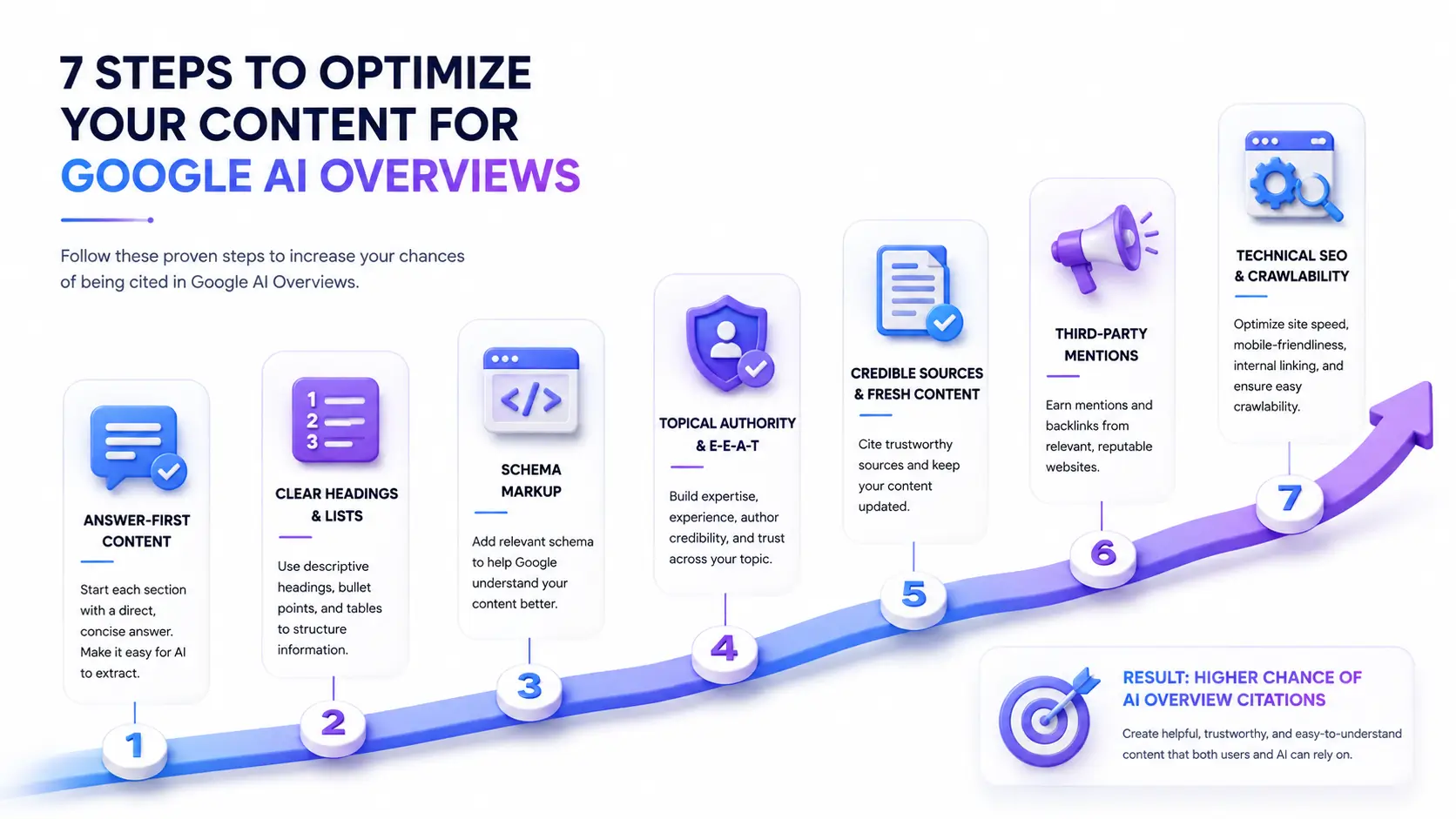
These steps are ordered roughly by how much control you have over them and how quickly you can act, starting with what you can change today.
1. Write Answer-First, Extractable Passages
Start each section with a direct, self-contained answer to the question implied by its heading, in one to three sentences. Don’t bury the answer under three paragraphs of setup. Google’s AI is looking for a passage it can lift cleanly, and a direct opening line gives it exactly that.
2. Structure Content With Clear Headings and Lists
Use descriptive H2s and H3s that mirror how people actually phrase questions, and break out steps, comparisons, or criteria into numbered or bulleted lists. This structure does double duty: it helps human skimmers, and it helps the AI fan-out process match your content to the right sub-question.
3. Add Schema Markup (FAQ, HowTo, Article)
Structured data doesn’t guarantee a citation, but it’s a strong eligibility signal. Pages with valid FAQPage, HowTo, and Article schema tend to show up in AI-generated citations more consistently than pages without it, because schema makes your content’s structure explicit and machine-readable rather than something the AI has to infer.
4. Build Topical Authority and E-E-A-T Signals
Publish enough depth on a topic that your site reads as a genuine expert on it, not a one-off article. Add author bios, credentials, and a detailed “About” page, and make sure your business details are consistent across the web. These entity signals feed into how Google’s Knowledge Graph recognizes and categorizes you as a real, trustworthy source.
5. Cite Credible Sources and Keep Content Fresh
Reference reputable studies, official data, or original research where relevant, and revisit older content to update outdated facts and figures. Google’s AI systems favor fresh, accurate content when choosing what to summarize; stale statistics are a quiet way to fall out of consideration.
6. Earn Third-Party Mentions and Brand Signals
Citations, reviews, and mentions on other reputable sites strengthen your entity footprint the same way backlinks strengthened classic rankings. Despite claims that links no longer matter, citation chips still skew toward domains with real topical authority because AI Overviews extract from pages that already rank well.
7. Don’t Neglect Core Technical SEO and Crawlability
None of the above matters if Google can’t crawl and index your page in the first place. Keep your site fast, mobile-friendly, and free of indexing errors. AI Overviews sit on top of organic search, not beside it, so basic technical health is still the floor everything else is built on.
How to Track Whether You’re Being Cited
Unlike traditional rankings, AI Overview citations aren’t something you can casually eyeball in a rank tracker yet, but there are two practical ways to check.
Using Search Console’s AI Overview Report
Google Search Console has been rolling out an AI Overview dimension under Performance, letting you filter search-appearance data specifically for queries where your page showed up inside an AI Overview. Coverage and reporting lag behind real time, so check this periodically rather than expecting instant feedback.
Manually Testing Target Queries
For your priority keywords, search them directly and note whether an AI Overview appears and whether your page is among the cited sources. Do this consistently for a set of target queries so you can spot patterns in what kind of content earns a citation and what doesn’t.
Common Mistakes Beginners Make
- Writing “prompt-optimized” copy that sounds robotic and generic instead of genuinely useful; this reads as low quality to both users and the AI.
- Chasing AI Overview tactics while neglecting core technical SEO, which remains the entry requirement.
- Assuming that ranking in the first position guarantees a citation and overlooking lower-ranking pages that could still earn the citation by providing a clearer, more relevant answer.
- Skipping schema markup because it feels optional; it’s one of the more direct machine-readable trust signals available.
FAQ
What is a Google AI Overview?
An AI Overview is a generative summary Google places above standard search results, synthesizing information from multiple indexed web pages into one answer with linked sources, so users get a quick response without clicking through immediately.
How do I get my content cited in AI Overviews?
Publish clear, well-structured, answer-first content that ranks organically, add schema markup, cite credible sources, and build genuine topical authority. There’s no guaranteed shortcut; strong SEO fundamentals remain the foundation.
Do I need to rank in the first position to appear in an AI Overview?
No. AI Overviews can pull from pages ranking outside the top 3, sometimes even outside the top 10, if that page answers a specific sub-question more clearly and concisely than higher-ranking competitors.
Is AI Overview optimization different from traditional SEO?
Not fundamentally; it builds on the same foundation of helpful, well-structured, authoritative content. The difference is emphasis: passage-level clarity, schema, and entity/E-E-A-T signals matter more for AI citation than for classic rankings alone.
Can small or new websites appear in AI Overviews?
Yes, if the content is highly specific, well-structured, and directly answers a narrow question better than competitors. Domain size helps but isn’t a strict requirement for citation on niche queries.
How can I check if my site appears in AI Overviews?
Check Google Search Console’s “Search Appearance” filter for an AI Overview dimension where available, or manually search your target queries and see whether your page is cited in the AI-generated summary.