Digital marketing remains one of the most accessible, in-demand career paths available today and 2026 is a particularly good time to start. Businesses of every size still need people who can drive traffic, convert customers, and make sense of data, even as AI reshapes how that work gets done. This guide walks you through exactly how to become a digital marketer in 2026, step by step, with no prior experience required.
What Does a Digital Marketer Actually Do?
A digital marketer helps a business get found, get chosen, and get remembered online. That can mean optimizing a website for search engines, running paid ad campaigns, writing content that ranks, managing social media, or analyzing performance data to figure out what’s working.
Core Responsibilities Across Channels
Day to day, a digital marketer might write blog posts, build email campaigns, launch a Google or Meta ad, tweak a landing page, or pull a report on last month’s traffic. The role is broad by design most beginners eventually specialize, but everyone starts with exposure to multiple channels.
Digital Marketing vs. Traditional Marketing
Traditional marketing relies on channels like TV, print, and billboards, where results are hard to measure. Digital marketing happens on trackable channels search, social, email, ads so every campaign produces data you can analyze and improve. That measurability is a big part of why the field has grown so quickly.
Is Digital Marketing a Good Career Choice in 2026?
Yes. Businesses continue shifting budget toward digital channels every year, and that demand hasn’t slowed. It’s also one of the few careers where a formal degree isn’t a strict requirement skills and results matter more than credentials.
Industry Demand and Growth Outlook
Marketing management roles are projected to keep growing faster than the average for all occupations, driven largely by the continued shift of advertising budgets online. That growth trickles down to entry-level roles, since companies need people to execute the strategy senior marketers set.
Average Salary Expectations by Experience Level
Entry-level digital marketers typically start in the 45,000–60,000 range annually. With a few years of experience and a specialization, salaries commonly climb past $75,000, and marketing managers or senior specialists can earn significantly more depending on industry and location.
Step 1 – Learn the Fundamentals
Before touching any tool, spend a few weeks understanding how digital marketing fits together as a system: how SEO, content, ads, email, and social media all support the same goal of attracting and converting customers.
Core Concepts Every Beginner Must Know
Focus on the basics first: what a sales funnel is, how search engines rank content, how paid ads are auctioned, and how to read simple metrics like click-through rate and conversion rate. You don’t need to master any of these yet just recognize the vocabulary.
Free vs. Paid Foundational Courses
Google’s Digital Marketing & E-commerce Certificate and HubSpot Academy’s free courses are excellent, no-cost starting points. Paid bootcamps can accelerate the process, but they’re not necessary in the early stages free resources cover the fundamentals just as well.
Step 2 – Build Core Digital Marketing Skills
Once you understand the landscape, start building real, practical skills. This is the stage most beginners underestimate reading about SEO and actually doing keyword research are very different experiences.
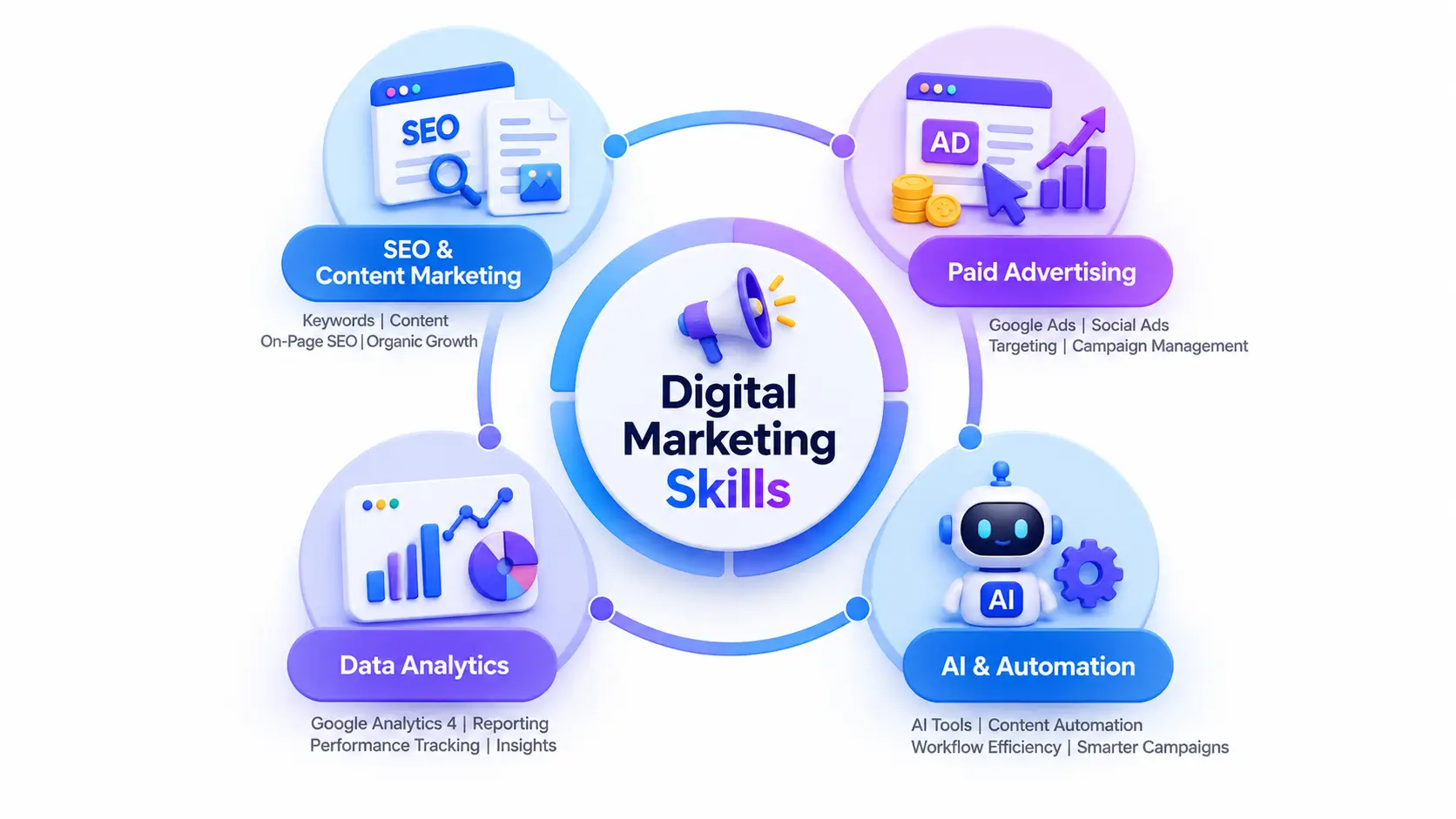
SEO and Content Marketing
Learn how to research keywords, structure a blog post, and understand basic on-page SEO. Content and search remain two of the highest-value skills in the field because nearly every business needs organic visibility.
Paid Advertising (PPC/Social Ads)
Get familiar with how Google Ads and Meta Ads campaigns are structured: targeting, bidding, ad copy, and budget management. Most platforms offer free training and even sandbox accounts to practice without spending real money.
Data Analytics and Reporting
Learn to navigate Google Analytics 4 and interpret basic reports: where traffic comes from, which pages convert, and where users drop off. Employers consistently value marketers who can turn numbers into decisions, not just describe them.
AI Tools and Automation Literacy
AI tools now draft ad copy, summarize analytics, and generate content outlines in seconds which means the bar for entry-level marketers has shifted. It’s no longer enough to know AI tools exist; you need to know how to use them well. Try this simple self-check: can you use an AI tool to draft a campaign brief, catch when its analytics interpretation is wrong, and refine its output into something strategically sound? If yes, you’re ahead of most beginners. If not, that’s exactly where to focus your practice.
Step 3 – Get Certified (Without Overdoing It)
Certifications prove baseline knowledge, but collecting them endlessly won’t get you hired on their own pair every certification with real practice.
Best Beginner Certifications (Google, HubSpot, Meta)
Start with Google’s Digital Marketing & E-commerce Certificate, the Google Analytics 4 certification, HubSpot’s Inbound Marketing course, and Meta’s Blueprint certification for social ads. These four cover the core channels employers ask about most.
Do Certifications Actually Get You Hired?
Certifications signal effort and baseline competence, but hiring managers care more about what you can show them working a campaign, a portfolio piece, a real result. Treat certifications as a supporting credential, not the centerpiece of your resume.
Step 4 – Choose a Specialization
Trying to be good at everything is the most common reason beginners stall out. Pick one area to go deep in once you’ve sampled the fundamentals.
How to Pick a Niche Based on Your Strengths
If you enjoy writing and research, SEO or content marketing is a natural fit. If you like numbers and testing, paid advertising or analytics suits you better. If you’re a natural communicator, social media or email marketing may be the better lane. Choose based on what energizes you day to day you’ll go further in a specialization you actually enjoy.
Popular 2026 Specializations
AI-assisted marketing, performance (paid) marketing, SEO and content strategy, and marketing analytics are among the fastest-growing specializations right now, as businesses look for people who can combine strategic thinking with technical, data-driven execution.
Step 5 – Build a Portfolio That Proves You Can Do the Work
Without work experience, your portfolio is your resume. This is where beginners either build real credibility or stay stuck applying to jobs with nothing to show.
Real Projects vs. Mock Projects
Real projects running a friend’s small business Instagram, starting your own niche blog, or managing an email list for a local nonprofit carry far more weight than hypothetical case studies. If real opportunities aren’t available yet, well-documented mock campaigns are a reasonable substitute.
Where to Showcase Your Work
Build a simple personal website or use LinkedIn’s featured section to display 3–5 projects with clear results: traffic growth, engagement numbers, or conversion improvements. Keep it organized and specific vague claims don’t build trust.
Step 6 – Land Your First Role or Client
With fundamentals, a specialization, and a portfolio in place, you’re ready to start applying or pitching.
Entry-Level Job Titles to Target
Look for roles like Marketing Assistant, SEO Specialist, Social Media Coordinator, Content Marketing Associate, or Digital Marketing Intern. These titles typically don’t require prior professional experience, only demonstrable skill.
Freelancing as an Alternative Starting Point
Freelancing lets you build experience and income simultaneously. Small businesses are often willing to take a chance on a motivated beginner at a lower rate, which gives you real case studies to use when pursuing full-time roles later.
How Long Does It Take to Become a Digital Marketer?
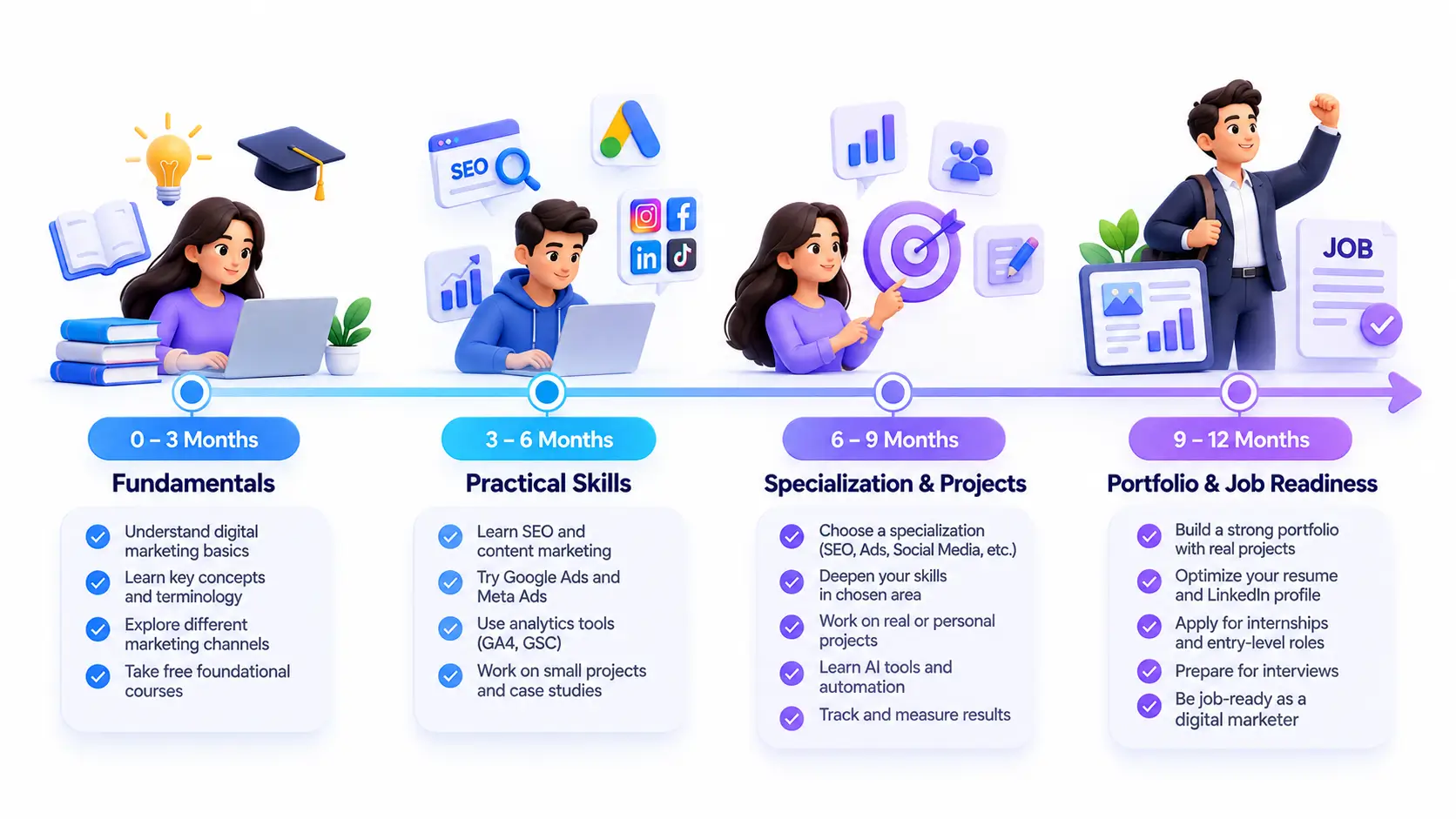
Most beginners can learn the fundamentals in 3–6 months with consistent, part-time study. Reaching a job-ready point with a chosen specialization and a working portfolio typically takes 6–12 months total. Moving faster is possible with full-time focus, but rushing the portfolio stage tends to backfire during interviews.
Common Mistakes Beginners Make
The most common mistake is chasing every certification and tool without ever applying the skills to a real project. A close second is trying to specialize too early, before sampling enough of the field to know what actually fits. Finally, many beginners treat AI tools as a shortcut rather than a skill to develop which shows up quickly in interviews and on the job.
FAQs
Is digital marketing a good career in 2026?
Yes, demand remains strong as businesses continue shifting budgets online. Growth is especially high in AI-assisted marketing, performance advertising, and content strategy roles, and the field offers flexible entry points for beginners without formal degrees.
Do I need a degree to become a digital marketer?
No. While some employers prefer a business or marketing degree, most digital marketing roles prioritize demonstrable skills, certifications, and a portfolio over formal education. Many successful marketers are self-taught or bootcamp-trained.
How long does it take to become a digital marketer?
Most beginners can learn foundational skills in 3–6 months of consistent study and practice. Becoming job-ready with a working portfolio typically takes 6–12 months, depending on time invested and chosen specialization.
What is the best digital marketing certification for beginners?
Google’s Digital Marketing & E-commerce Certificate, HubSpot’s Inbound Marketing course, and Google Analytics 4 certification are widely recognized starting points. They’re free or low-cost and respected by employers as proof of baseline knowledge.
How much can a digital marketer earn?
Entry-level digital marketers typically earn in the 45,000–60,000 range annually, with experienced specialists and managers earning well above $75,000, depending on location, specialization, and whether they work in-house, agency, or freelance.
Can I become a digital marketer with no experience?
Yes. Building a personal blog, running mock campaigns, volunteering for a small business’s social media, or freelancing on small projects are all ways to gain real experience before your first formal role.
Final Thoughts
Becoming a digital marketer in 2026 doesn’t require a degree, a huge budget, or years of waiting it requires a clear path and consistent action. Start with the fundamentals, build one real skill at a time, choose a specialization that fits you, and let your portfolio do the talking. The businesses hiring right now aren’t looking for perfection they’re looking for someone who can learn fast and show results.