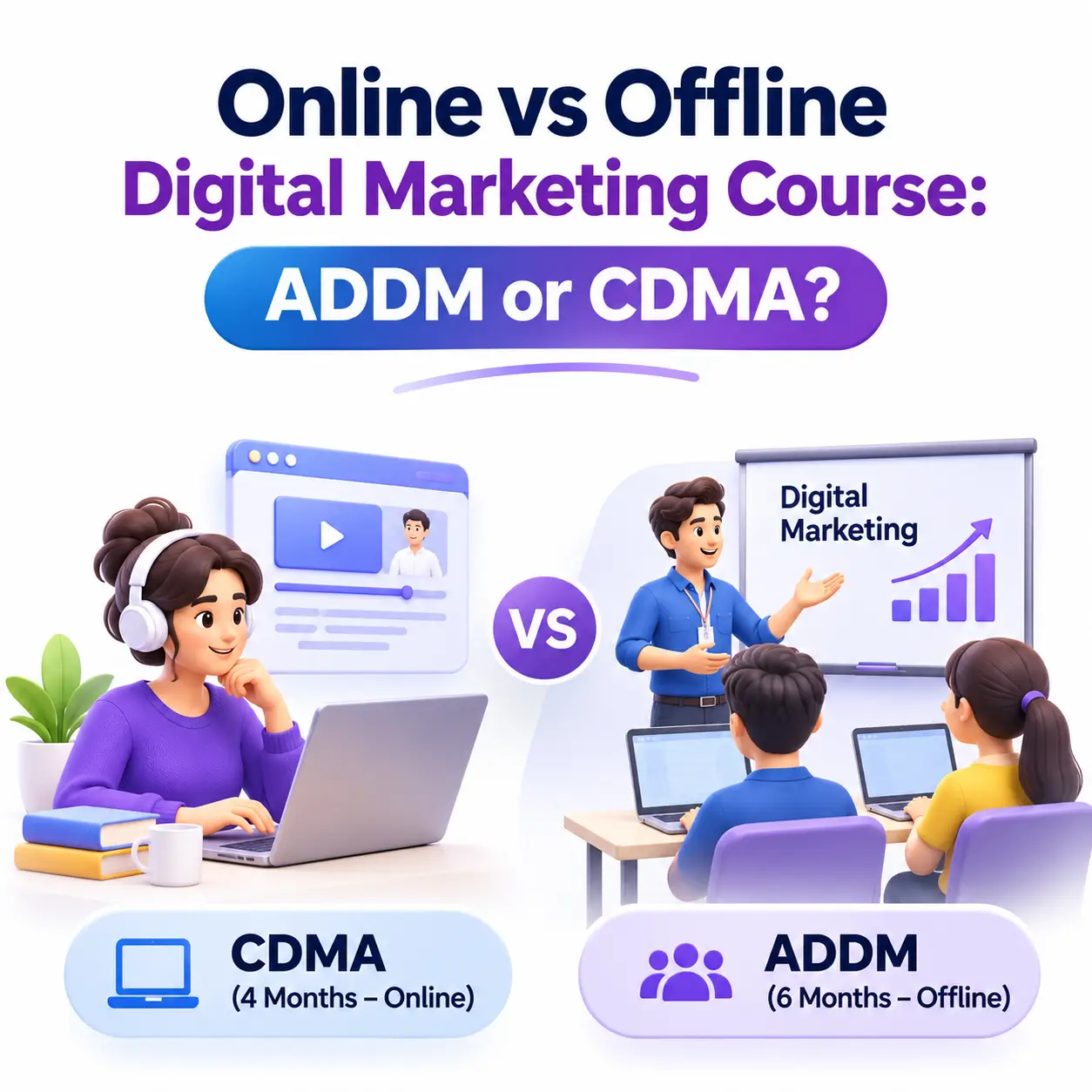
Choosing an online vs offline digital marketing course comes down to how you learn, how much time you can commit, and what you want to be able to do at the end. This guide compares two courses with different formats: the Certified Digital Marketing Associate (CDMA), a four-month online program, and the Advanced Diploma in Digital Marketing (ADDM), a six-month classroom program. It explains where they differ and how to decide.
Which Course Fits You? The Short Answer
Choose CDMA if you want a shorter, focused program that you can attend online, built around search, paid advertising, LinkedIn and analytics. Choose ADDM if you prefer in-person classes and want a wider scope that also covers email marketing, WordPress website building and e-commerce.
In an online vs offline digital marketing course decision, neither format is better in every case. The right one depends on your schedule, your learning style and the skills you need first. The sections below explain each point so you can decide with facts instead of assumptions.
CDMA vs ADDM: What Each Course Offers
CDMA: The Four-Month Online Program
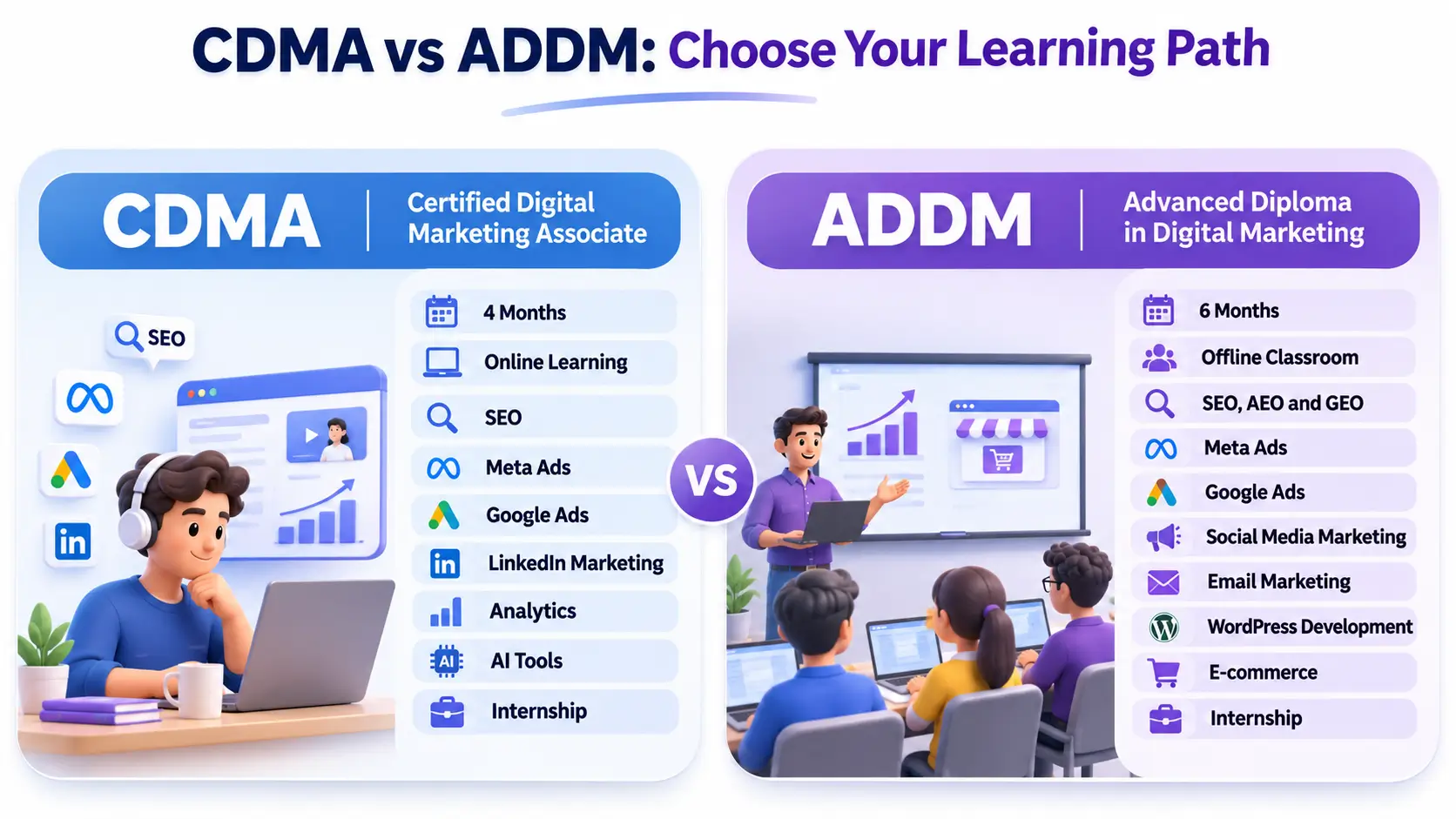
The Certified Digital Marketing Associate is an online course for beginners, students, career changers and working professionals. It covers SEO, Meta advertising, Google Ads, LinkedIn marketing and analytics, with AI tools used for research, content and automation. An internship component lets learners practise on live work while they study. A full breakdown is available in our guide to the 4-month online digital marketing course.
ADDM: The Six-Month Offline Program
The Advanced Diploma in Digital Marketing runs for six months in classroom batches. Its course page states that it is currently offered offline only, so confirm batch details before you plan around it. The syllabus covers SEO (including AEO and GEO, which focus on appearing in answer engines and AI-generated responses), Meta and Google Ads, social media, email marketing, WordPress website development and e-commerce. You can read the module-by-module detail in our guide to the 6-month advanced diploma in digital marketing.
Online vs Offline Digital Marketing Course: How Do the Formats Compare?
Both formats can produce skilled marketers. What changes is the way you study, who you learn with, and how much structure surrounds you.
Flexibility and Schedule
An online course removes travel and fits more easily around a job, a college timetable or a business. That is the main strength of CDMA for working professionals and for learners who live far from a campus. Offline learning asks you to be present at set times, which suits people who want a fixed routine and fewer distractions at home.
Practice and Feedback
In any online vs offline digital marketing course, the format matters less than the amount of practice it includes. In a classroom, a trainer can see your screen, correct a campaign setup immediately and answer questions as they arise. Online sessions can offer live classes and mentor feedback too, but they depend on a stable connection and on your willingness to ask questions. Check how each course handles assignments, reviews and internship work.
Peer Learning and Environment
Classroom batches give you peers to discuss campaigns with, compare results and build contacts in the local industry. Online learners can find similar value through group projects and live discussion, though starting those conversations takes more effort. Independent learners often do well online, while those who draw energy from a group often prefer a classroom.
How Do the Syllabi Differ?
CDMA concentrates on the channels most beginners need first: search, paid social, Google Ads, LinkedIn and analytics. Analytics work involves tools such as Google Search Console, which shows how a website performs in Google Search, and GA4 (Google Analytics 4), which reports how visitors behave on a site.
ADDM adds range. Beyond the core channels, it includes email marketing, WordPress website development and e-commerce setup, along with special sessions on branding and freelancing. Learners finish with a broader set of outputs, such as a live website and a store setup, alongside campaign work.
Paid advertising is the shared ground. Both courses teach Google Ads and Meta Ads, where results are judged with metrics such as click-through rate, cost per click and return on ad spend.
What Do Both Courses Have in Common?

The format is not the only thing to compare, because the two courses share several features. Both build AI tools into the learning process, from research and content drafting to automation. Both include an internship, so learners practise on live work instead of waiting until the end. Both teach Google Ads and Meta Ads, and both cover LinkedIn marketing.
These shared features mean you are not choosing between a practical course and a theoretical one. You are choosing between a shorter, focused path and a longer, broader one, and between two ways of attending class. Tool lineups change over time, so ask for the current list of tools and certifications for the batch you plan to join.
Which Format Suits Your Goal?
When making an online vs offline digital marketing course choice, match the course to the outcome you want:
- Working professional: CDMA’s online format and shorter duration are easier to balance with a full-time job.
- Student or recent graduate: Either works. ADDM gives more breadth and a classroom routine, while CDMA reaches the fundamentals faster.
- Entrepreneur or small business owner: ADDM’s website and e-commerce modules help if you need to build an online presence. CDMA suits those who mainly need ads and SEO.
- Freelancer: ADDM includes sessions on freelancing and client handling. CDMA suits those who want to start offering a few services quickly.
- Career changer: Decide by available time. Four months is a lighter commitment, and six months allows broader practice.
Anyone comparing online vs offline digital marketing courses in Trivandrum should also think about travel time. A daily classroom schedule works well for people who live nearby, while online learning suits those who live outside the city or work during the day.
Common Mistakes When Choosing Digital Marketing Course
Watch for these:
- Choosing online because it seems easier, then not setting aside fixed weekly hours for practice.
- Choosing offline without checking the daily commute, which can wear down attendance over several months.
- Comparing only duration, when the syllabus, internship and feedback matter just as much.
- Assuming a longer course is automatically better, or that a shorter one is automatically faster to a job.
- Skipping the questions about fees, batch timing and eligibility until after you have decided.
A better approach is to write down your goal, your weekly free hours and your preferred way of learning. Then compare the two courses against that list. If one course fits all three, the decision is usually clear.
Questions to Ask Before You Enrol
Dotin Digital Academy lists both courses on its website, and its admissions team can confirm current details. Whichever academy you consider, ask these questions:
- What is the current fee, and what does it include?
- Which batch dates and timings are available?
- How is the internship organised, and what work do learners do?
- What will I have built by the end that I can show an employer?
- How do trainers give feedback on assignments?
- Which certifications are included, and what do they cover?
Fees vary by course, format and batch, so a direct quote is more reliable than any figure found online. Treat placement figures as the academy’s own claims and ask how they are measured. No course can guarantee a job. Your portfolio, interview performance and consistent practice decide the outcome.
Frequently Asked Questions
Does an online vs offline digital marketing course change the quality of learning?
Less than most people expect. Either format can work if it includes live sessions, practical assignments and feedback. Quality depends on the practice you do and your own consistency more than on where the classroom is.
Can I start with CDMA and move to ADDM later?
Many learners build skills in stages, but the academy decides whether any credit or fee adjustment applies. Ask the admissions team before enrolling if you plan this path.
Do I need a technical or marketing background?
No. Both courses start from the fundamentals. The WordPress module in ADDM uses Elementor for page design, so coding is not a stated requirement. Confirm eligibility with the admissions team.
Which course is better for freelancing?
Either can support it. CDMA prepares you to offer services such as SEO or ad management sooner, while ADDM adds website building, e-commerce and freelancing sessions. Your portfolio matters more than the course name.
Does either course guarantee a job?
No. Placement assistance can help with interview preparation and introductions, but employers hire based on skills, projects and interviews. Outcomes also depend on effort and the job market.
Is four months enough to learn digital marketing?
It is enough to build entry-level foundations when the course is practice-heavy. Mastery comes from continued work on real campaigns after the course ends.
Conclusion
The online vs offline digital marketing course question has no universal answer. Choose CDMA when flexibility, speed and a focus on core channels matter most. Choose ADDM when in-person training and a wider syllabus, including websites and e-commerce, suit your goals. Both include AI tools and an internship, so the real differences are format, duration and breadth. Dotin Digital Academy’s admissions team can confirm current batches and details for each course.
Still unsure which course matches your schedule and goals? Speak with the admissions team through the contact page and get your questions answered before you decide.