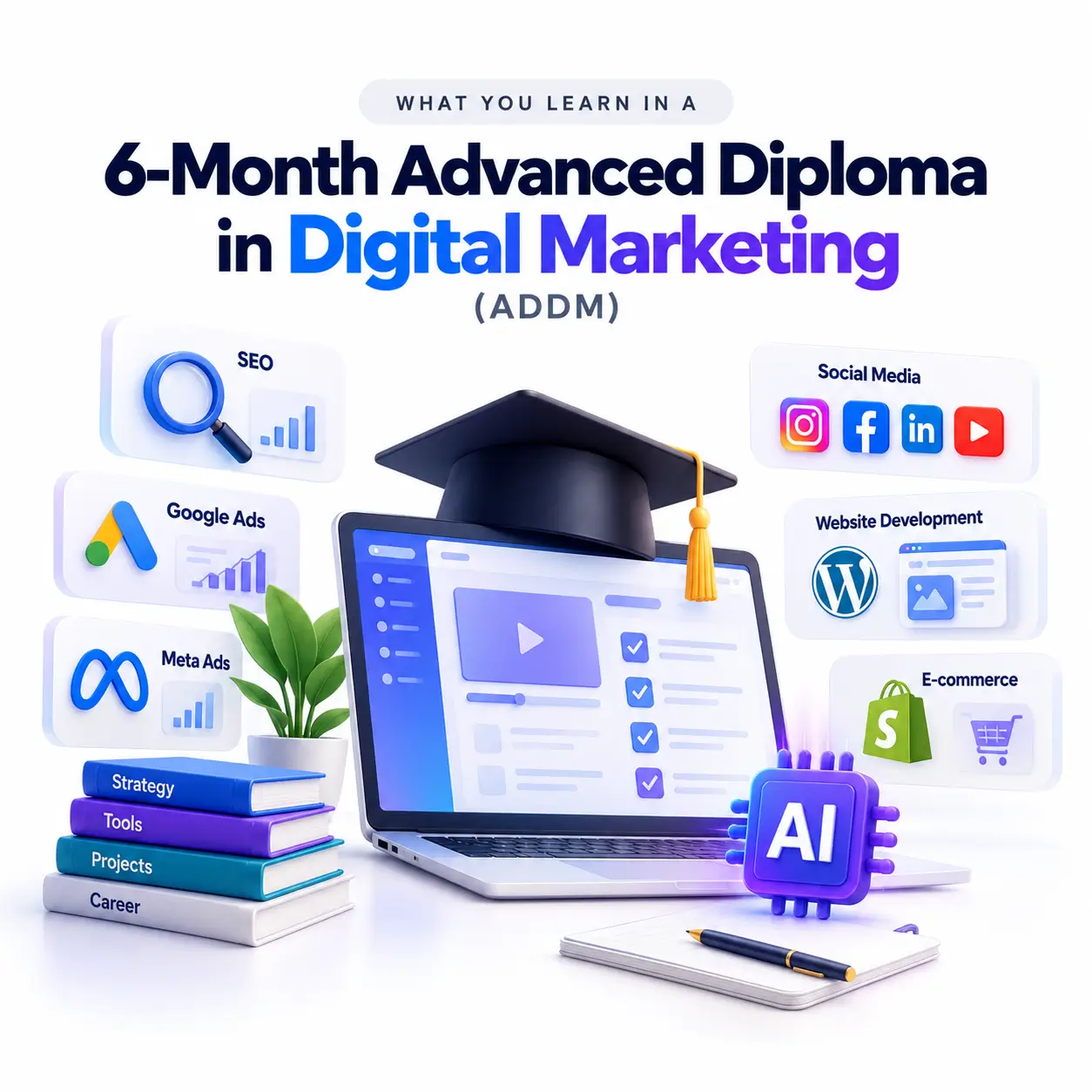
Ask ten beginners what digital marketing actually teaches, and you will get ten vague answers. Course pages list buzzwords, but they rarely show what you can do when classes end. This guide fixes that.
An advanced diploma in digital marketing is a structured, job-focused program that takes you from marketing basics to running live campaigns. Dotin Digital Academy’s ADDM is a six-month, internship-integrated and AI-integrated course, delivered offline in Thrissur, Calicut, Trivandrum and Kochi. Below you’ll find every module, the tools involved, and what you should have built by the end.
Key takeaways
- ADDM covers SEO, Meta Ads, Google Ads, social media, email, WordPress and e-commerce in one six-month program.
- AI is built into the modules, including AI-driven keyword research and AI-era search optimization (AEO, VEO and GEO).
- Each module ends with a tangible output, such as an SEO audit, a campaign presentation or a live website.
- Batches are offline only, and Dotin’s placement figures are the academy’s own claims, so verify them.
What Is an Advanced Diploma in Digital Marketing?
An advanced diploma in digital marketing is a practical, multi-skill program that goes past introductory theory into SEO, paid ads, websites and e-commerce. It aims to make you job-ready, not just informed.
What is an advanced diploma in digital marketing?
Think of it as a full toolkit rather than a single skill. Instead of learning only social media or only SEO, you learn how the channels connect. Traffic from search, ads and social feeds lands on a website, gets tracked, and turns into leads or sales. An advanced program teaches that whole chain and makes you practise it on real projects.
Who is it for?
Dotin built an advanced diploma in digital marketing for students, creators, career-switchers and entrepreneurs. It starts from foundations, and no coding prerequisite. Entrepreneurs can use it to run their own marketing, and creators can use it to grow an audience. Confirm eligibility with the admissions team, and review the formal requirements.
The ADDM Syllabus, Module by Module
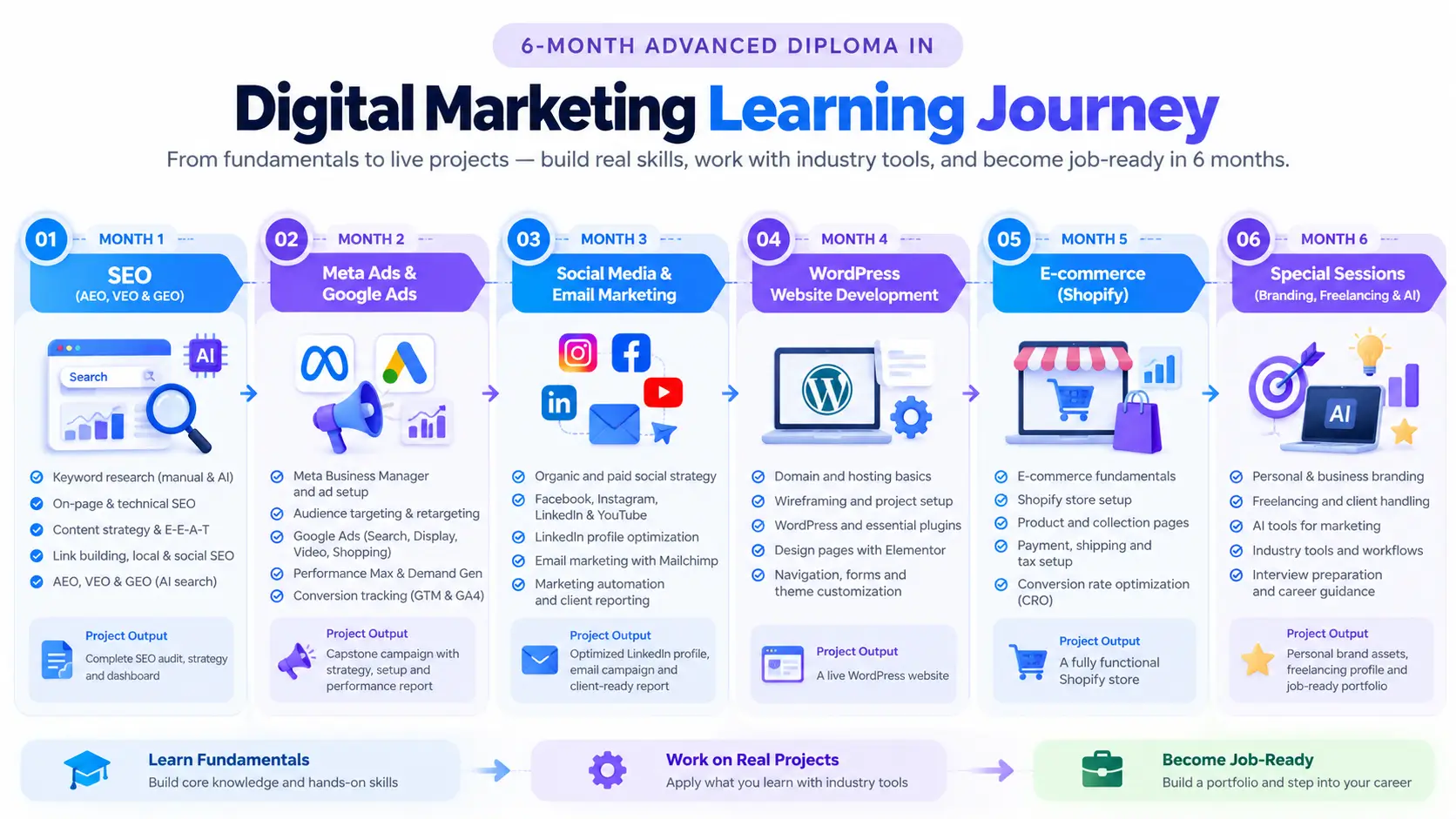
The advanced diploma in digital marketing syllabus has six blocks: SEO, paid advertising, social and email, WordPress, e-commerce and special sessions. Each one is tied to a project, so you leave with proof of skill instead of just notes.
Search Engine Optimization, Including AEO, VEO and GEO
SEO is the craft of earning free visibility on search engines. You begin with foundations, then learn keyword research both manually and with AI. Content structuring follows, along with E-E-A-T, Google’s quality framework of Experience, Expertise, Authoritativeness and Trustworthiness. Technical topics include on-page SEO, schema markup, SERP features and Core Web Vitals (Google’s page-speed and stability measures). Off-page work covers link building, plus local and social SEO. The AI portion covers tools, risks and blog calendars. It also introduces AEO, VEO and GEO, which are about being found in answer engines and AI-generated responses.
You’ll walk away with: a complete SEO audit, strategy and dashboard.
Paid Advertising: Meta Ads and Google Ads
Paid advertising means buying reach and measuring the return. On Meta, you set up Business Manager and ad accounts, then choose objectives such as awareness, traffic, engagement, leads, sales or app promotion. You learn audience segments and website retargeting using the pixel and events, which show ads to people who already visited your site. You then analyse results using CTR (click-through rate), CPC (cost per click) and ROAS (return on ad spend).
Google Ads training covers the auction, bidding and Ad Rank, plus keyword match types and campaign structures. You build Search, Display, Video and Shopping campaigns, then move to Performance Max and Demand Gen. Google Merchant Centre, copywriting, and conversion tracking through Google Tag Manager and GA4 complete the picture.
You’ll walk away with: a capstone campaign with strategy, setup and presentation, plus a client-style performance report.
Social Media, LinkedIn and Email Marketing
You learn organic and paid social fundamentals and set up presences on Facebook, Instagram, LinkedIn and YouTube. The LinkedIn module covers profile optimization, content frameworks and engagement strategy. Email marketing teaches list management, segmentation, campaign design and analysis, using tools like Mailchimp. Marketing automation tools and client reporting tie these channels together.
You’ll walk away with: an optimized LinkedIn profile, an email campaign and a client-ready report.
WordPress Website Development
Every marketer needs a website they control. You start with domain and hosting basics, then wireframing and project setup. From there you install WordPress and plugins, design pages in Elementor, and build navigation, forms and theme customizations. No coding is required for this approach.
You’ll walk away with: a live WordPress website.
E-commerce and Shopify
You compare B2B, B2C and D2C (direct-to-consumer) models. You explore WhatsApp and Instagram commerce tools, then set up a store on Store.link or Shopify. Product and collection optimization comes next, along with CRO (conversion rate optimization, meaning turning more visitors into buyers) and AOV (average order value).
You’ll walk away with: a working online store setup.
Special Sessions
Dedicated sessions cover branding and identity, personal branding, freelancing and client handling, AI tools in marketing, Beyond Meta, HTML SEO, marketing foundations, Canva and organic content creation. These add the softer skills that decide whether you land clients or jobs.
You’ll walk away with: a personal brand kit and freelancing know-how.
|
Module |
What you learn |
What you’ll have built |
| SEO (incl. AEO/VEO/GEO) | Keyword research, on-page, technical, off-page, local, AI in SEO | SEO audit, strategy and dashboard |
| Meta Ads and Google Ads | Objectives, retargeting, Search/Display/Video/Shopping, Performance Max, GTM and GA4 | Capstone campaign and performance report |
| Social, LinkedIn, Email | Platform setup, content frameworks, segmentation, automation | LinkedIn profile, email campaign |
| WordPress | Hosting, Elementor, forms, plugins | Live website |
| E-commerce | D2C models, Shopify, CRO, AOV | Working store setup |
| Special sessions | Branding, freelancing, Canva, content creation | Personal brand kit |
How AI and Industry Tools Are Built In
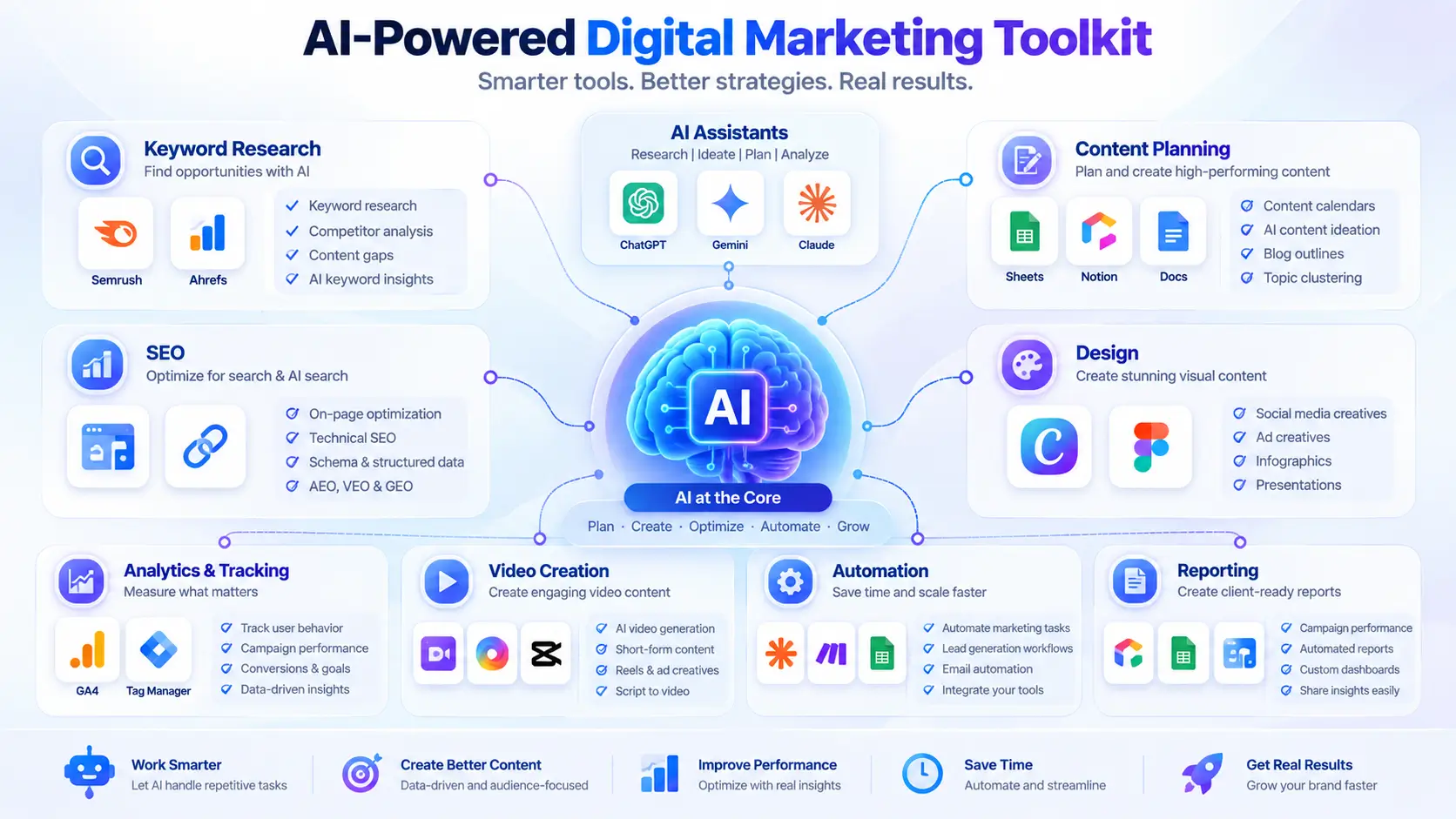
AI is woven through the ADDM modules rather than added as a single lecture. That matches where the job market is heading. The World Economic Forum’s Future of Jobs Report 2025 lists AI and big data as the fastest-growing skills, followed by networks and cybersecurity and technology literacy, and two-thirds of surveyed employers plan to hire talent with specific AI skills. The same report also expects marketing and media skills to grow, driven by technological advances. (WEF, 2025) The Future of Jobs Report 2025 +2
AI in SEO and Content Workflows
In the SEO module, AI supports keyword research, content planning and blog calendars. Just as important, the syllabus covers AI’s risks. AI drafts can be generic, inaccurate or off-brand, and search engines reward genuine expertise. Learning where to trust AI and where to edit it is a skill in itself.
The Tool Stack You’ll Use
Around 30 marketing tools and around 17 AI tools. The marketing side spans analytics and tag management (GA4, Tag Manager), SEO platforms (Ahrefs, Semrush, Moz, Ubersuggest), website tools (WordPress, Elementor, Shopify), design (Canva) and email and CRM (Mailchimp, HubSpot). The AI side includes ChatGPT, Gemini, Claude, HeyGen, Gamma, Ideogram and invideo. Tool lineups change, so confirm the current list with Dotin.
Internship, Mentors and Real Projects
The internship is what turns classroom learning into experience. Because it runs inside the six months, you practise on live work while the concepts are fresh.
Is 6 Months Enough for a Beginner?
Six months is enough to build job-ready foundations, but not mastery. A focused program with a live internship can get you to entry-level competence, particularly if you put in practice hours outside class. Platforms and algorithms keep changing, so expect to keep learning after graduation. Results depend on effort, the local job market and how well you present your portfolio.
What You’ll Have Built by the End
By the final month, a diligent learner should hold a portfolio of real outputs: an SEO audit and dashboard, a Google Ads capstone, a Meta Ads performance report, a live WordPress site and a Shopify store setup. Guest mentors add industry perspective, including Akshin Nair (freelance performance marketing consultant), Favour Francis (Founder, OBW India), Shan A Salam (Founder, The eCom Show) and Shebin P T (Performance Marketing Manager, WPPMedia).
Certifications and Career Paths
ADDM pairs training with recognizable credentials and maps to several entry-level roles. Certification adds credibility, but employers still look hardest at what you can show.
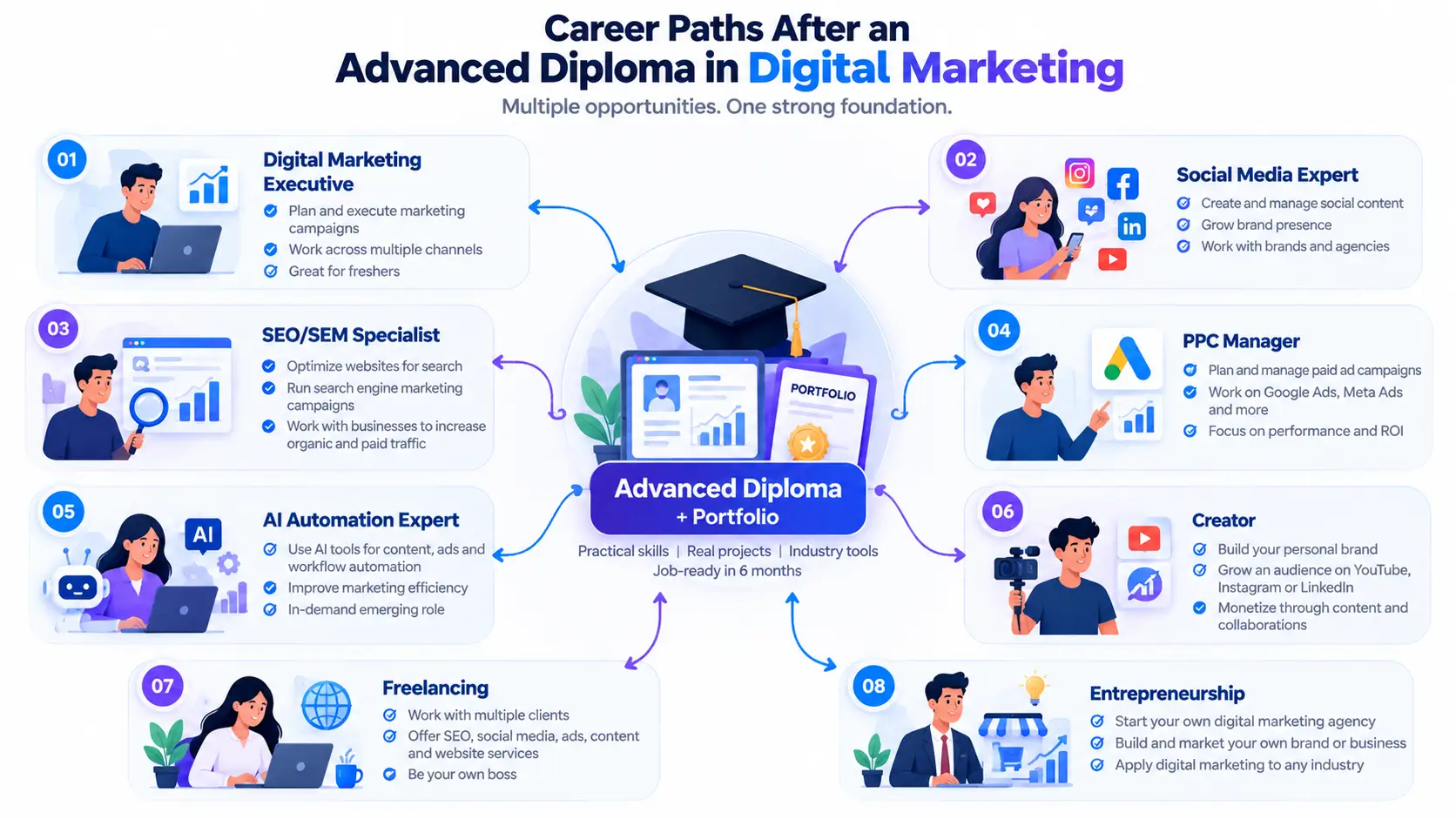
Jobs After ADDM
Digital Marketing Executive, Social Media Expert, SEO/SEM Specialist, PPC Manager, AI Automation Expert and Creator. Freelancing and starting your own venture are also options, and Dotin highlights several student-founded startups. Whichever path you choose, your portfolio decides how quickly you get interviews.
How to Read Placement Claims
Dotin reports a 95% placement rate and offers placement assistance. Treat these as the academy’s own claims. Before enrolling in any institute, ask how it defines “placed,” how many batches the figure covers, typical roles and pay ranges, and whether you can speak to recent graduates.
Is ADDM Right for You?
ADDM suits people who want hands-on, in-person, agency-style training and can commit six months. It suits others less well.
Who Benefits Most and Who Might Prefer Another Path
Beginners who learn best by doing, career-switchers, and would-be freelancers stand to gain the most. If you need online-only learning, want a multi-year academic degree, or only need one narrow skill like ad management, another route may fit better.
Frequently Asked Questions
1. What is an advanced diploma in digital marketing?
It is a structured, job-oriented program that goes beyond basics to cover SEO, paid advertising, social media, email, website building and e-commerce. At Dotin Digital Academy, ADDM runs six months and combines classroom learning with an integrated internship and hands-on campaign work.
2. What subjects are covered in ADDM?
Core modules include SEO, Meta Ads, Google Ads, LinkedIn organic marketing, email marketing, WordPress development and e-commerce. Special sessions add branding, freelancing, Canva, organic content creation and AI tools in marketing. AI also appears inside modules, such as AI-driven keyword research in SEO.
3. Is 6 months enough for a beginner to get a job?
Six months can build job-ready foundations when training is hands-on. ADDM pairs modules with an integrated internship, so beginners practise on live campaigns instead of only theory. Mastery still takes ongoing practice, but a portfolio of real projects gives entry-level candidates a credible starting point.
4. Do I need a technical background to join?
Dotin positions advanced diploma in digital marketing for students, career-switchers, creators and entrepreneurs, so it starts from foundations. Coding isn’t a stated prerequisite, and the WordPress module uses Elementor for page design. Confirm eligibility criteria with the admissions team before enrolling.
5. Is the course online or offline?
ADDM is currently offered in offline batches only, at campuses in Thrissur, Calicut, Trivandrum, and Kochi. Learners attend in person, which supports the hands-on, internship-integrated format. Check with the academy for current batch dates.
6. What jobs can I get after ADDM?
Graduates target roles such as Digital Marketing Executive, Social Media Expert, SEO/SEM Specialist, PPC Manager, AI Automation Expert and Creator, plus freelancing. Dotin reports a 95% placement rate and offers placement assistance. Outcomes depend on individual effort and market conditions.
Conclusion: Is the Advanced Diploma in Digital Marketing Worth It?
An advanced diploma in digital marketing like ADDM teaches the full chain from search and ads to websites, stores and AI tools, and it measures progress by what you build. It is not a guarantee, but it is a structured route to a portfolio. To confirm current batches, fees and eligibility, visit www.tvm.dotinacademy.com or contact your nearest Dotin Academy campus.