Email marketing is the practice of sending messages to people who have chosen to hear from you, with the goal of building relationships and encouraging action, such as a purchase, a signup, or a reply. If you’ve ever received a welcome message after joining a website, or a “your order has shipped” note, you’ve been on the receiving end of it.
Despite the rise of social media, email remains a marketer favorite. Litmus data puts the average return at $36 for every $1 spent, the highest of any digital channel. This guide explains how it works and how to start.
What Is Email Marketing?
Email marketing is a form of digital marketing in which a business or creator sends emails to a list of subscribers. Those emails might share news, teach something useful, promote a product, or confirm a purchase. Unlike an ad that interrupts someone, a marketing email lands in an inbox the person chose to share with you.
Think of it as an invited conversation. The formats differ, but the principle is the same: useful messages, sent to people who asked for them.
Why “Permission” Is the Core Idea
Permission separates email marketing from spam. A subscriber has opted in, usually by filling out a form or ticking a box. That consent makes the channel trustworthy, and in many countries it’s also what the law requires.
How Does Email Marketing Work?
The Five-Step Cycle
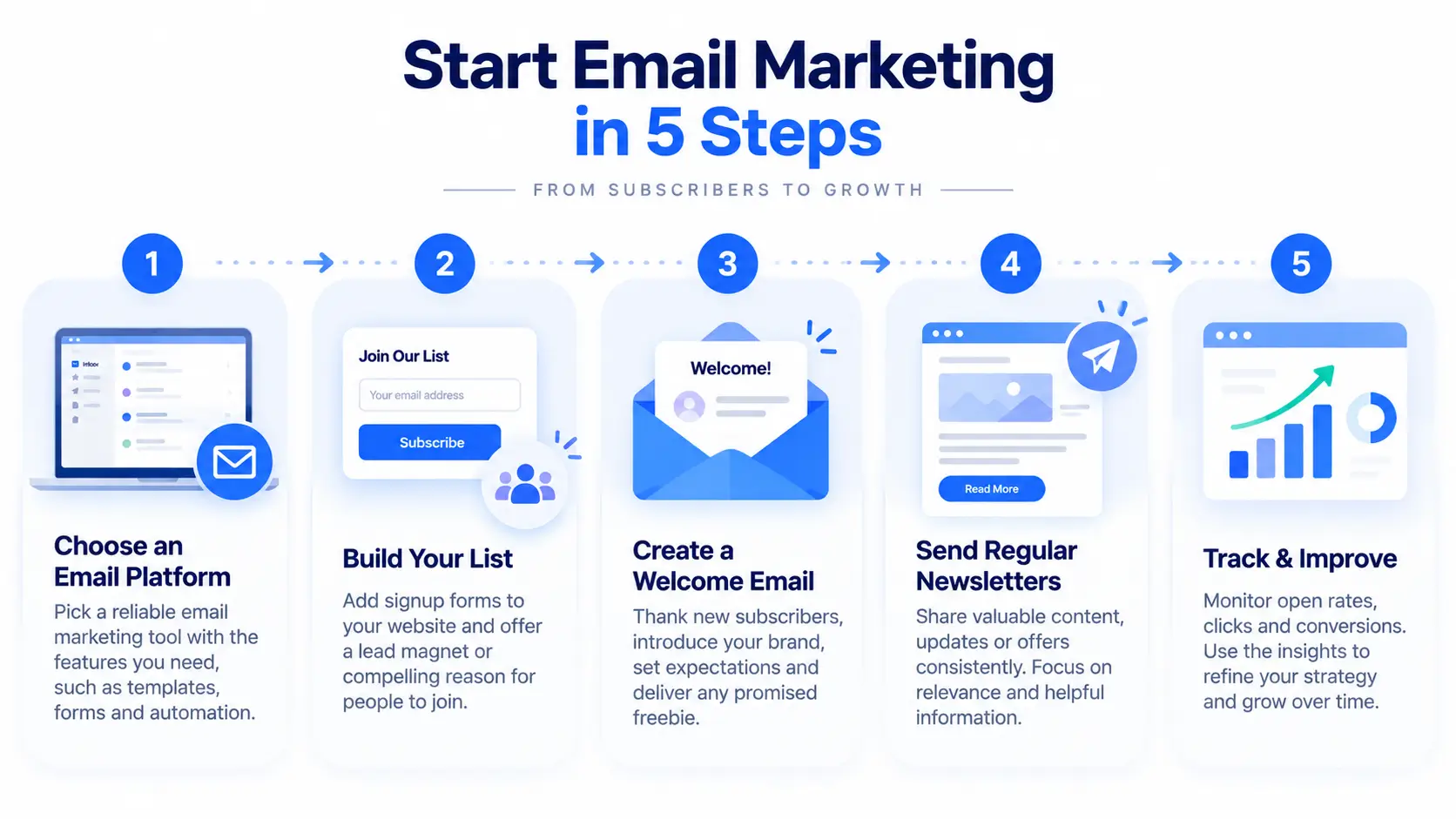
Most email marketing follows the same loop:
- Collect. Visitors join your list through a signup form on your website or a checkout page.
- Store. Their addresses are saved in an email marketing platform.
- Segment. You group subscribers by interest or behavior, so messages feel relevant.
- Send. You send one-off campaigns, like a monthly newsletter, or automated messages triggered by an action.
- Measure. You track who opened, clicked, or bought, then use those results to improve the next email.
The loop repeats, and each pass teaches you more about what your audience wants.
What Is an Email Service Provider?
An email service provider (ESP) is the software that does the heavy lifting. It stores your list, helps you design and send emails, handles unsubscribes automatically, and reports results. Popular examples include Mailchimp, Brevo, and Kit, and many offer free plans for small lists.
Can you just use your regular inbox? For anything beyond a handful of contacts, no. Personal inboxes cap how many emails you can send, can’t manage unsubscribes properly, and make it far more likely your messages get flagged as spam.
Types of Marketing Emails
You don’t need every format. Here are the five you’ll meet most often.
- Newsletters: Regular emails (weekly, fortnightly, or monthly) sharing updates, tips, or stories. Example: a fitness coach sends a Friday email with a recipe and a workout.
- Promotional emails: These drive a specific action, such as buying during a sale. Example: a store announces a 48-hour discount on winter jackets. Use them sparingly, or subscribers will tune out.
- Welcome emails: Sent right after signup, they introduce you and set expectations. They’re often among your most-read messages because interest is at its peak.
- Transactional emails: Triggered by a customer’s action, such as order confirmations, password resets, and shipping updates. People expect and open them.
- Automated emails: Also called drip campaigns or flows, these send themselves when a condition is met, like an abandoned-cart reminder or a re-engagement message. They take time to set up but then work around the clock.
Benefits of Email Marketing
- You own your audience. Social platforms can change their algorithms overnight, shrinking your reach. Your email list is yours to keep.
- It’s cost-effective. Sending an email costs little compared with most advertising.
- It’s targeted. You can tailor content to subscribers’ interests.
- It’s measurable. You can see exactly who opened, clicked, and converted.
Is Email Marketing Still Effective in 2026?
Yes, and the evidence is strong. But here’s the nuance most guides skip: the $36 average is real, but your result probably won’t be $36.
An average hides a wide spread. In the Litmus State of Email 2025 report, 35% of marketing leaders earned 10–36 per $1 spent, 30% earned 36–50, and 21% didn’t measure email ROI at all. Results depend on list quality, relevance, and execution.
Calculate your own return with this simple formula:
ROI = (money earned − money spent) ÷ money spent × 100
If you spend $100 on tools and time and earn $1,000 in sales from email, your ROI is 900%.
How Does It Compare to Social Media?
Social media is excellent for discovery, because strangers can find you. Email is better for relationships, because you reach people who already said yes, without an algorithm deciding who sees you. The smartest approach uses social to attract people and email to keep them.
Email Marketing vs. Spam: The Rules You Must Know
What Is the Difference Between Email Marketing and Spam?
Spam is unsolicited email sent without permission. Email marketing is permission-based: people opt in, you’re honest about who you are, and they can leave whenever they like. Following these norms also protects your sender reputation, which affects whether your emails reach the inbox.
How to Start Email Marketing: A Beginner’s Checklist
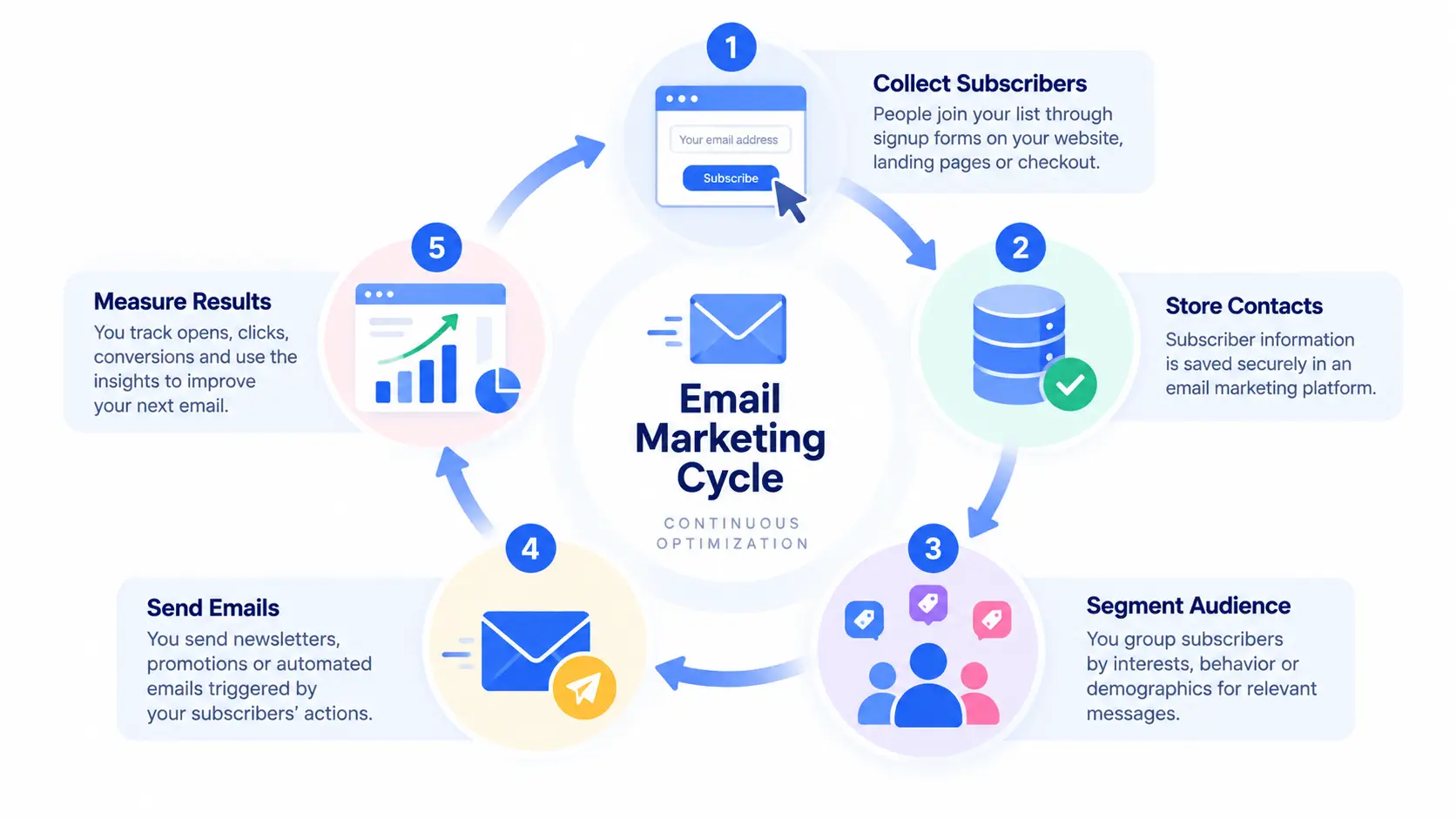
Choose an Email Service Provider
Pick a platform with a free or low-cost plan, a drag-and-drop editor, signup forms, and basic automation.
Build Your List
Add a signup form to your website and give people a reason to join. This incentive is called a lead magnet: a checklist, a short guide, a discount code, or simply a promise of valuable weekly tips. Collect only what you need; an email address and first name are plenty.
Send Your First Welcome Email and Newsletter
Create a welcome email that thanks new subscribers, says what to expect and how often, and delivers any promised freebie. Then commit to a realistic newsletter schedule. Consistency matters more than frequency, so a reliable fortnightly email beats a burst of daily messages followed by silence.
How Much Does Email Marketing Cost?
You can start for free. Many platforms offer free plans for small lists, and paid plans typically scale with subscribers and features. Your biggest early investment is time.
Email Marketing Metrics to Track
- Open rate: the share of recipients who opened your email. Treat it as a rough signal, since privacy features in some email apps can inflate it.
- Click-through rate (CTR): the share who clicked a link, usually a better measure of real interest.
- Unsubscribe rate: how many people opt out per send. A sudden spike suggests a mismatch between your content and expectations.
- Conversion rate: the share who completed your goal, such as buying or registering.
Common Beginner Mistakes
- Buying email lists. Purchased contacts haven’t given consent, which risks legal trouble and spam complaints.
- Sending the same message to everyone. Even basic segmentation improves relevance.
- Ignoring mobile. Many people read email on their phones, so keep layouts simple.
- Hiding the unsubscribe link. It frustrates readers and breaks the rules.
Frequently Asked Questions
What is email marketing in simple terms?
Email marketing is the practice of sending commercial or informational messages to people who have agreed to receive them, in order to build relationships and drive action. Businesses use it to share offers, news, and helpful content, turning subscribers into customers and customers into repeat buyers, all through the inbox.
How does email marketing work?
A business collects email addresses with permission, usually through a signup form, then stores them in an email service provider. It sends campaigns or automated messages to segments of that list, and tracks opens, clicks, and conversions. Results guide improvements to future emails, subject lines, timing, and content.
Is email marketing still effective in 2026?
Yes. Email remains one of the highest-returning digital channels, with industry surveys commonly citing an average of about $36 earned per $1 spent (Litmus). Unlike social media, you own your list and don’t depend on an algorithm. Results vary widely by industry, list quality, and execution, so treat averages as benchmarks, not guarantees.
What are the main types of marketing emails?
The most common types are newsletters, promotional emails, welcome emails, transactional emails (receipts, shipping updates), and automated lifecycle emails such as abandoned-cart reminders and re-engagement messages. Beginners usually start with a welcome email and a regular newsletter, then add automation as their list grows.
Is email marketing the same as spam?
No. Spam is unsolicited mail; email marketing is permission-based. Laws such as CAN-SPAM (US), GDPR (EU/UK), and CASL (Canada) require honest sender details, a clear unsubscribe option, and, in many regions, prior consent. Following these rules protects your sender reputation and keeps your emails out of the spam folder.
How do I start email marketing as a beginner?
Choose an email service provider, add a signup form to your website, and offer a small incentive such as a guide or discount. Send a welcome email, then a consistent newsletter. Track open rate, click rate, and unsubscribes, and refine from there. Start simple; you can add segmentation and automation later.
Conclusion
Email marketing is just one part of a successful digital marketing strategy. If you want to learn SEO, Social Media Marketing, Google Ads, Content Marketing, Email Marketing, Analytics, and Performance Marketing through practical, industry-focused training, it’s time to build your skills with the right guidance. Join Dotin Digital Academy’s Digital Marketing Course in Trivandrum and gain the practical knowledge you need to plan, execute, measure, and optimize real-world digital marketing campaigns.



Pingback: Shopify Marketing For Beginners: A Step-by-Step Guide 2026