What Is Answer Engine Optimization (AEO)?
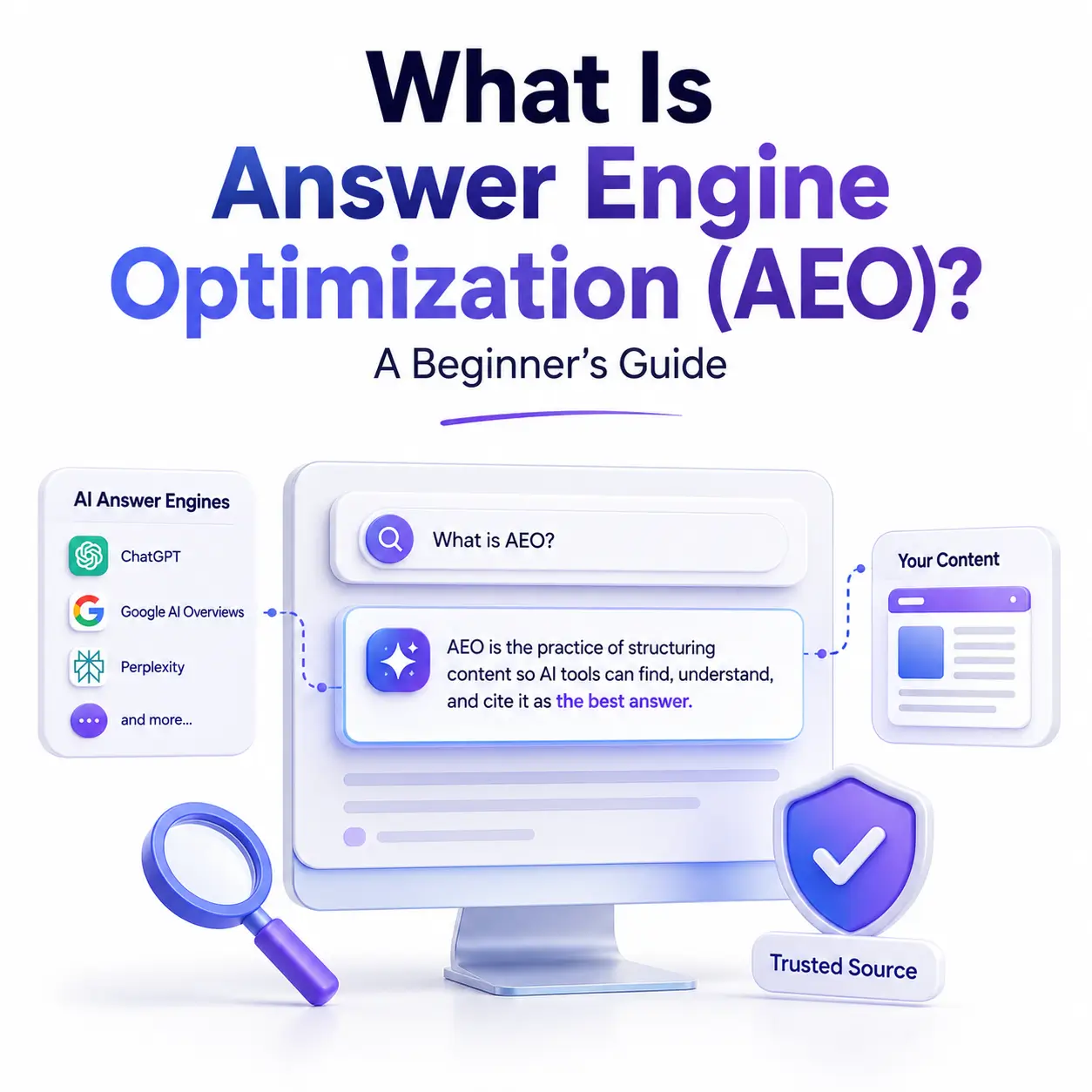
Answer Engine Optimization (AEO) is the practice of structuring content so AI-powered tools like ChatGPT, Perplexity, and Google AI Overviews can easily find, understand, and cite it as a direct answer to a user’s question, instead of just listing it as a link to click.
In other words, AEO shifts the goal from “get people to click on my page” to “become the source an AI system trusts enough to quote.” For decades, ranking on page one of Google was the finish line. Now, a growing share of searches never produce a list of links at all they produce one synthesized answer, pulled together from multiple sources. AEO is how you make sure your content is one of those sources.
If you’re new to SEO in general, think of AEO as a specialized layer built on top of it: the fundamentals of good content, clear structure, and topical authority still matter, but AEO adds new requirements around how easily a machine can extract and trust what you’ve written.
Why Answer Engine Optimization Matters Now
AEO isn’t a theoretical concept for the future it reflects a shift in search behavior that’s already well underway. Two changes are driving this.
The Rise of AI Overviews, ChatGPT, and Perplexity
Search no longer happens only on a search engine results page. People now ask questions directly inside ChatGPT, Perplexity, Google’s AI Overviews, and Copilot, and expect a complete answer in return. Analysts at Gartner have projected that traditional search engine volume could fall by roughly 25% by 2026 as more of this behavior moves to AI-powered answer engines.
The Shift Toward Zero-Click Search
Even within traditional Google search, more results end without a click than ever before. One widely cited industry analysis found that about 60% of Google searches ended without a click in 2024, as featured snippets, knowledge panels, and AI-generated summaries increasingly satisfy the user’s question on the results page itself.
Together, these trends mean visibility is no longer just about ranking. It’s about being the version of the answer that gets repeated back to the user whether or not they ever visit your site.
How Answer Engine Optimization Works
How AI Answer Engines Find and Choose Sources
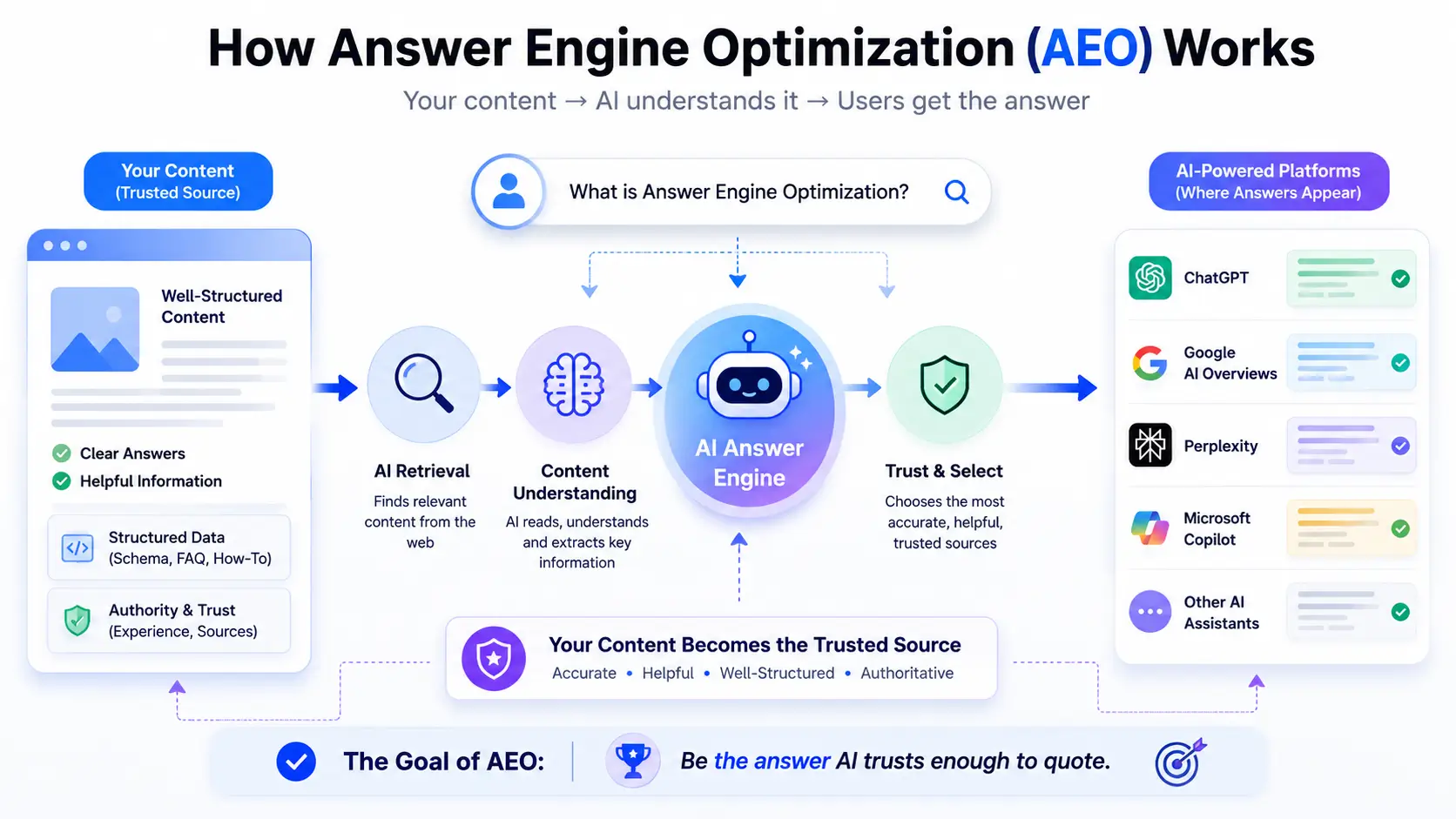
Most answer engines don’t invent information from nothing. They retrieve content from the web (often via an underlying search index), evaluate multiple sources, and synthesize a response favoring pieces that answer the question clearly, appear trustworthy, and are easy to extract cleanly.
What Makes Content “Extractable” and Citable
- Answers the question directly, early in the section not buried under a long introduction
- Uses plain, precise language rather than vague or overly clever phrasing
- Organized with clear headings that map to real questions that people ask.
- Backs up claims with specific facts, numbers, or named sources
Structured Data, Schema, and Machine-Readability Basics
Structured data (like FAQ schema or How-To schema) helps machines understand what type of content is on a page and what question each section answers. It doesn’t guarantee a citation, but it removes friction it makes your content easier for a crawler or AI system to interpret correctly the first time.
AEO vs. SEO: What’s the Difference?
AEO and SEO share a foundation; both depend on relevant, well-organized, authoritative content, but they optimize for different outcomes. The table below breaks down the core differences.
| Aspect | Traditional SEO | Answer Engine Optimization (AEO) |
| Primary goal | Rank high in search results | Be selected and cited as the direct answer |
| Success metric | Clicks and rankings | Citations and mentions in AI answers |
| User behavior | Browses a list of links | Receives one synthesized answer |
| Content format | Optimized for keywords and backlinks | Optimized for clarity, structure, and extractability |
Importantly, AEO doesn’t replace SEO. Most practitioners treat it as an additional layer: you still need the authority and technical foundation that SEO builds, but you also structure content specifically so an AI system can lift and cite it.
AEO vs. GEO: Are They the Same Thing?
This is where beginners often get stuck, because the industry hasn’t fully agreed on the terminology yet. Here’s the simplest way to think about AEO and GEO.
- Some marketers use AEO and GEO (Generative Engine Optimization) interchangeably, treating both as “optimizing for AI search.”
- Others use AEO as the broader umbrella term for earning visibility and citations across AI-powered answer engines.
- Others use GEO more narrowly, to describe how you optimize specifically for how generative AI models synthesize and phrase their answers.
You don’t need to pick a side in this naming debate to get started. What matters is the underlying skill: structuring content so AI systems can find it, trust it, and quote it accurately whichever acronym your team prefers to call that work.
Examples of Answer Engine Optimization in Action
Featured Snippets
When Google pulls a short, direct answer into a highlighted box at the top of search results, that’s a classic example of AEO at work the source page structured its content clearly enough to be extracted verbatim.
AI Overviews Citations
When Google’s AI Overview synthesizes an answer to a query and links out to the pages it drew from, the sites included are, functionally, winning at AEO for that query.
Voice Assistant Answers
When a smart speaker reads back a single answer to a spoken question, it’s typically pulling from one well-structured source rather than reading a list of results. Another everyday example of answer engine optimization already shaping how people get information.
How to Get Started with AEO (Beginner Checklist)
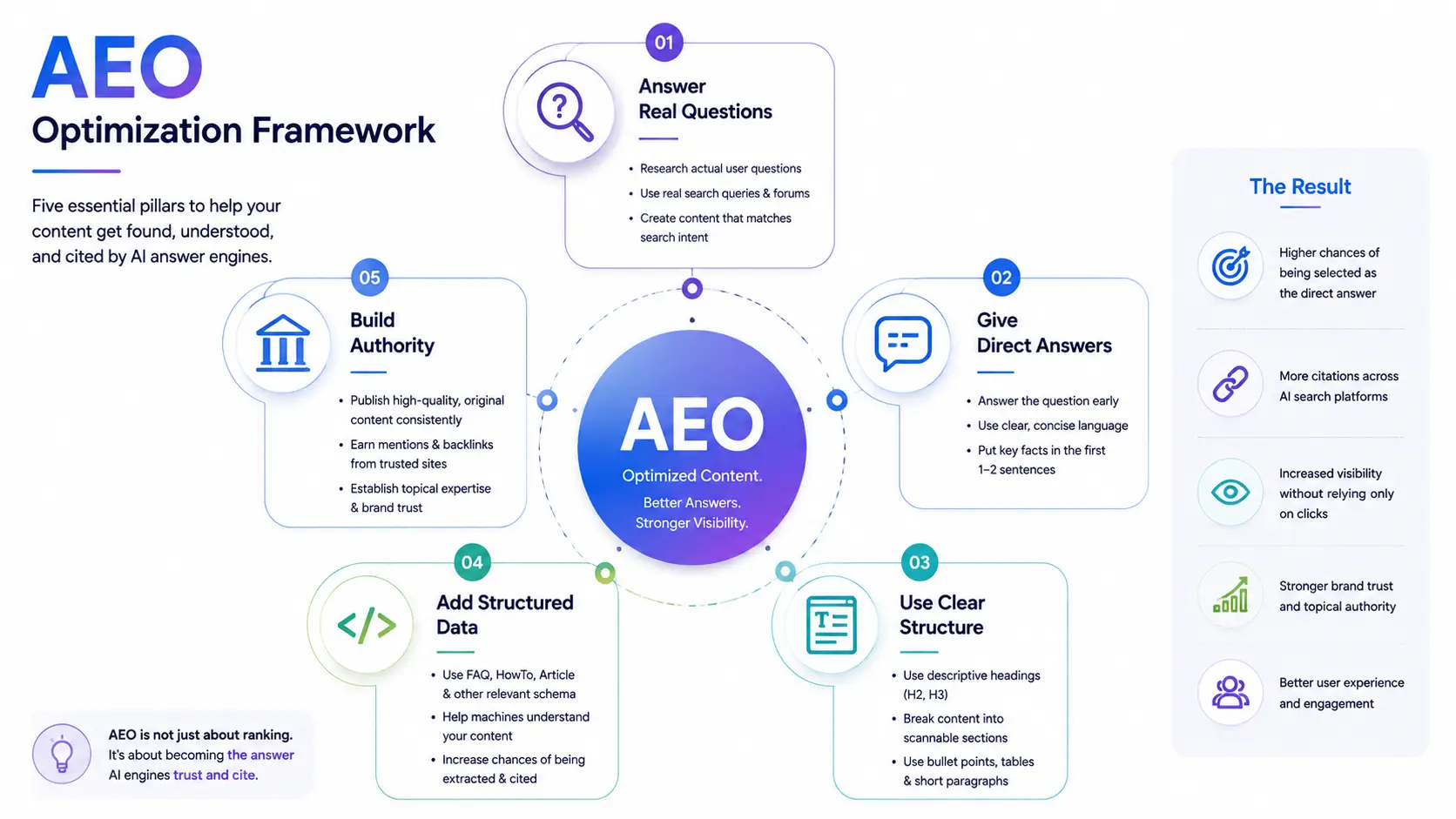
Structure Content Around Real Questions
Start with the actual questions your audience is asking, not just keywords. Look at “People Also Ask” boxes, forums, and customer questions for the exact phrasing people use.
Use Clear, Direct Answers Near the Top
Answer the core question within the first sentence or two of a section. Save nuance, caveats, and examples for after the direct answer, not before it.
Add FAQ Schema and Structured Data
Mark up your frequently asked questions with FAQ schema so search engines and AI crawlers can easily identify question-and-answer pairs on the page.
Build Topical Authority and Third-Party Presence
AI systems weigh consistency and reputation across the web, not just your own site. Being mentioned accurately on other reputable sites, forums, and directories strengthens the odds that an AI system trusts and cites your brand.
Common Mistakes Beginners Make with AEO
- Writing long, meandering introductions before answering the actual question
- Treating AEO as a replacement for SEO instead of an added layer on top of it
- Skipping structured data because it feels “too technical” for a beginner
- Focusing only on your own website and ignoring third-party mentions and citations
- Using vague, clever phrasing instead of plain, specific language AI systems can parse cleanly
Frequently Asked Questions
What is answer engine optimization in simple terms?
Answer Engine Optimization (AEO) is the practice of structuring content so AI tools like ChatGPT, Perplexity, and Google AI Overviews can easily find, understand, and cite it as a direct answer instead of just ranking it as a link in search results.
How is AEO different from SEO?
SEO focuses on ranking web pages so people click through to your site. AEO focuses on getting your content selected and cited as the actual answer inside an AI-generated response, where a click may never happen at all.
Is AEO the same as GEO?
They’re closely related and often used interchangeably. Some marketers treat AEO as the broader practice of earning AI citations, while GEO (Generative Engine Optimization) refers more specifically to optimizing for how generative AI models synthesize answers.
Does AEO replace traditional SEO?
No. AEO builds on SEO fundamentals like authority, relevance, and structure. Most experts recommend treating AEO as an additional layer on top of strong SEO, not a replacement for it.
What’s an example of answer engine optimization?
A common example is writing a clear, one-sentence definition near the top of an article that directly answers a specific question making it easy for Google’s featured snippets or an AI Overview to lift and cite as the answer.
How do I start optimizing for answer engines?
Structure your content around real user questions, answer them clearly within the first few sentences of each section, use FAQ and structured schema markup, and build authority through consistent, citation-worthy expertise.



Pingback: SEO Vs AEO Vs GEO: What's The Difference Explained In 2026
Pingback: AEO For Local Businesses In Kerala: Beginner's Guide 2026