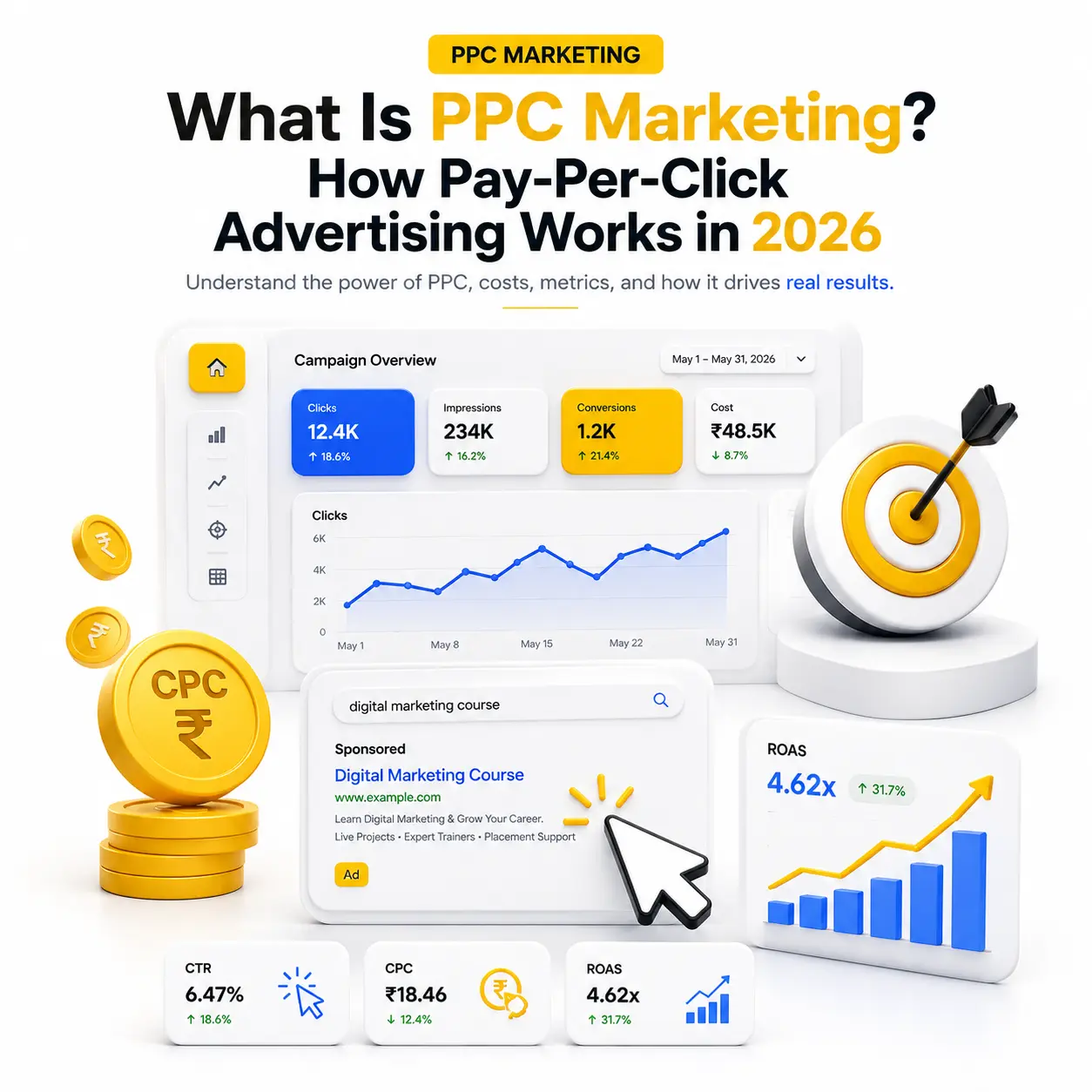
PPC marketing is a form of online advertising where you pay a fee each time someone clicks your ad. Instead of earning traffic organically through SEO, you bid for placement on platforms like Google Ads, Meta, or LinkedIn and you pay only when a user actually clicks through to your site.
That definition is simple. The mechanics underneath it are not, and that gap is where most advertising budgets get wasted. This guide covers how the ad auction really works, what PPC costs in 2026, how it compares to SEO, and how to launch a first campaign that doesn’t burn money.
What Is PPC Marketing?
The name describes the pricing model pay-per-click. You aren’t buying impressions or airtime. You’re buying a visit, and you’re only charged when that visit happens.
This makes PPC fundamentally different from most advertising. A billboard charges you for exposure whether anyone looks or not. A PPC campaign charges you for an action someone saw your ad, wanted what you offered, and clicked. That accountability is the channel’s core advantage: every rupee, dirham, or dollar is traceable to a specific keyword, ad, and outcome.
PPC ads appear across search results, social feeds, shopping carousels, YouTube pre-rolls, and display banners on partner sites. Search is where most businesses start, because search ads reach people already actively looking for a solution.
How Does PPC Advertising Work?
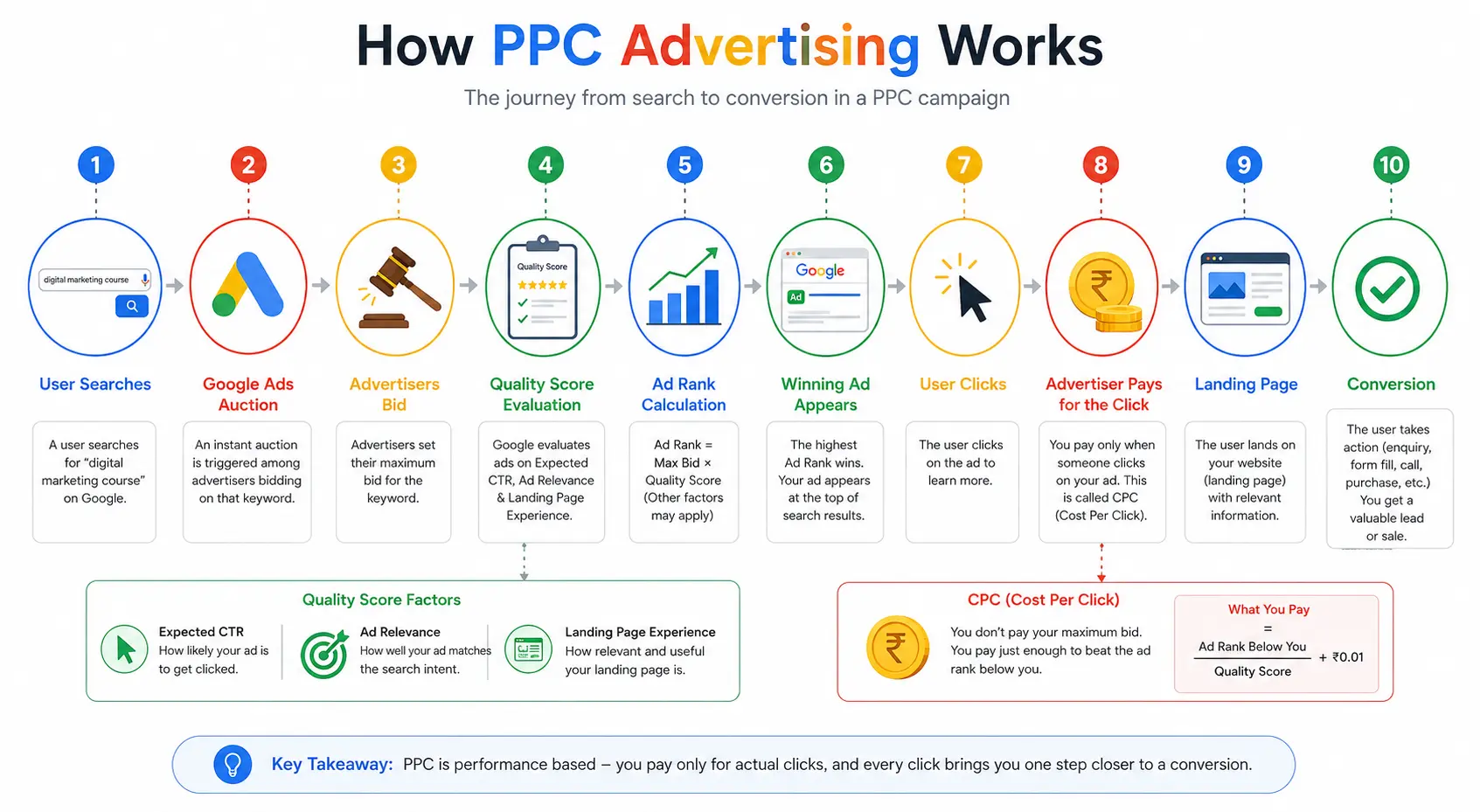
Every time someone searches a keyword you’ve bid on, an auction runs in milliseconds, before the page loads. Advertisers don’t take turns, and the highest bidder doesn’t automatically win.
Ad Rank and Quality Score
Platforms rank ads using a formula that combines your bid with the quality of your ad experience. Google calls this Ad Rank, and it’s driven largely by Quality Score a 1–10 rating built from three inputs:
- Expected click-through rate: how likely people are to click your ad
- Ad relevance: how closely your ad copy matches the search query
- Landing page experience: whether the page delivers what the ad promised
Simplified, Ad Rank = Bid × Quality Score. Which produces a result that surprises most new advertisers:
| Advertiser | Max bid | Quality Score | Ad Rank | Position |
| A | ₹40 | 3 | 120 | 3rd |
| B | ₹25 | 8 | 200 | 1st |
| C | ₹30 | 5 | 150 | 2nd |
Advertiser B bids the least and wins the top slot. Better still, B pays less per click than A does for a worse position. Quality Score isn’t a vanity metric it’s a direct discount on your media cost.
What you bid vs what you pay
Your maximum bid is a ceiling, not a price. You’re generally charged just enough to beat the advertiser ranked below you. Bid ₹30 in an auction you could have won at ₹18, and you pay ₹18. This is why aggressive bidding without relevance work is the fastest way to overspend.
The Main Types of PPC Advertising
- Search ads capture existing demand highest intent, highest cost per click.
- Display and remarketing ads are banners across partner sites. Cheap clicks, low intent; best for re-engaging past visitors.
- Shopping ads show product image, price, and store name directly in results. Essential for e-commerce.
- Social and video ads on Meta, LinkedIn, and YouTube create demand rather than capture it, targeting who someone is rather than what they searched.
Rule of thumb: if people are already searching for what you sell, start with search. If they don’t know your category exists, start with social.
PPC vs SEO: Which One Do You Need?
| Factor | PPC | SEO |
| Time to results | Hours | 4–12 months |
| Cost profile | Ongoing spend | Upfront effort, low marginal cost |
| Traffic durability | Stops with budget | Compounds over time |
| Testing speed | Immediate | Slow |
PPC is rented traffic. SEO is owned traffic. The honest decision rule choose PPC first when you need revenue within the quarter, when you’re validating a new offer, or when your organic rankings are months away from mattering. Choose SEO first when your margins are thin and your timeline is long.
If you’re looking to build practical expertise in Google Ads, SEO, and paid media before managing live campaigns, enrolling in a digital marketing course can provide the hands-on skills needed to create, optimize, and scale successful PPC campaigns. Run together, PPC and SEO compound results.
PPC keyword data tells you which terms actually convert, which is far better guidance for your content strategy than search volume alone.
How Much Does PPC Cost in India in 2026?
There’s no flat answer, but there are reliable planning ranges. Most Indian advertisers pay between ₹5 and ₹50 per click on Google Search, with the cross-industry average sitting near ₹24. Display clicks are cheaper still, typically ₹5 to ₹10.
Industry matters enormously. Education, local services, and fashion e-commerce sit at the low end often ₹5 to ₹40 per click. Legal, insurance, finance, and real estate keywords climb to ₹100, ₹500, or in the most competitive verticals ₹1,500 and beyond, because one converted client justifies the bid. Location matters too CPCs in Delhi NCR, Mumbai, and Bengaluru typically run 30–50% higher than Tier 2 cities for the same keyword.
For a realistic starting budget, ₹15,000 to ₹50,000 per month is the practical range for a small business test. Below roughly ₹15,000, you won’t generate enough click volume to optimise anything whatever you “learn” at that spend is statistical noise.
Costs are also rising globally. US search CPCs climbed roughly 12% year over year into 2026, for a structural reason: as AI Overviews compress organic click volume, more traffic is routed through paid placements, raising competitive pressure in the auction. Indian auctions follow the same dynamic on a delay. PPC hasn’t just become more expensive it has become harder to avoid, and sloppy campaigns are punished faster than they were three years ago.
The PPC Metrics That Actually Matter
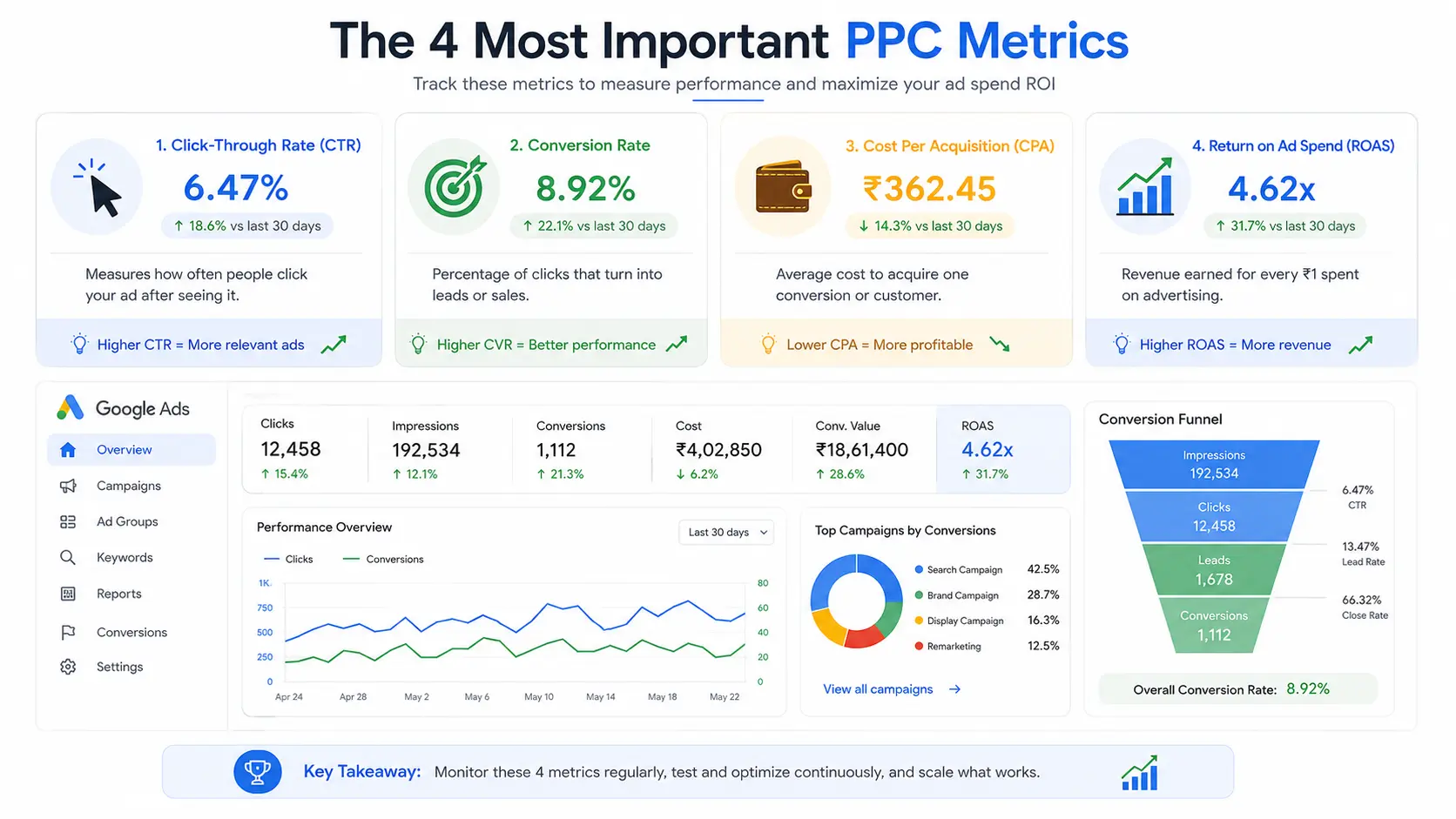
Clicks are not the goal. Track these instead:
- Click-through rate (CTR): healthy search CTR in India sits around 5–8%, higher than Western averages because there are fewer advertisers per query. Below 3% usually means weak ad copy or poor keyword match.
- Conversion rate: what percentage of clicks become leads or sales. WordStream’s 2026 benchmark study of over 13,000 campaigns put the international Google Ads average at 8.18% Indian accounts vary widely by vertical.
- Cost per acquisition (CPA): what one conversion costs you.
- Return on ad spend (ROAS): revenue ÷ ad spend. Spend ₹1,00,000, generate ₹4,00,000, and your ROAS is 4:1.
A high CPA isn’t automatically a problem. If your average customer is worth ₹2,00,000, a ₹10,000 CPA is excellent. Always read benchmarks against your own unit economics.
How to Launch Your First Campaign
- Define the conversion before the keyword. Decide what a successful outcome looks like a form fill, a call, a purchase and make sure it’s measurable.
- Set up conversion tracking first. Running ads without tracking means paying for data you’ll never see.
- Build a tight keyword list, plus negatives. Twenty highly relevant keywords beat two hundred loose ones. Add negative keywords (“free,” “jobs,” “cheap”) from day one.
- Match the landing page to the ad promise. If your ad advertises a specific service, the click should land on that service page never the homepage.
- Let it run before you judge it. Most campaigns need two to four weeks to exit the learning phase.
Common Mistakes That Waste Budget
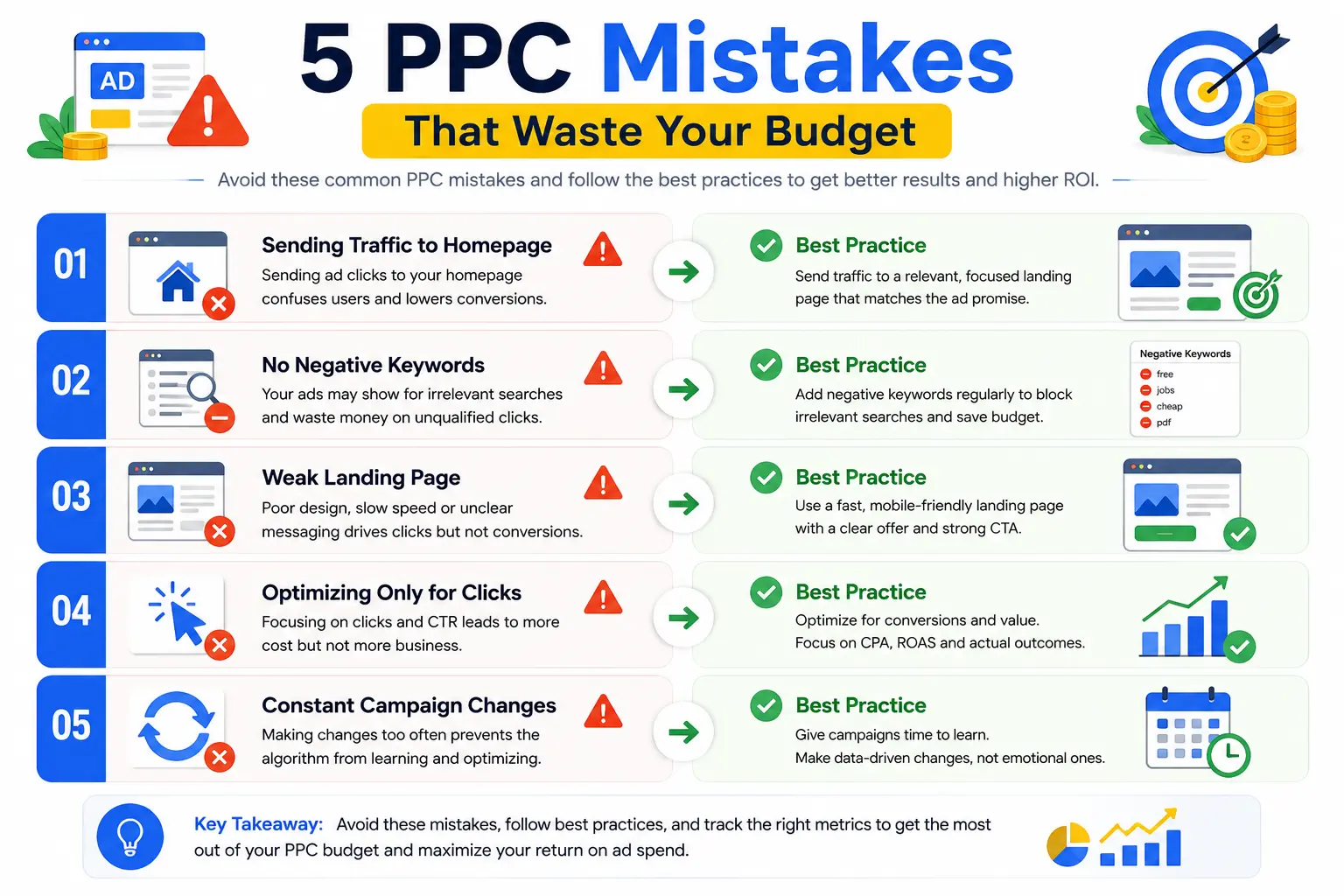
- Sending paid traffic to a generic homepage instead of a dedicated landing page
- Skipping negative keywords and paying for irrelevant searches
- Optimising for clicks and CTR rather than conversions and revenue
- Restructuring campaigns weekly, preventing the algorithm from ever stabilising
Is PPC Right for Your Business?
PPC works well when you have a proven offer, a converting landing page, healthy margins, and the ability to track outcomes. It works poorly when margins are razor-thin, the sales cycle is long with no nurture system, or your website can’t convert the traffic you’re buying. Fixing conversion problems before buying traffic is almost always the cheaper sequence.
Frequently Asked Questions
What is PPC marketing in simple terms?
PPC marketing is online advertising where you pay a fee each time someone clicks your ad. Instead of earning visits organically through SEO, you bid for ad placement on platforms like Google Ads, Meta, or LinkedIn, and pay only when a user actually clicks through to your website.
How much does PPC advertising cost in India?
Costs vary widely by industry and city. Most Indian advertisers pay ₹5 to ₹50 per click on Google Search, with an average near ₹24. Legal, insurance, and finance keywords can exceed ₹500 per click. A practical starting budget for a small business is ₹15,000 to ₹50,000 per month.
What is the difference between PPC and SEO?
PPC buys immediate visibility through paid placements and stops the moment your budget does. SEO earns visibility through organic rankings, which take months to build but continue delivering traffic without ongoing spend. PPC is rented traffic; SEO is owned traffic. Most businesses need both.
How long does it take to see results from PPC?
PPC delivers traffic within hours of launch, but meaningful performance data takes longer. Most campaigns need two to four weeks to exit the algorithmic learning phase and gather enough conversions for reliable optimisation. Expect 60 to 90 days before judging true profitability.
Can I run PPC campaigns myself or do I need an agency?
You can run basic search campaigns yourself with solid keyword research and conversion tracking in place. Specialists become worthwhile once monthly spend crosses roughly ₹1,00,000, or when you’re managing Shopping, Performance Max, or multi-platform campaigns where mistakes get expensive fast.