Every year someone declares Facebook dead, and every year businesses keep landing customers there. So is Facebook marketing still worth it in 2026? For most businesses with a clear offer, yes, but not the way it worked in 2017. This guide covers who Facebook works for, what it costs, and how to start without wasting money. It ends with a five-question scorecard so you can decide for yourself.
The Short Answer: Is Facebook Marketing Still Worth It?
Yes, if the right people are on Facebook and you can show up consistently. It is a strong fit for local businesses, community-driven brands, and anyone selling to adults over 30. It is a weaker fit if your customers are mostly under 25, your offer is unclear, or you can’t track sales.
- Worth it if: you serve a local area, sell to 30+ audiences, or want to build a community through Groups.
- Skip it (for now) if: your audience lives on TikTok, you have no clear offer, or you can’t spare even a few hours a week.
- Either way: don’t expect free posting alone to deliver big results.
Facebook in 2026 by the Numbers
Is Facebook Dead? What the Data Says
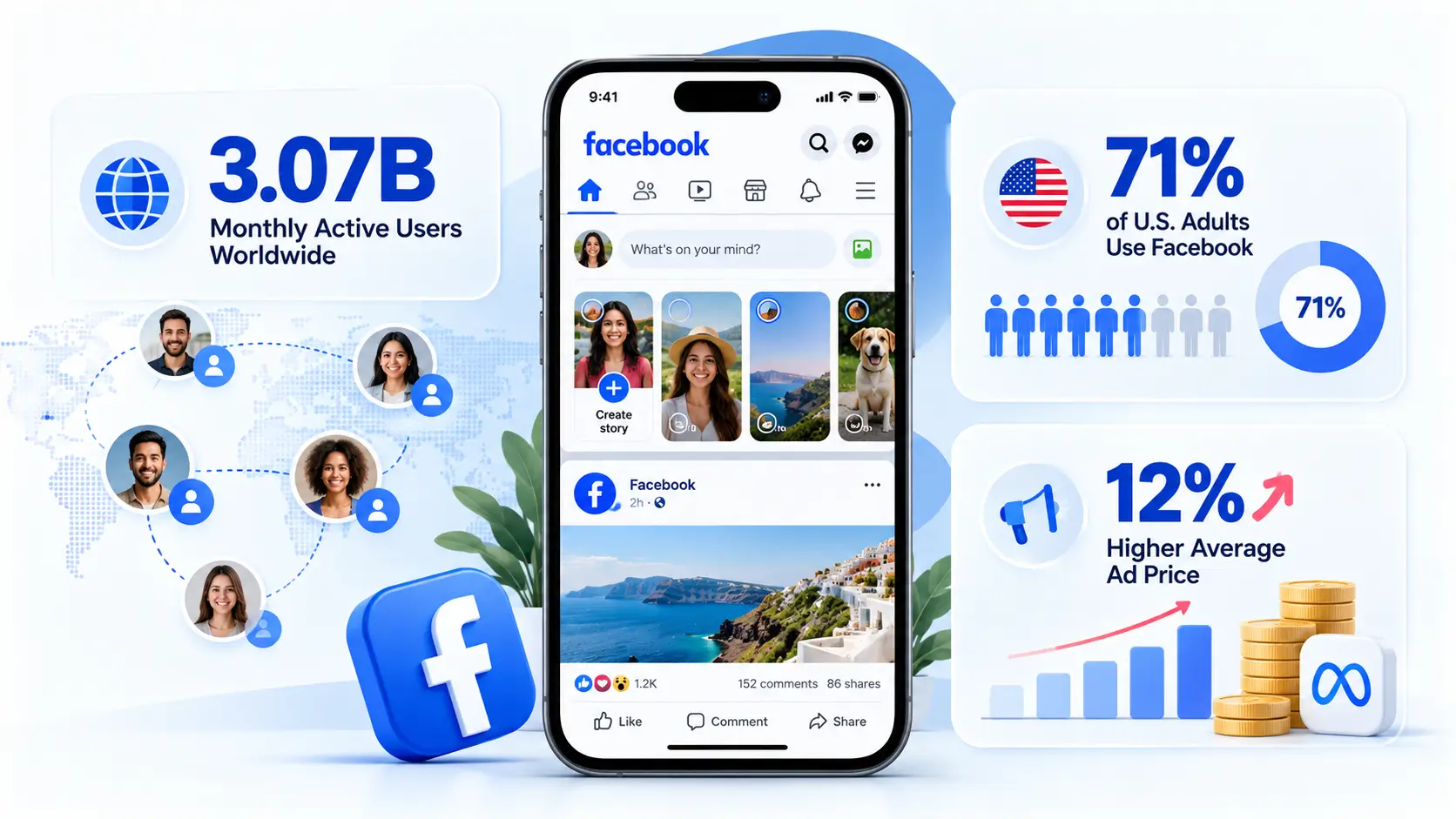
No. Facebook has roughly 3.07 billion monthly active users worldwide, according to Statista figures cited by Ascend Group Media. In the U.S., Pew Research Center’s Americans’ Social Media Use 2025 found that 71% of adults use Facebook. Only YouTube (84%) reached more.
There is a caveat. Pew also found that Facebook and YouTube were the only major platforms without significant growth over the past four years, while Instagram usage rose about 40%. Facebook hasn’t collapsed, but it has plateaued. The right conclusion is that it’s enormous, not booming.
Who Is Actually Using Facebook Today
Facebook is used by a majority of U.S. adults in every age group, but it’s most popular with 30- to 49-year-olds, 80% of whom use it, according to Pew. Women are also more likely than men to use it. If your customers are parents, homeowners, or working professionals, they’re probably on Facebook. If they’re teenagers, they mostly aren’t.
Where Costs Are Heading
Advertising is getting pricier. Neal Schaffer’s analysis of Meta’s Q1 2026 results reports that the average price per ad rose 12% year over year, even as ad impressions grew 19%. In plain terms, the same budget buys a little less than it did a year ago. That doesn’t make Facebook ads a bad deal, but it does mean sloppy campaigns are more expensive than before.
What Has Changed on Facebook and Why Old Advice Fails
How the Facebook Algorithm Works in 2026
Facebook’s algorithm decides what appears in each person’s feed. Today it leans heavily on creative quality and engagement rather than the manual audience targeting advertisers once relied on. For beginners, that means the content itself matters more than clever settings. If people watch, comment on, and share your posts, Facebook shows them to more people.
Why Organic Reach Is Limited, and What Still Gets Seen
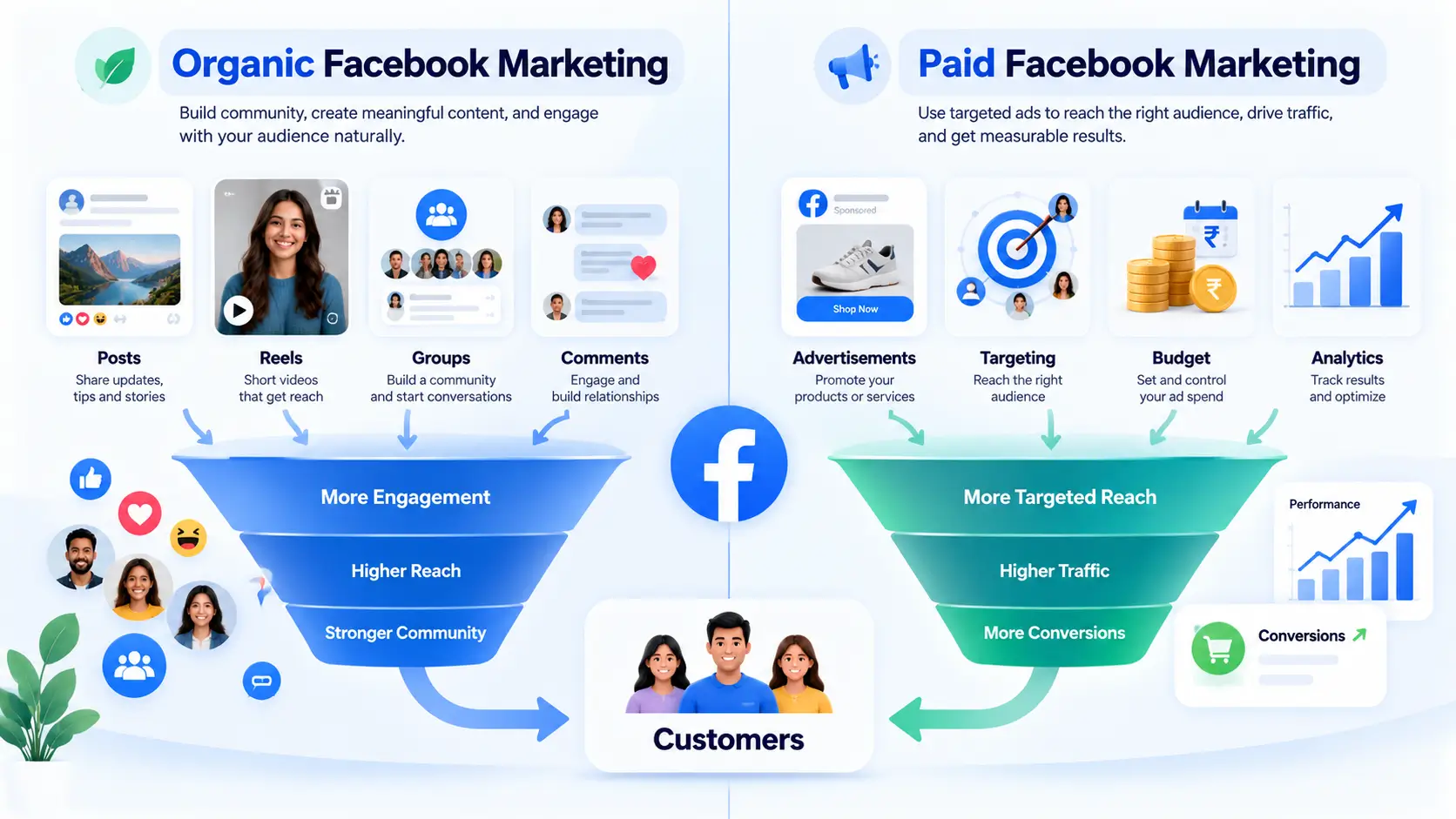
Organic reach is the number of people who see your posts without you paying. For business Pages, it’s low, and Facebook wants users to stay on Facebook, so posts that push people away tend to underperform. Two habits hurt most: text-only posts and posting without ever replying to comments. What still gets seen is content that starts conversations.
The Rise of Reels and Short-Form Video
Short-form video, especially Reels, is now Facebook’s main driver of organic reach. You don’t need a studio. A 20-second phone video answering a common customer question, or showing a product in use, often outperforms a polished graphic.
Who Should and Shouldn’t Use Facebook Marketing
Is Facebook Marketing Worth It for Small Businesses?
Often, yes. Local businesses benefit most because of Groups, Marketplace, events, and location-based ad targeting. A café, salon, contractor, or fitness studio can reach nearby customers cheaply. Many small businesses also see value because Facebook and Instagram share one ad platform, so a single campaign can run on both.
Facebook vs. Instagram: Which Is Better for Your Business?
Neither wins universally. Instagram suits visual brands and younger audiences. Facebook is stronger for community building, local reach, and customers over 30. Since both are owned by Meta, beginners can start on Facebook and extend the same ads to Instagram with little extra work.
Who Should Not Use Facebook Marketing?
Facebook is a poor first choice if your audience is mostly under 25, your offer is unclear, or you have no way to track results. Long sales cycles, such as high-consideration B2B, may only see indirect returns, where social media profiles warm up prospects but doesn’t close deals alone. In those cases, fix the basics or lead with another channel.
The 5-Question “Worth It?” Scorecard
Answer yes or no to each:
- Are most of your customers over 30?
- Do you serve a local or regional area?
- Can you state your offer in one sentence?
- Can you spend at least 3–4 hours a week on this?
- Can you track where sales come from?
4–5 yes: start now, with organic posts plus a small ad test. 2–3 yes: start organic only and build up. 0–1 yes: fix the basics first, then revisit Facebook.
What Facebook Marketing Costs
Can You Do Facebook Marketing for Free?
Yes. Posting, replying to comments, and joining or running a Group cost only time. But results are usually slower and smaller, because organic reach is limited. Free tactics work best for local businesses that already have a community around them.
How Much Should Beginners Budget for Facebook Ads?
Meta ads have low daily minimums, so many beginners test with 5–10 a day. Costs vary by industry, location, and creative quality, so treat your first month as a learning budget rather than a revenue target. One rule of thumb from Feedbird, a vendor opinion rather than hard data, is that Facebook ads suit brands whose average order value can absorb a customer acquisition cost of $30 or more.
Do Facebook Ads Still Work in 2026?
For businesses with a clear offer, working conversion tracking, and creative worth showing, most analyses say yes. The weak spots are unclear offers and budgets too thin to learn from.
How to Start Facebook Marketing as a Beginner: 5 Steps
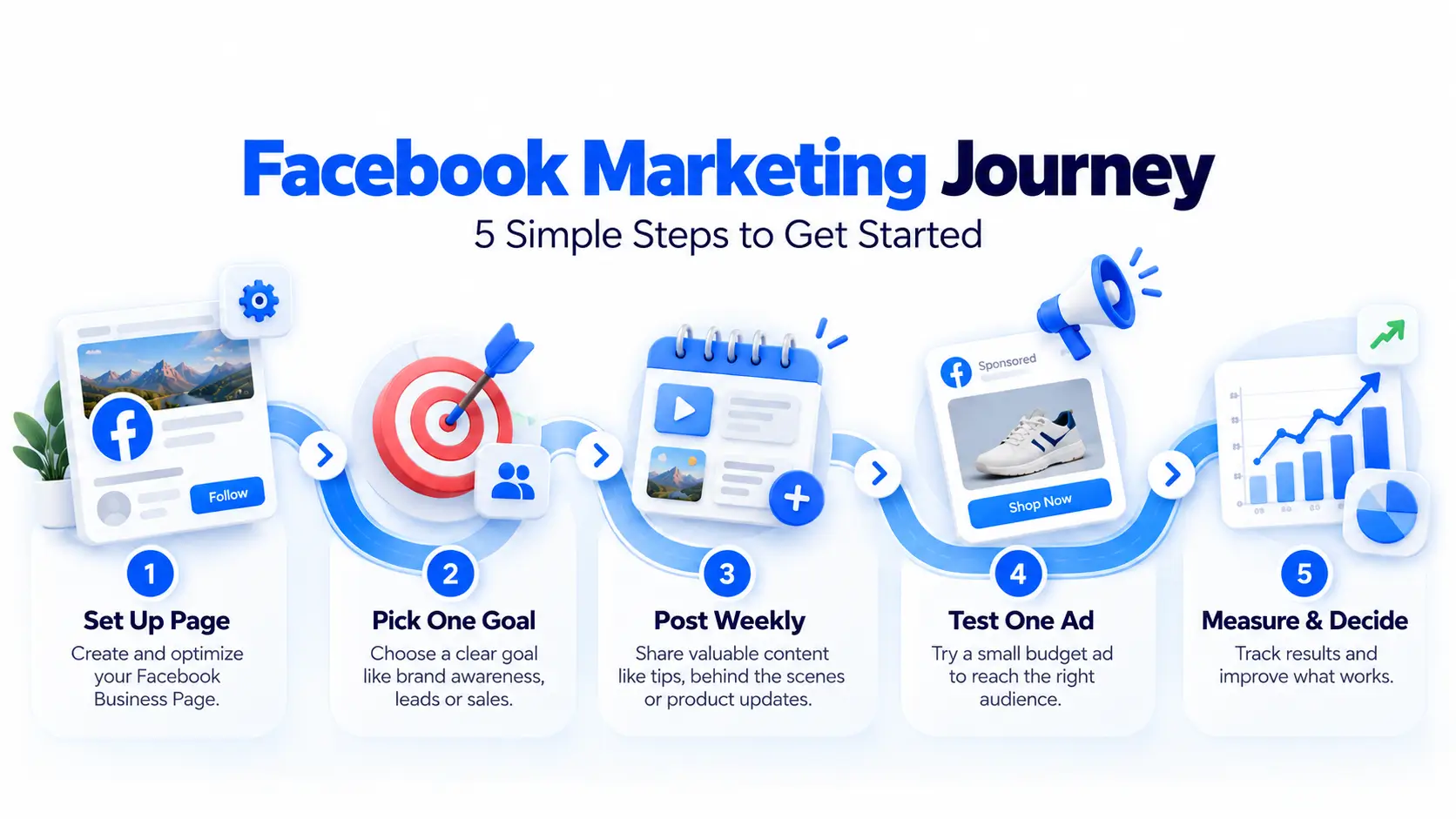
Step 1: Set up your Page and Meta Business Suite. Create a Business Page with a clear name, profile photo, and description, then manage it through Meta Business Suite. Add your contact details and a call-to-action button.
Step 2: Pick one goal. Choose one: local awareness, leads, or online sales. Trying to achieve all three at once dilutes everything.
Step 3: Post a simple weekly rhythm. Aim for two to three posts a week, with at least one short video. Mix helpful tips, behind-the-scenes moments, and customer stories. Reply to every comment.
Step 4: Test one small ad. Pick your best-performing post or a simple offer, set a small daily budget, and run it for at least a week. Install Meta’s tracking (the Pixel or Conversions API) so you can see what happens after someone clicks.
Step 5: Measure and decide after 60–90 days. Look at cost per lead or sale, not likes. If results are promising, scale slowly. If not, adjust your creative or offer before spending more.
Common Beginner Mistakes to Avoid
- Posting only text. Video and images earn far more attention.
- Posting and walking away. Unanswered comments signal a dead Page.
- Boosting posts without a goal. Clicking “Boost” on random posts burns budget.
- Skipping conversion tracking. Without it, you’re guessing.
- Judging too early. Give any approach several weeks of data before deciding.
Verdict: Is Facebook Marketing Worth It in 2026?
For most local businesses and brands selling to adults over 30, yes. Facebook still has massive reach, strong ad tools, and a community-friendly format. It just demands better content and smarter testing than it used to. Run the scorecard above, start small, and let your own data decide. Ready to try it? Set up your Page this week and post your first short video.
Frequently Asked Questions
Is Facebook marketing still worth it in 2026?
Yes, for most businesses with a clear offer, especially local businesses and brands targeting adults over 30. Facebook still reaches about 71% of U.S. adults, according to Pew Research, and its ad tools remain strong. Organic reach is limited, so expect to combine free posting with a small ad budget.
Is Facebook dead for marketing?
No. Facebook still has more than 3 billion monthly active users worldwide, and Pew found usage among U.S. adults has stayed stable since 2021 rather than collapsing. What has changed is who uses it and how it works, so it performs especially well for customers aged 30 and up.
Is Facebook or Instagram better for business?
Neither wins universally. Instagram suits visual brands targeting younger audiences, while Facebook is stronger for local businesses, Groups, community building, and customers over 30. Because both are owned by Meta and share one ad platform, beginners can start on Facebook and run the same ads on Instagram with little extra work.
How much does Facebook marketing cost?
Organic Facebook marketing is free: posting, replying to comments, and joining Groups cost only time. Paid ads have low daily minimums, so beginners often test with 5–10 a day. Costs vary by industry, location, and creative quality, so treat your first month as a learning budget, not a revenue target.
Can you get results on Facebook without paying for ads?
Yes, but expect slower, smaller results. Organic reach for Pages is limited, so focus on short-form video like Reels, active Groups, and genuine comment replies. Text-only posting and walking away rarely gets seen. Free tactics work best for local businesses with an existing community.
Who should not use Facebook marketing?
Facebook is a weaker fit when your audience is mostly under 25, your offer is unclear, or you can’t track results. Long-cycle B2B businesses may also see indirect returns rather than direct sales. In those cases, fix your offer and tracking first, or prioritize TikTok, LinkedIn, or search.